sharing a poetic LIFELINE with the world

Archive for the ‘Uncategorized’ Category

Aragman, the Fifth

As my sister Muselings have demonstrated, we’ve approached the Aragman armed with butterfly nets, howitzers, and an array of tactics. I aimed for congruity of the alternating lines, and didn’t worry about syllabic symmetry.

My seemingly serene (publicly, at least), alter ego had a lot to say about being the subject of this poem. She’s usually the Wise Woman, link to the universal. Maybe she still is — let me know what you think. Below is the revised version, followed by the original post. Comments?

Moon Spirit (Graf, 2006)

Moon Spirit

Om — is it porn?
Watch, howling, heady.
No mop I stir 
but gates I open,
Import ions
of all persuasions.

In prism, too —
treacherous harmonics
I romp to sin,
bare it all in beaming light
Impostor in?
This Goddess of the Night?

Sin pit room,
raucous pounding sound.
Imp riots on,
curses ecliptic arc.
Prison it, Om,
for its own good.

Motion rips,
I stir the brew,
Trim poison,
cast away deception.
Sip it, moron —
vintage lunacy just for you.

. . . I Trip On Oms . . .

(revised, per comments and experimentation!
This is where I started:)

Moon Spirit

I Trip On Oms,
treacherous harmonics.
No mop I stir
but gates I open,
Import ions
of all persuasions.

Sin pit room,
raucous pounding sound.
Imp riots on,
curses ecliptic arc.
Prison it, Om,
for its own good.

Motion rips,
I stir the brew,
Trim poison,
cast away deception.
Sip it, moron —
vintage lunacy just for you.

Impostor in?
Is this the Goddess of the Night?
I romp to sin,
bare it all in beaming light
minor posit —
howling loud, heady, you must ask —

Om — is it porn?

Prompts: Jump-Start Your Poetry

English: harvest moon

Image via Wikipedia

Sometimes I feel like my poetic well has dried up like the middle of the Sahara desert. So I did a little sleuthing for inspiration.  I’ll pull a poem nugget from each of these sites and see if I can get a poem out of them.

http://poetsonline.blogspot.com/2009/05/random-poetry-line-generator.html which yielded the lines “In the water of discord the seasons sleep,” and “In the stillness of the soul the spirits turn, ”

http://www.languageisavirus.com/title-o-matic.html

“Shine Portrait”

http://languageisavirus.com/phrase-generator/

“It is the dying spirit.

Lost moon, velvet spirit.

Wither, decline. With sharp flames

Declining, shining.”

Here’s what I came up with:

Shine Portrait

In the stillness of the soul the spirits turn,
Lost moon, velvet spirit.

It is the dying spirit,
Declining, shining, burnt orange crescent
Tangled in purple-bruised clouds
Evening’s mantle dusted with stars
You wither, decline, disappear

In the water of discord where seasons sleep
Sister moon’s spirit stirs, sharp flames
Calling out to seasons
You shine once more
A glowing orb, reincarnating  spirit

In the stillness of the soul, spirit awakes
Found moon, craggy spirit.

©2012 Lin Neiswender


Make Visible: Start Your Own Tribe

Please refer to my previous post Make Visible:  Find Your Tribe.

So you’ve checked out a few social networking sites and been to a few local meetings but don’t really feel comfortable with any of them.  Give it time!  Maybe you just need to hang around for awhile and get to know people better.  Or maybe, and this is very likely, the groups don’t address you specific interests.  What to do?  Why not start your own social networking site or offline group and find your tribe?

Wait.  Don’t abandon the sites and groups you’ve tried out.  They are good places to find people with similar or the same interests that you have.  Here are seven easy steps to starting your own tribe:

  1. Decide on the focus for your group. It should be something you are passionate about. You don’t need to know everything about your subject to start a group about it.
  1. Name your group. Find a name you can live with that sums up what your group is all about.
  1. Find a free (or paid) platform for your new tribe. Or find a meeting place for your offline group.  Here are some suggestions, by no means exhaustive.

Online:

Google Groups

Yahoo Groups

Webs.com

Tribe.net

Ning.com

Offline:

Libraries

Churches or Synagogues

Community Centers or Convention Centers

Cafés

Restaurants

  1. Then set up your site the way you want or consider topics for your first offline meeting.  Real world groups have slightly different considerations than online groups.  You will need to find out about refreshments, if you need a key, if they need to buy drinks or food (if in a café or restaurant), and if there’s a fee to use the room.  For online groups you may be able to design the site the way you want it to look, and set notification and membership settings. You can usually decide whether to let anyone join, join by invitation only, or to extend your membership to a select few.  For offline groups you also have a choice whether to have a public group or a private group where you handpick the members.
  1. Advertise!  This is where those previous networking sites and offline groups come in.  They are great places to post about your new group and find new members for your new tribe.  You can email and call your friends and post on Facebook, Twitter and Google+.  Keep in mind whether or not you are inviting “everybody”, interested parties only, or a few select friends.  That will determine how and where you publicize your new group.
  1. Provide content.  Some people will come to your group and just chat, but it’s better to give them something to chat about.  For online groups you can provide your own content, photos, writing, and artwork.  Depending on whether your group is public or private, you can also share book excerpts.  Always when sharing, share who the author or artist is. For real world groups, you may just have the group members bring something to talk about, or you could bring in speakers or teach classes in your subject.  It may cost to hire speakers or teachers, so this is another opportunity to provide your own content or have group members take on these roles.
  1. Don’t let all this go to your head!  Sure you started the group and can decide who goes and who stays, but don’t be a dictator.  Let your new friends voice their opinions and post their own content.  Encourage dialogue and respect among equals.  As owner, you are in charge of getting rid of any spam accounts, sharing basic guidelines, and discouraging explicit photos and profanity (if that bothers you or becomes a problem).

One caveat:  Your group may start slowly, may be active at times and inactive at other times, or may grow exponentially.  You never know.

If you are interested in Divination subjects, like Tarot and the Runes, please join me at The Divine Life Google Group:

Enhanced by Zemanta

Six Questions for . . . the Poetic Muselings . . . Magdalena Ball, and more

Six Questions For . . .

We’re being interviewed on Jim Harrington’s blog, “Six Questions For . . .” on March 1, 2012. Jim’s guest include publishers, editors, and others in the field of writing. His goal, to paraphrase from his blog, is to:

. . . provide authors with specific information about what editors are looking for in the submissions they receive, offer editors a venue for advertising their publications and getting the word out about what, in their opinion, constitutes ‘good writing.’

We’re delighted to share ideas about what we look for, and our approach — and to be in such great company. Please read Jim’s interview and let us know what you think.

. . . Magdalena Ball . . .

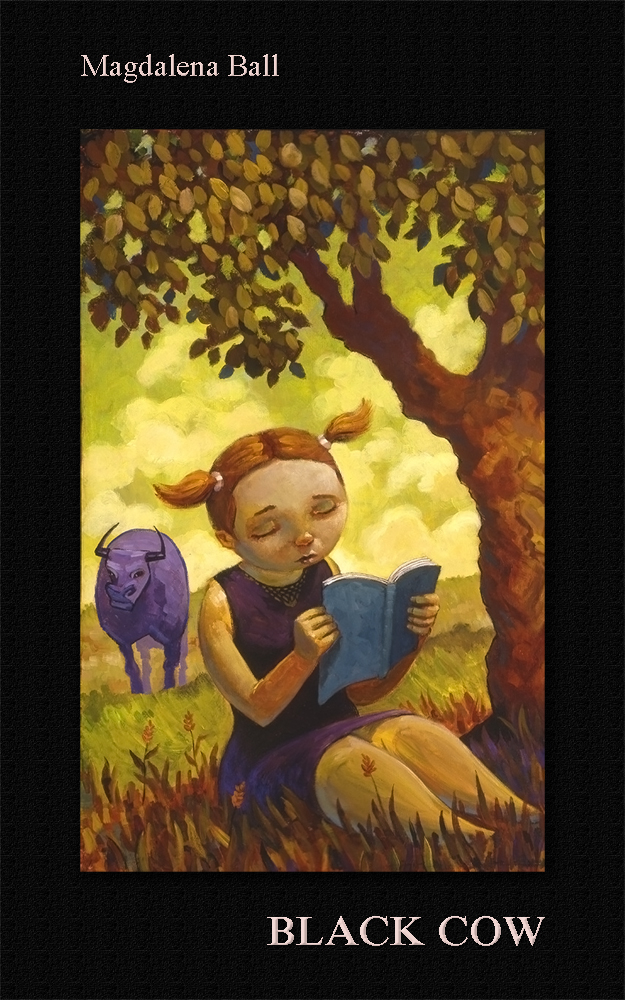
will be our guest on Weds., March 14, 2012. Our interview, starting from a focus on poetry and creativity, will be quite different from the  others on her blog tour. Her recent book, Black Cow, has rave reviews.

Visit her site to learn more, including the prizes she’s offering.  “The draw is open to anyone who comments, re-tweets (please use #blackcow – it’s not mandatory, but will help me find the tweets!), or updates their status with info about anything to do with the visits.”  Magdalena Ball  http://magdalenaball.com/wordpress/

. . . and More:

Thank you for responses to my question last week about markets or guidance for our 14-year old poet. Please take a look at the post, and send your ideas. Thanks!  Mentoring and being Mentored

thank you!

Mentoring and being Mentored

This week, I am mentoring a very talented 14-year old poet, and supporting one of our Poetic Museling mentors. Interesting to be of service up and down this ladder.

First of all, congratulations to MAGDALENA BALL for Black Cow, her recently released novel. Reviews praise its depth, craftily written prose, the core subject so many of us face — is success as we’ve defined it destroying us, our families, and lives? Sometimes, desperation is the greatest motivator to force us to take the unmapped turn-off to something else. But is that other road the answer, or the path to a worse problem?

I’m anxious to read this book for several reasons:  Maggie is one of our incredible mentors, who helped make Lifelines real. Not only did she teach the chapbook workshop that brought us together to continue writing, and edited our work, but she’s an accomplished and marvelous poet. And a voracious, eclectic reader — a woman after my own heart — who’s Compulsive Reader website is a treasure of possibilities.

And Maggie is one of the most sincerely caring, compassionate people I’ve met, if only online. I value her advice, talent, and willingness to share and nurture others, and her friendship. I hope someday to have the chance to get to Australia and give her a big hug.

Here are some links to follow for more info:

Magdalena Ball –  Book Musing
Magdalena Ball – Black Cow
AMAZON (discounted!)  |   BARNES & NOBLE | BOOK DEPOSITORY (free worldwide shipping!) |   BEWRITE BOOKS
Join the book tour (for fun, prizes, and a lot of info)!
Black Cow Discussion Questions and book club visits

~~~~~~~~~~~~~~~

The other end of the spectrum is equally exciting.  I almost  never am far away from my other poetry passion, as editor of the Apollo’s Lyre poetry column. I receive poems from all over the world; from those diving into the submission pool for the first time, as well as those with pages-long credentials. All ages, forms, subjects. Some are “perfect” as they are, some need tweaking; often the most widely-published poets are the most open to editing, but not always. I plan a series of posts about the process, and publishing, from my editor view.

Recently, a young lady with an intriguing voice, nicely constructed poems, and subjects that tap into the universal, sent me her work. Unfortunately, Apollo’s Lyre contains some adult-themed subjects or words, articles, flash fiction, and poetry, as well as sillier, lighter items. We are not an appropriate venue for her work.

However, I want to help “C.” find a good place to sub her poems — I think she’s very talented, and hope some day I can publish her, and also say that I read her early work and gave her the encouragement to keep writing, exploring, and putting herself out for the world to see.

With her permission, and that of her mother, I’m contacting fellow poets, poetry publishers, and my contacts in general to ask:  Where could a 14-year old poet send her work?

If any of you have ideas I can share with “C.”, please let me know. Be part of this mentoring process — there’s plenty of room here!

Thank you —

Michele


Make Visible: Find Your Tribe

It is so important as creatives that we find a group of people that we feel comfortable with.  They share our values, our interest in creating and inspire and challenge us. Or maybe we just like to hang around with them, have fun and do fun things with them.  Groups offer us a chance to make friends, learn and share.  All this applies to both online and offline groups.

Online Groups:

Where do you start?

Tribe                                      many interests

Yahoo Groups                          many interests

Google Groups             many interests

Image representing Tribe as depicted in CrunchBase

Image via CrunchBase

CoachCreativeSpace                all creative interests

Writer’s Digest Community       writers

Wet Canvas                             visual artists

For Tribe, Yahoo and Google groups there’s a box to put in your interest (keyword), a list of groups will come up that you may want to join.

Offline Groups:

Where do you start?

This depends on the size of your community.  You may be able to find groups through Meetup.com, your local newspaper, Weekly, or posted at your library or grocery store.  These groups may be related to interests, like writing, activities, like yoga, or church or self-help groups.

What next?

Join the group, post an introduction or go to the first meeting and introduce yourself, be friendly, become involved, participate.

It’s that simple.


Enhanced by Zemanta

Capture the Moment in Poetry — Kristen

Whether you’re a poet or an artist, there are some ways to keep an image fresh in your mind. This works wonders, when the focus is in nature, landscape or people. To catch the essence is to capture the moment with memory, notes and/or photography.

1. Memory–If you have a good or an excellent photographic memory, you can remember how it feels when you see the image. Let it trickle down in your mind–the colors, the senses, the portrait. When you’ve found the muse, stare at it outside in person, or through the window. (During winter, do it inside and via the windows.) Close your eyes, count to ten, and open them.

If you dabble in both poetry and art, go for it. Paint /draw the image first–it doesn’t matter, if it’s in crayons, colored pencils or chalk, or with paint. While it dries, write from your heart. Use good descriptions. Use your senses and let it rip! Feel free to free write, before you polish it in edits for a final draft.

2. Notes–If you’re not good in art or don’t have a good reliable memory, you can use an alternate method. Bring a notebook or notepad with pencils or pens, or a portable tape recorder/digital voice recorder. If you have a laptop, bring that along too.

Scribble down your first thoughts and feelings, the symbolism, the imagery in short-hand or long-hand writing. With a DVR, speak your mind and record it. With your laptop, you can do both, especially if you have a speaking component in your WP document, and then can save it in memory. Keep your notes in a folder or in a WP document with an external disk drive. If you lose track of thought, you can always refresh your memory and revisit/replay your notes at any time.

3. Photography–Lastly, you can do what I did a few years ago. I’ve captured it in film. If you have any kind of camera–whether digital or not–or a camcorder, you can utilize it to really envision the images of people, places and things. (I’ve used my photos of sunrises, sunsets and city lights.)

Use up the entire film cartridge with different muses, get it developed, download it on a CD-Rom (even for your laptop or desktop computer), and save it for your digital photo album. Keep the duplicates and negatives for a regular photo album for a back-up source in safe-keeping. Like with written or tape-recorded notes, you can always go back to your photos at any time.

There you have it! Whether by memory, note-taking, and/or photography, you can capture the essence of fantastic poetry twofold… or threefold. Start with one and try another.  Try all three! You’ll be amazed on how affective it works.

(posted by Michele for Kristen)

When a Poem Just Doesn’t Work

I wrote two poems that were very dear to me, but unfortunately never quite hit their mark with my critique buddies, neither the Poetic Musings nor my in-town group.

Almost every poem I shared with my critique groups has been improved by the act of putting it out there, reading it aloud to my local group, and understanding how my marvelously eclectic poetic friends interpreted my words and my intentions.

Each of these poems were different in structure and organization. They were about two friends of mine, very different people, who meant and still mean a great deal to me. I received guidance, comments, reworking suggestions, but no matter what I did, they never came to life. The richness and intensity of emotions, the imagery, and the story remained elusive.

I’m going to give you some background, then share portions of one of these poems, what I was trying to get across when I wrote it. I’d like your input and ideas about how to make it closer to its heart.

The first poem is titled “My Laurel Burch Bag“. It’s the story about how friendship grew out of an incident at a silent auction fundraiser for a shelter for battered women and children. “J” and I bid against each other several times for this marvelous bag, which Laurel had donated to the cause. I won.

Every time we saw each other, we joked about that Laurel Burch bag. That was in the early 1980s, and I still use it to carry anything that will fit. It’s traveled on trains, boats, airplanes, in cars and for 10 years in our motorhome as we traveled all around the US And Canada.

Every time I load my goodies into the bag, I think of “J”. For couple of years, on my infrequent trips to the Bay Area, I met “J” for lunch. She was in the midst of caring for her sister, who was in late stages of breast cancer. I always made it a point to get together with “J” when I came to town.

Our lunches often consisted of a lot of wine, mostly drunk by “J”, since I was driving; we had a couple of favorite locations where we were known and welcomed.

Sometimes we talked about how awful and unfair the situation was, the pain of watching, the feelings of impotence at how little we could do to change anything. Other times we giggled our way through crazy assortments of appetizers and desserts, reminiscing about some of the wacky things we’d done together.

I didn’t realize until several years later just how much my visits and off-the-wall sense of humor helped “J” cope with the reality she went back to face when we were done.

I haven’t been back in almost 4 years, but I intend to contact “J” when we are there later this year. I know we’ll pick back up somewhere along that lengthening thread of friendship that doesn’t unravel even if we haven’t seen each other nor spoken much during this time.

All of this I want to load into my Laurel Burch bag. Perhaps it is too much to try to carry in one poem, no matter how I pack it in, take it all out, reorganize, and repack it. But I keep trying.

Now I would like your help to see if there is a way to make it all fit, to fill my Laurel Burch bag with these memories and love. Here are two working versions.

Thank you.

My Laurel Burch Bag, Ver. 1,

A thought of “J” tangles
me and my Laurel Burch bag,
lavender-and-animals
tote filled with shoes, papers,
dirty underwear,
and Writers Conference memories.

Over twenty years ago
we became friends, “J” and I,
supported the ERA
(which failed)
and a battered women’s shelter,
(which succeeded).

We tried, in our own way
to make a difference.
We did, sometimes,
for a while.

When her sister was dying
I’d take her to lunch,
let her escape,
each time I came to town.

We’d retell stories
unrelated to the day’s sorrow
— like fighting over who’d get
the Laurel Birch bag
at that fundraiser.

I didn’t realize
how important this was
’til she thanked me
a dozen years later
for being there

memories woven strong
with fiber of friendship
in my Laurel Burch bag.


My Laurel Burch Bag, Ver. 2

Alive and aging memories
of friendship stashed
in my Laurel Burch bag

I lug them carelessly,
fill precious space
with shoes, papers,
dirty underwear

Image spins my head
I’m sipping cabernet,
drinking in rich refractions
with each shift of hand

Drift into Don Quixote’s gap
with my friend “J”,
when we believed
it was possible
to make a difference

Laurel Burch bag
reminder of those days
its soul protection for our hearts
respite when we’d meet
and mourn Joan’s sister
not yet dead, but dying

Never Forget Your Dreams

Several years ago, I found Refuse to Choose, by Barbara Sher, author of WishCraft and other amazing books. This one was directed at “scanners”- those of us who have so many projects and so many ideas that we can’t figure out what to do first and often end up paralyzed into inaction. I come back to this book repeatedly for inspiration and validation that I’m not really crazy.

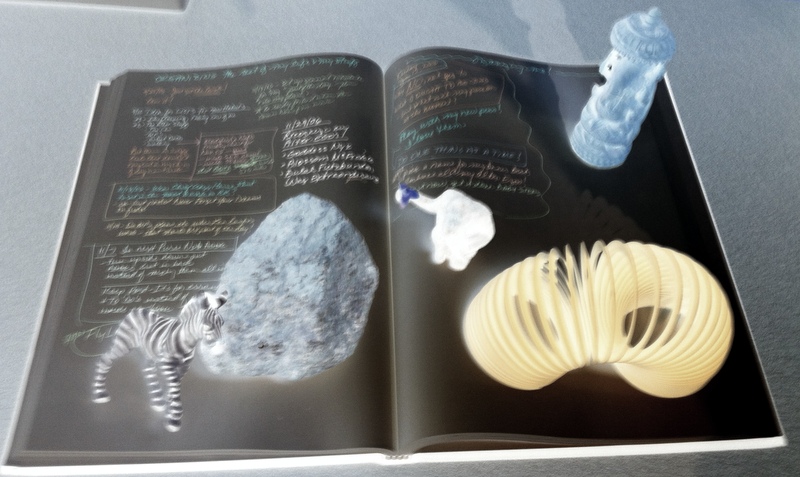
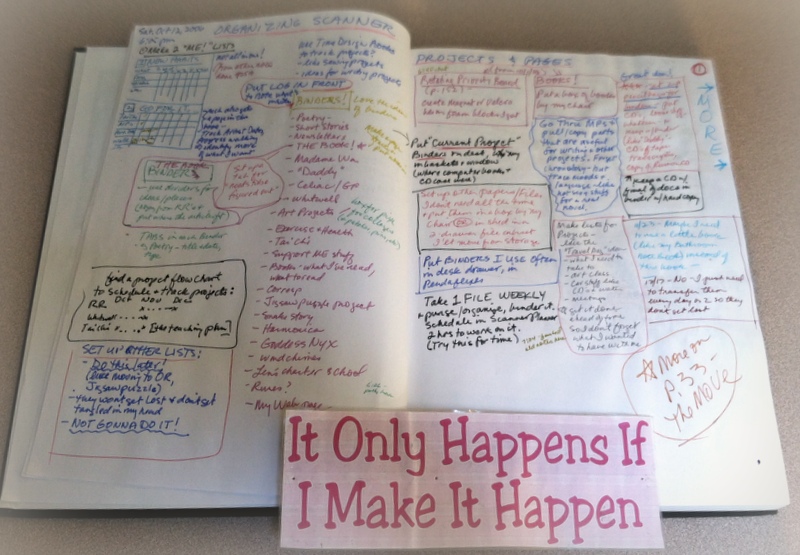
A major tool in this book is a “Scanner Journal”, a place to track all of the wild things that go on in my head and that I really really want to do, or at least explore a bit. I’m sharing excerpts of my journal in this post. This photo, from my favorite T-Shirt, sums it up, and is on the cover of mine.

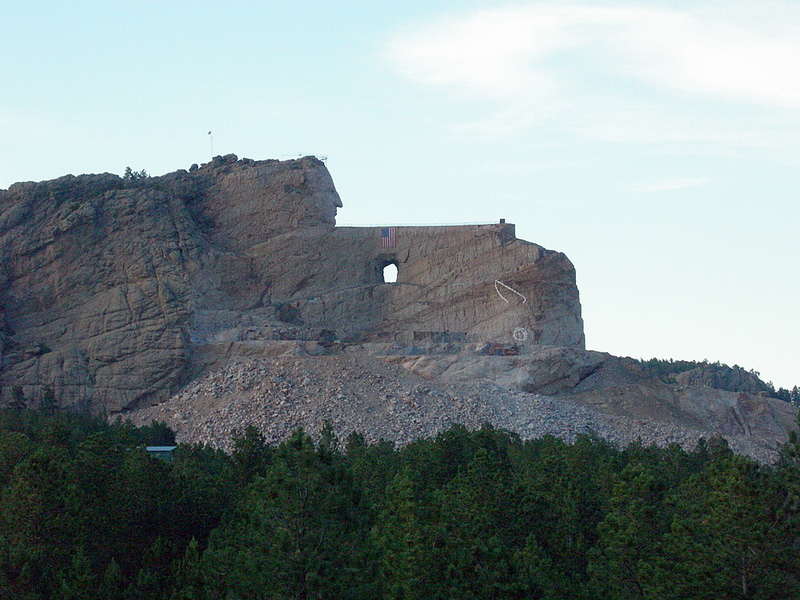
I’ve been fascinated for years by the Chief Crazy Horse Memorial project, near Mount Rushmore in South Dakota. The carving of the mountain has been going on for over 50 years, with no federal or public funds involved. We’ve been there twice and I carry around a piece of mountain* to remind myself to never forget my dreams. (The project and my connection are a story for another time and place.)

While I’m recuperating from hand surgery and limited to typing with one finger on my left hand, I’m learning to communicate with my Dragon voice recognition program. So far, Dragon listens somewhat better on the Mac than it ever did on my PC. But to work this way is a stretch – I usually handwrite my poetry and notes for articles, novel ideas and whatever else is kicking around in my head. I’m not used to writing aloud, but maybe this will create interesting new synaptic brain links.

Mary’s post about the Bliss Box really started me thinking about all those ideas I’d shelved during the past year and half since my car accident and assorted other distractions. Several items in the opening shot of this post live conceptually in my Bliss Box, which once held tea; I bought it because I wanted the box, and gave away most of the contents.

Scanners are not only permitted but actually encouraged to follow their wild tangents, capturing them in a semi-organized fashion in their Scanner Journal. Here’s a sample page, plus perhaps the wisest statements I ever came up with and which is posted all over my house:

I looked through my Scanner Journal to see how my dreams are faring –  what I’ve forgotten or at least misplaced, who’s still nagging me (yes, they are real life critters to me), and the ones that dance with joy because they’re getting attention.

I was surprised:

Our poetry anthology is out there in the universe. We adopted a wonderful dog. My office and workspace are even better than I imagined when I created them in my head. I began practicing tai chi on a fairly regular basis and participated on stage with my class in a martial arts program.

A NaNo novel I pitched was well received at a writers conference before my car accident, etc., pulled me away. Perhaps this is the most fragile of my projects: a novel that’s a cross between Catch 22 and Terms of Endearment, which an important person wants to see. And I haven’t done anything with it.

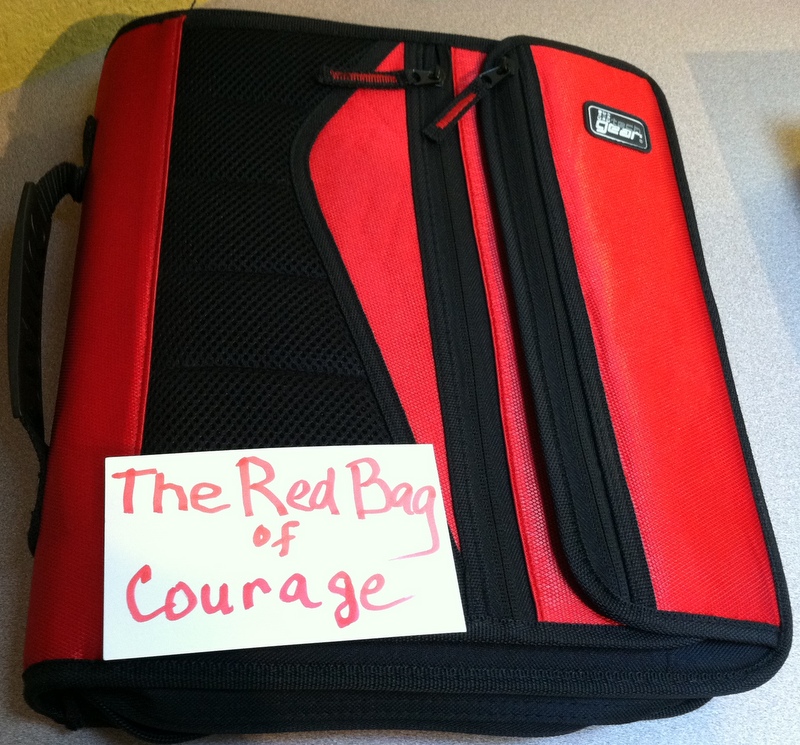
But it’s all the poetry that’s clamoring to be put on paper with purple fountain pen ink that shouts the loudest. My latest answer to dealing with all of these critters who must  be fed is what I call my Red Bag of Courage:  a large zipped binder with sections for portions of several projects. Sometimes you’ve just gotta hand-write a note instead of typing onto the iPad. After I can carry it . . it will include new poetry I’ve written, blog ideas, etc. I’m inspired again.

If you look back at the opening photo here’s where you’ll find:

~Ganesch, to keep me on track. When I’m following my right path, Ganesch removes obstacles in my way. When I’m not heading where I should, he throws boulders and icky things on the road to get my attention.

~A monkey I need to watch diligently to keep him off my back.

~A slinky to remind me there are many ways of getting from Point A to Point B, and to have fun while I’m doing it.

~My rock from of the Chief Crazy Horse Memorial. Korczak gave this answer to the question of how one goes about carving an image out of a mountain: “Study and observe, then remove what is not the horse.”

~A zebra, because I think zebras are cool, and I like to color them brightly when I have the chance.

~The open book and everything on it are all reverse images created in Picasa when I was playing around today. That’s why the paper is black, and the monkey is white.

Sometimes I just have to create my own reality. Enjoy creating yours.


Enter the World of Haibun

The torii of Itsukushima Shrine, the site's mo...

I learned a new literary term yesterday, haibun, when I was reading a story by another writer in a group I belong to. It turns out that haibun is a relatively new literary form that combines prose and poetry, notably haiku. It’s been around since 17th century Japan but is relatively new to Westerners.

According to Wiki, “A haibun may record a scene, or a special moment, in a highly descriptive and objective manner or may occupy a wholly fictional or dream-like space. The accompanying haiku may have a direct or subtle relationship with the prose and encompass or hint at the gist of what is recorded in the prose sections.”

So I thought I’d try writing one. Here it is.

Master of Pain

A friend can block pain like turning off a light switch. I ask him, how does he do it? Easy, he says. I focus my mind completely on the task at hand, so deeply that I block out everything else. I’ve been able to do this since I was a young boy.

That explains it. How he achieved so much on playing fields, working through pain to win gold. Great success in board rooms with marriage crumbling around him. Calm and collected in storm of chaos while others cry like croaking ravens. I’m envious.  Why can’t I do that?

Hand grips glass tightly
He likes to watch birds soaring
Feelings numb like hand
Later I find out he was once a twelve-year-old, giving CPR to his dying father.
Maybe I don’t need that light switch after all.

©2012 Lin Neiswender