sharing a poetic LIFELINE with the world

Archive for the ‘Creativity’ Category

Report from the Mass Poetry Festival


Swirls Four
Medium: Mouse on mousepad
Artist: Margaret Fieland

Painted Rectangles
Medium: Mouse on Mousepad
Artist: Margaret Fieland

This past weekend I attended the Mass Poetry Festival, which took place this past Friday, Saturday, and Sunday. I skipped Friday, but I did  attend both Saturday and Sunday.

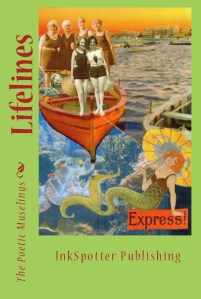
Back when the event was in the planning stages, I got an email about a reading of poetry from their books by Massachusetts authors who had published a book of poetry in 2011. I hesitated — “Lifelines” was written by six of us, and I was “sure” they’re reject me — but sent in my information anyway.

They said yes, illustrating yet again my father’s maxim, “nothing ventured, nothing gained.”  I hope I remember this: not to assume I will be rejected simply because something is a reach or is out of my comfort zone.

I was part of the Sequential Poetry Reading for poets with new books of poetry that appeared in 2011.  The reading started at Noon on Saturday and lasted until 2:40. We were told that we each would have eight minutes to read, but we had a couple of no-shows, so we each had ten minutes.

The reading went well. The audience included us poets and about an equal number of what I expect were friends or family. It was a real treat to be be able to listen to the poets reading from their own work. A good many (most) of them simply read from a copy of their book. I might have done the same except for Michele’s excellent advice to print out what I wanted to read in LARGE, DARK type, and to practice. I did both, and I was very glad I did. Michele also suggested alternating dark and light poems.  I doubt that, left to my own devices, I’d have thought of this either.

There  were a long list of workshops taking place all three days of the festival, and we were encouraged to sign up in advance. I did sign up for several things, but as it turned out, simply walking into the workshop was generally good enough. I suspect the pre-sign-up thing was to figure out expected attendance at the workshop in order to facilitate room assignments, number of handouts, and the like. Next year, I will attempt to sign up for what interests me, but I won’t be a slave to the schedule.

The workshops themselves were tremendous fun. I arrived Saturday morning, signed in, got a copy of the workshops and a map, and by that time it was a bit too late for me to get to much in the way of workshops, so I ended up going to a couple of the art activity things that had been set up with kids in mind.

I *love* art activities — my mother was an artist who specialized in portraits. I was hugely energized by the art projects, and ended up spending several hours Saturday evening after I returned home playing with MS paint. I didn’t get much sleep Saturday night — MS paint is hugely addicting, and I was pretty pumped up from the festival — so I considered skipping Sunday. In the end, I decided that I would just main line coffee and go for it.

Good decision. The first workshop I attended was given by someone I know. He’s a kick-ass teacher, and I had signed up for the workshop. Not only was the workshop very good, but the attendees, as is often the case with Tom’s workshops, were equally interesting. Several of us exchanged email addresses, and I hope we will keep in touch.

There was also a  lit mag and small press event, and I bought several journals and a book of poetry, collected flyers from some of the lit magazines. I’m reluctant to order off the internet for magazines I’ve never had a chance to look over in person, so I was delighted to have the opportunity to pick up some of the ones I was interested in. The poetry book is a book with poetry in French on one side and a translation by Marilyn Hacker on the other. I find reading modern poetry in French a challenge, so I welcome the opportunity to, first, cover up Marilyn’s translation and simply read the poems in French, and eventually, to read her translation as well.

I didn’t stay for the Saturday night headliners — they started at 7:30 — but the Sunday headliners started at 2:15, so I did go to that. The readers were Frank Bidart, Martha Collins, and Stephen Dunn. Stephen Dunn is one of my favorite poets. I  knew two of the poems he read.

What engages me as a reader and writer of poetry is conciseness and precision in language, the sound of the words themselves, their cadence. Freshness of imagery. A sense of humor. A poem that forces me to take another look at the familiar, evocation of emotion.

Here is one of the poems he read — one of the two I recognized:
What Goes On
by Stephen Dunn

After the affair and the moving out,
after the destructive revivifying passion,
we watched her life quiet

into a new one, her lover more and more
on its periphery. She spent many nights
alone, happy for the narcosis

of the television. When she got cancer
she kept it to herself until she couldn’t
keep it from anyone. The chemo debilitated
and saved her, and one day

her husband asked her to come back —
his wife, who after all had only fallen
in love as anyone might
who hadn’t been in love in a while —

and he held her, so different now,
so thin, her hair just partially
grown back. He held her like a new woman

and what she felt
felt almost as good as love had,
and each of them called it love
because precision didn’t matter anymore.

And we who’d been part of it,
often rejoicing with one
and consoling the other,

we who had seen her truly alive


Enhanced by Zemanta

Focus on Form: Aragman, Lin Style

Angel 013

Angel 013 (Photo credit: Juliett-Foxtrott)

This week’s poem, an aragman, was a real challenge for me.

I generated over 2000 anagrams with the link http://Wordsmith.org/anagram using my pets’  names and saved the results to a Word document. I then picked about 50 that appealed to me which I could see had potential as leading lines into my choice of non-anagram words.

I put them into 2 six-line stanzas starting as odd number lines, even numbers my choice of words, with a single anagram as the closing line. There are rules suggested for syllables which I dare to say I ignored- I was having enough of a problem getting the poem to make some sort of cohesive whole! My favorite anagram I couldn’t work in was “Gale omen sky” so maybe I can use that and some of the other left-over bits in a new project.

Here is my effort:

Smokey Angel

-an Aragman-

Gleams key on          
St. Peter’s belt
As elegy monk
Drowns his sorrows
La genome sky
Hovers over all

Angels key Om
Praising abounds
Make yes long
Open golden gates as
Gale monkeys
Laugh in storm like

Leaky gnomes

© 2012 Lin Neiswender


Prompts: Jump-Start Your Poetry

English: harvest moon

Image via Wikipedia

Sometimes I feel like my poetic well has dried up like the middle of the Sahara desert. So I did a little sleuthing for inspiration.  I’ll pull a poem nugget from each of these sites and see if I can get a poem out of them.

http://poetsonline.blogspot.com/2009/05/random-poetry-line-generator.html which yielded the lines “In the water of discord the seasons sleep,” and “In the stillness of the soul the spirits turn, ”

http://www.languageisavirus.com/title-o-matic.html

“Shine Portrait”

http://languageisavirus.com/phrase-generator/

“It is the dying spirit.

Lost moon, velvet spirit.

Wither, decline. With sharp flames

Declining, shining.”

Here’s what I came up with:

Shine Portrait

In the stillness of the soul the spirits turn,
Lost moon, velvet spirit.

It is the dying spirit,
Declining, shining, burnt orange crescent
Tangled in purple-bruised clouds
Evening’s mantle dusted with stars
You wither, decline, disappear

In the water of discord where seasons sleep
Sister moon’s spirit stirs, sharp flames
Calling out to seasons
You shine once more
A glowing orb, reincarnating  spirit

In the stillness of the soul, spirit awakes
Found moon, craggy spirit.

©2012 Lin Neiswender


Make Visible: Find Your Tribe

It is so important as creatives that we find a group of people that we feel comfortable with.  They share our values, our interest in creating and inspire and challenge us. Or maybe we just like to hang around with them, have fun and do fun things with them.  Groups offer us a chance to make friends, learn and share.  All this applies to both online and offline groups.

Online Groups:

Where do you start?

Tribe                                      many interests

Yahoo Groups                          many interests

Google Groups             many interests

Image representing Tribe as depicted in CrunchBase

Image via CrunchBase

CoachCreativeSpace                all creative interests

Writer’s Digest Community       writers

Wet Canvas                             visual artists

For Tribe, Yahoo and Google groups there’s a box to put in your interest (keyword), a list of groups will come up that you may want to join.

Offline Groups:

Where do you start?

This depends on the size of your community.  You may be able to find groups through Meetup.com, your local newspaper, Weekly, or posted at your library or grocery store.  These groups may be related to interests, like writing, activities, like yoga, or church or self-help groups.

What next?

Join the group, post an introduction or go to the first meeting and introduce yourself, be friendly, become involved, participate.

It’s that simple.


Enhanced by Zemanta

Make Visible: Capture Your Ideas

This post was inspired by Michele’s wonderful post:  Never Forget Your Dreams.

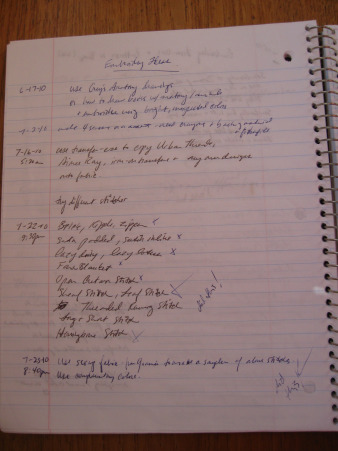
If you capture your ideas you’ll actually have more of them.  For one thing, you will have a record of the ideas you do have! This applies to writing, art and even things like organizing your garage.  I use a Scanner Daybook (from Barbara Sher’s Refuse to Choose) for my craft, organization, school, and other ideas.  Some pages below:

100 Dreams

Click on photo to enlarge.

For writing ideas I have a small notebook in my purse, but any piece of scratch paper will do.  Then I transfer the writing ideas to 4 x 6 notecards that I keep in a “recipe” box.  I also keep notes on my computer desktop using Stickies (a computerized version of yellow sticky notes).  Other methods of capturing your ideas include leaving pens and notepads around the house, using voice-activated software for computer, voice recorders or saving notes on your phone or blackberry.


img_16631

Embroidery Ideas


Why capture your ideas?  Not only will you have a record of ideas that you can refer to later for inspiration or planning;  you will free your brain up from trying to remember them.  This leaves you space to use your imagination and bring your ideas to fruition in the form of a story, artwork or clean garage.  🙂


Enhanced by Zemanta

Enter the World of Haibun

The torii of Itsukushima Shrine, the site's mo...

I learned a new literary term yesterday, haibun, when I was reading a story by another writer in a group I belong to. It turns out that haibun is a relatively new literary form that combines prose and poetry, notably haiku. It’s been around since 17th century Japan but is relatively new to Westerners.

According to Wiki, “A haibun may record a scene, or a special moment, in a highly descriptive and objective manner or may occupy a wholly fictional or dream-like space. The accompanying haiku may have a direct or subtle relationship with the prose and encompass or hint at the gist of what is recorded in the prose sections.”

So I thought I’d try writing one. Here it is.

Master of Pain

A friend can block pain like turning off a light switch. I ask him, how does he do it? Easy, he says. I focus my mind completely on the task at hand, so deeply that I block out everything else. I’ve been able to do this since I was a young boy.

That explains it. How he achieved so much on playing fields, working through pain to win gold. Great success in board rooms with marriage crumbling around him. Calm and collected in storm of chaos while others cry like croaking ravens. I’m envious.  Why can’t I do that?

Hand grips glass tightly
He likes to watch birds soaring
Feelings numb like hand
Later I find out he was once a twelve-year-old, giving CPR to his dying father.
Maybe I don’t need that light switch after all.

©2012 Lin Neiswender


Persona Poems

English: Gwendolyn Brooks, Miami Book Fair Int...

Gwendolyn Brooks

Persona Poems

Persona poems are poems that are written in a voice other than that of the author, where the author pretends to be someone else. The first one I wrote was in response to a poetry writing exercise. The next one that I recall writing ended up in “Lifelines.” Since then, I’ve created two imaginary poets as part of the science fiction novels I’m writing, and written at least 30 poems by each of them.

Writing a persona poems involves getting inside the head of the narrator (or in my case, the supposed author of the poems). It’s kind of like acting a part in a play, except that the writer is creating their own dialogue.

One thing that surprised me in creating the two poets and writing in their voices was the ease with which I slipped inside their heads. The first poet I created, Raketh Namar, namesake of the main character in my novel Relocated, which will be available from MuseItUp publishing this coming July, was supposed to live and write 5,000 years before the action in the novel, and was the author of one of the most sacred texts of my aliens, the Aleynis. I don’t usually write prayers or write about spiritual subjects, yet I found myself writing them without difficulty.  This past November I created another poet, Constance Trusdatter, a very political poet who lives and writes about 100 years before the action of my current work in progress, another science fiction novel with some of the same characters as the first. I don’t usually write much about politics, yet a good number of Constance’s poems are strongly worded poems about this very subject.

Here is a persona poem by Gwendolyn Brooks, one of my favorite poets.The young girl’s voice, her longing, and her desire to be  bad come through so clearly.

Notice the pattern of two unrhymed lines followed by two lines with end rhymes, and how in the final stanza both pairs of lines rhyme.

http://www.poetryfoundation.org/poem/172082

a song in the front yard

By Gwendolyn Brooks
I’ve stayed in the front yard all my life.
I want a peek at the back
Where it’s rough and untended and hungry weed grows.
A girl gets sick of a rose.

I want to go in the back yard now
And maybe down the alley,
To where the charity children play.
I want a good time today.

They do some wonderful things.
They have some wonderful fun.
My mother sneers, but I say it’s fine
How they don’t have to go in at quarter to nine.
My mother, she tells me that Johnnie Mae
Will grow up to be a bad woman.
That George’ll be taken to Jail soon or late
(On account of last winter he sold our back gate).

But I say it’s fine. Honest, I do.
And I’d like to be a bad woman, too,
And wear the brave stockings of night-black lace
And strut down the streets with paint on my face.

Enhanced by Zemanta

Make Visible: End of the Year Self-Evaluation for Writers

The end of the year is a fantastic time to evaluate one’s writing life with an eye to the future.  It’s a time to look at the big picture and see if you have met, exceeded, or fallen short of your self-created writing goals for the year.  This self-evaluation was inspired by the About.com Graduate School post, Check in With Yourself: End of Semester Self-Evaluation.  I’ve found that doing a regular self-evaluation is a great tool for reflection on my graduate school experiences.  This evaluation is not an excuse for you to beat yourself up; instead it will allow you to get a clearer picture of your writing life.

Consider your responses to these questions.  It might help to actually write them down.  🙂

Consider the last year:

  • How did my year begin?
  • What were my submission plans, writing goals, and marketing plans (if applicable)?
  • Did I allocate enough time for writing, typing and editing my work?
  • Were my expectations met?
  • What surprised me this year?
  • If I could do anything over, what would I choose?  What would I do differently?
  • What are my writing strengths and witnesses?
  • How might I address these weaknesses?
  • How can I augment these strengths?
  • What have I learned this year?  About writing?  About subjects of interest to me?  Personally?

After thoughtful consideration, what can you conclude about your year?  What will you do differently next year?

Some ideas to think about for 2012:

Set aside regular times to write.  Be flexible.  If you are a morning person write in the mornings, if not, write in the afternoons or evenings.  Consider investing in writing prompt books or get writing prompts off the internet, so you are not stuck for ideas.  Remember, writers write!

Consider collaborating on a writing project with a writing friend or online critique group.  Collaborating is a great way to support one another while holding each other accountable.

Take time at the end of 2011 or the beginning of 2012 to revisit your writing goals.  Are they too ambitious or not ambitious enough?  Can you break your goals down into smaller, more manageable steps?  If you haven’t made any writing goals, is it time to do so?  Think about sharing your writing goals with supportive family members and friends.  Do you have any deadlines looming?  Make a note of those and give yourself time to meet them.

Reflect on any Works in Progress (WIPs) you have.  Is it time to let your WIPs go or is it time to breathe new life into a WIP?

Every year is a new beginning.  A new year is a great time to establish good writing habits and to reflect on the past year.  It’s also a good time to congratulate yourself on what you accomplished in 2011 and realize what you did right. See you in 2012!

Enhanced by Zemanta

Let’s Write a Holiday Poem

English: Modern Bubble light

In honor of  the winter holidays, let’s write a poem celebrating one. Stumped for ideas? You won’t be for long.

Jot down your very brief answers to the following questions:

  1. What is the first time you remember celebrating this holiday?
  2. Who was there with you?
  3. Which was your most memorable celebration of this traditional holiday?
  4. What is the favorite scent you remember from this holiday?
  5. What was the most special gift you received during this holiday?
  6. What is your favorite sound associated with this holiday?
  7. What is the favorite food or beverage you associate with this holiday?
  8. What is the holiday decoration you remember best from this holiday?
  9. What texture or tactile memory do you have of this holiday?

My answers were:

  1. The year my Dad hung balloons and streamers from the ceiling for Christmas morning.
  2. My little sister and two older brothers and our parents.
  3. The first one I remember.
  4. The smell of the blue spruce tree branches.
  5. A huge stuffed panda bear.
  6. The metal bells we got to hang from the lower branches that would tinkle as we swept by.
  7. Pumpkin pie topped with whipped cream.
  8. The angel hair spider webs that diffused the light around the oil-bubbling candle tree lights.
  9. The cozy feel of red and white candy-striped flannel nightgowns

Now, work these memories into a free-verse poem. Nothing has to rhyme. You can rearrange or delete or add more ideas as you go along. Try for a natural flow and pleasing sound of the words you choose.

Here’s my poem:


The Big Christmas

Santa came! Santa came! I shout with my four-year old squeal

Streamers cascade from the ceiling where balloons hover,
Held in place by static electricity and pieces of tape
The room, to me, a fairyland of bubble lights and halos
Pungent scent of  blue spruce tree, needles sticky

Tinkling bells as we pull out presents
My package wrapped in bright paper so big I ask,
Is it a horse?
No horse, better yet, a giant panda, black and white
Contrasting with the chaos of color around me

The memory of my sister and me, in our peppermint-striped
Flannel nightgowns as we hug our new stuffed animal friends
My brothers follow two strings leading outside,
To discover bicycles hung in the trees

Our excitement intoxicating my parents as they share
A Christmas hot toddy and  slice of pumpkin pie
Smiles tired but satisfied,
At this big Christmas
©2011 Lin Neiswender

When you are satisfied with your poem, print it out or email it to the people with whom you share these memories. It will be a holiday gift to them like no other. Perhaps you’ll inspire them to write their special poems too.


Make Visible: From Consumer to Creator

I bet you have lots of media in your home, like CDs, books, DVDs, even art—all made by someone else or a group of other people.  Have you ever considered making your own media, your own art?  As the rash of consumerism that spreads over the country at this time of year attests, there is a huge market for the products of creativity.  I ask you to consider making your own music, writing your own books, directing your own movies and decorating your walls with your own art.  Right away, there are objections:  You don’t have the talent, money, time, skills, contacts to do this!  Maybe not.

The creators of media (art) aren’t any different than you and me.  “They put their pants on one leg at a time,” as my dad used to say.  Maybe they have a vision to share, maybe not, maybe they have time, talent, money and all that good stuff, maybe not.  It’s not about becoming a writer, musician, artist, filmmaker.  This is about being creative and expressing yourself.  We will still buy media, that’s not in question.  It’s time to be creators of art rather than only consumers of art.  Be brave!  You don’t have to share just yet.  Get out pen and paper, a guitar, paint and paintbrush or video camera.  I double dog dare you!

English: paintbrush

Image via Wikipedia

Enhanced by Zemanta