sharing a poetic LIFELINE with the world

Archive for the ‘Poetry’ Category

Focus on Form: Villanelle

Welcome to Focus on Form. For the next three weeks, each of us Muselings will be writing a poem in the same form and sharing it here on the blog. 

Welsh poet Dylan Thomas

Welsh poet Dylan Thomas (Photo credit: Wikipedia)

Form

A villanelle is a 19th century form was originally a song/dance sung by a troubadour. The modern form developed in the 19th century.

Rules

A Villanelle is a a nineteen line poem consisting of five tercets and a concluding quatrain. It contains only two rhymes. The first and third line of each of the tercets and the first and final two lines of the concluding quatrain form one, and the middle lines of the tercets and the second line of the quatrain form the second.  In addition, the first and third lines of the first tercet are refrains. Thus. let A1, B1 A2 be the first tercet, and a small a or b indicate a line that rhymes with either the A lines or the B line, the poem lays out as:

A1, B1, A2    a3, b2, A1    a4, b3,A2    a4,b4,A1   a5,b5,A3    ,b5,A1,A2

In addition to the rhymes and the refrain,  in a classic villanelle, the lines themselves should be in iambic pentameter and the repeated lines be repeated without variation.

Tip: pay careful attention to the first stanza, and especially to the end words, as you will need to find a goodly number of rhymes for them.

Examples

Do Not Go Gentle Into That Good Night
Dylan Thomas (1914-1953)

Do not go gentle into that good night,
Old age should burn and rage at close of day;
Rage, rage against the dying of the light.

Though wise men at their end know dark is right,
Because their words had forked no lightning they
Do not go gentle into that good night.

Good men, the last wave by, crying how bright
Their frail deeds might have danced in a green bay,
Rage, rage against the dying of the light.

Wild men who caught and sang the sun in flight,
And learn, too late, they grieved it on its way,
Do not go gentle into that good night.

Grave men, near death, who see with blinding sight
Blind eyes could blaze like meteors and be gay,
Rage, rage against the dying of the light.

And you, my father, there on the sad height,
Curse, bless me now with your fierce tears, I pray.
Do not go gentle into that good night.
Rage, rage against the dying of the light.


One Art
Elizabeth Bishop (1911-1979)

The art of losing isn’t hard to master;
so many things seem filled with the intent
to be lost that their loss is no disaster.

Lose something every day. Accept the fluster
of lost door keys, the hour badly spent.
The art of losing isn’t hard to master.

Then practice losing farther, losing faster:
places, and names, and where it was you meant
to travel. None of these will bring disaster.

I lost my mother’s watch. And look! my last, or
next-to-last, of three loved houses went.
The art of losing isn’t hard to master.

I lost two cities, lovely ones. And, vaster,
some realms I owned, two rivers, a continent.
I miss them, but it wasn’t a disaster.

–Even losing you (the joking voice, a gesture
I love) I shan’t have lied. It’s evident
the art of losing’s not too hard to master
though it may look like (Writeit!) like disaster.

My own try:

This poem comes from Robert Lee Brewer’s PAD challenge for April 18th: take a regional cuisine and make it the title of the poem

Southern Fried Chicken

A chicken fried in oil’s a wonderous thing
so spicy, crispy, crunchy with a golden crust
You’ll take a bite. Your mouth will want to sing.

Add salt, paprika for that special zing.
A pinch of jalapeno is a must.
A chicken fried in oil’s a wonderous thing

The spicy pepper adds a bit of bling
to penetrate the chicken’s flesh.  I trust
you’ll take a bite. Your mouth will want to sing.

The oil must be hot so you can bring
the crust to crispness. As we have discussed,
a chicken fried in oil’s a wonderous thing

Keep clear of boiling oil. It will sting.
If oil becomes too hot it may combust.
You’ll take a bite. Your mouth will want to sing.

At last the chicken’s ready, and you spring
to action, find the flavor most robust.
A chicken fried in oil’s a wonderous thing
You’ll take a bite. Your mouth will want to sing.

Your Turn

Now I open it up to you. I welcome any feedback on my poem, as long as it is constructive and not destructive. Let’s help each other improve.

I’d love to see your own attempts at the form as well. You can post them in the comments here, or on future posts, or link to your poem if it’s on a separate site.


Enhanced by Zemanta

Report from the Mass Poetry Festival


Swirls Four
Medium: Mouse on mousepad
Artist: Margaret Fieland

Painted Rectangles
Medium: Mouse on Mousepad
Artist: Margaret Fieland

This past weekend I attended the Mass Poetry Festival, which took place this past Friday, Saturday, and Sunday. I skipped Friday, but I did  attend both Saturday and Sunday.

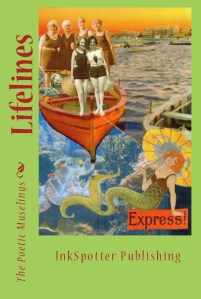
Back when the event was in the planning stages, I got an email about a reading of poetry from their books by Massachusetts authors who had published a book of poetry in 2011. I hesitated — “Lifelines” was written by six of us, and I was “sure” they’re reject me — but sent in my information anyway.

They said yes, illustrating yet again my father’s maxim, “nothing ventured, nothing gained.”  I hope I remember this: not to assume I will be rejected simply because something is a reach or is out of my comfort zone.

I was part of the Sequential Poetry Reading for poets with new books of poetry that appeared in 2011.  The reading started at Noon on Saturday and lasted until 2:40. We were told that we each would have eight minutes to read, but we had a couple of no-shows, so we each had ten minutes.

The reading went well. The audience included us poets and about an equal number of what I expect were friends or family. It was a real treat to be be able to listen to the poets reading from their own work. A good many (most) of them simply read from a copy of their book. I might have done the same except for Michele’s excellent advice to print out what I wanted to read in LARGE, DARK type, and to practice. I did both, and I was very glad I did. Michele also suggested alternating dark and light poems.  I doubt that, left to my own devices, I’d have thought of this either.

There  were a long list of workshops taking place all three days of the festival, and we were encouraged to sign up in advance. I did sign up for several things, but as it turned out, simply walking into the workshop was generally good enough. I suspect the pre-sign-up thing was to figure out expected attendance at the workshop in order to facilitate room assignments, number of handouts, and the like. Next year, I will attempt to sign up for what interests me, but I won’t be a slave to the schedule.

The workshops themselves were tremendous fun. I arrived Saturday morning, signed in, got a copy of the workshops and a map, and by that time it was a bit too late for me to get to much in the way of workshops, so I ended up going to a couple of the art activity things that had been set up with kids in mind.

I *love* art activities — my mother was an artist who specialized in portraits. I was hugely energized by the art projects, and ended up spending several hours Saturday evening after I returned home playing with MS paint. I didn’t get much sleep Saturday night — MS paint is hugely addicting, and I was pretty pumped up from the festival — so I considered skipping Sunday. In the end, I decided that I would just main line coffee and go for it.

Good decision. The first workshop I attended was given by someone I know. He’s a kick-ass teacher, and I had signed up for the workshop. Not only was the workshop very good, but the attendees, as is often the case with Tom’s workshops, were equally interesting. Several of us exchanged email addresses, and I hope we will keep in touch.

There was also a  lit mag and small press event, and I bought several journals and a book of poetry, collected flyers from some of the lit magazines. I’m reluctant to order off the internet for magazines I’ve never had a chance to look over in person, so I was delighted to have the opportunity to pick up some of the ones I was interested in. The poetry book is a book with poetry in French on one side and a translation by Marilyn Hacker on the other. I find reading modern poetry in French a challenge, so I welcome the opportunity to, first, cover up Marilyn’s translation and simply read the poems in French, and eventually, to read her translation as well.

I didn’t stay for the Saturday night headliners — they started at 7:30 — but the Sunday headliners started at 2:15, so I did go to that. The readers were Frank Bidart, Martha Collins, and Stephen Dunn. Stephen Dunn is one of my favorite poets. I  knew two of the poems he read.

What engages me as a reader and writer of poetry is conciseness and precision in language, the sound of the words themselves, their cadence. Freshness of imagery. A sense of humor. A poem that forces me to take another look at the familiar, evocation of emotion.

Here is one of the poems he read — one of the two I recognized:
What Goes On
by Stephen Dunn

After the affair and the moving out,
after the destructive revivifying passion,
we watched her life quiet

into a new one, her lover more and more
on its periphery. She spent many nights
alone, happy for the narcosis

of the television. When she got cancer
she kept it to herself until she couldn’t
keep it from anyone. The chemo debilitated
and saved her, and one day

her husband asked her to come back —
his wife, who after all had only fallen
in love as anyone might
who hadn’t been in love in a while —

and he held her, so different now,
so thin, her hair just partially
grown back. He held her like a new woman

and what she felt
felt almost as good as love had,
and each of them called it love
because precision didn’t matter anymore.

And we who’d been part of it,
often rejoicing with one
and consoling the other,

we who had seen her truly alive


Enhanced by Zemanta

Make Visible: Aragman

I made my anagram poem, an Aragman, from a line from “A Blessing”, a beautiful poem by James Arlington Wright.  I found 6001 anagrams for “contain their happiness.”  I chose the ones I used for the poem below from the first 1000.

Here are the basic rules for constructing an Aragman (courtesy of Mary Jensen, her post is here: Focus on Form:  Aragman).

*****************************************************************************

Rules

The poem consists of six-line stanzas, ending with a stand alone line.

The concept centers around anagrams (“aragman” is, in fact, an anagram of “anagram”). Here are the rules, as set by Buttaci:

  1. First of all, begin with a word or two, perhaps your first name or first and last name. Settle on a word or two with not too many letters.
  2.  After you settle on a word, go to the internet site http://Wordsmith.org/anagram
  3. Type in your word and click on “Get Anagrams.” Instantly, you will be provided with all the words that use the letters of your chosen word.
  4. Copy/paste all the words that are derived from your chosen word and carry it over to your Microsoft Word screen, give the file a name, and save it.
  5. Now take a look at each of the anagrams and decide on a few for your aragman. You will need three for each six-line stanza. From the list select those anagrams that can be woven into your poem.
  6. In each stanza, odd-numbered lines 1, 3, and 5 are different anagrams from your list. If it’s possible, restrict each anagram on these lines to the same number of syllables. Make these anagram lines darker than the others. Even-numbered lines 2, 4, and 6 are completions of corresponding anagram lines 1, 3, and 5. If possible, let these completion lines also conform to the same number of syllables.
  7. The poem’s last line stands alone, after the stanzas, and it is one more anagram line.

The trick for this is finding a good phrase or word that will produce enough workable anagrams. Have fun trying different word combinations until you find something you like.

******************************************************************************

Those are the rules, here’s how to break them.

Contain Their Happiness

(you are a blessing to me)

You speak to me in code, tapping on my wrist,

heartaches pinion pints

the pinions of my heart, the engines of my mouth,

apothecaries ninth spin

the bottle spins, “Drink Me” the tag reads,

piranhas cops ninetieth

he’s not like the others, for the 90th time,

partisanship once thine

I cleave you, we break apart,

pharaohs incites tenpin

like bowling in bikinis, it’s a delicate dance,

antenna choppiest irish

radio only gets U2 songs from the 80s, vinyl varieties,

passionate chip thinner

to fit into your white-picket-fence vision, let me

phantasies enrich point

enter your dreams, as you have mine,

catnap pithiness heroin

such a diabolical drug in my veins.

© Anne Westlund

Point Judith, Rhode Island

Enhanced by Zemanta

Focus on Form: Aragman, Lin Style

Angel 013

Angel 013 (Photo credit: Juliett-Foxtrott)

This week’s poem, an aragman, was a real challenge for me.

I generated over 2000 anagrams with the link http://Wordsmith.org/anagram using my pets’  names and saved the results to a Word document. I then picked about 50 that appealed to me which I could see had potential as leading lines into my choice of non-anagram words.

I put them into 2 six-line stanzas starting as odd number lines, even numbers my choice of words, with a single anagram as the closing line. There are rules suggested for syllables which I dare to say I ignored- I was having enough of a problem getting the poem to make some sort of cohesive whole! My favorite anagram I couldn’t work in was “Gale omen sky” so maybe I can use that and some of the other left-over bits in a new project.

Here is my effort:

Smokey Angel

-an Aragman-

Gleams key on          
St. Peter’s belt
As elegy monk
Drowns his sorrows
La genome sky
Hovers over all

Angels key Om
Praising abounds
Make yes long
Open golden gates as
Gale monkeys
Laugh in storm like

Leaky gnomes

© 2012 Lin Neiswender


Focus on Form: Aragman

Welcome to Focus on Form. For the next three weeks, each of us Muselings will be writing a poem in the same form and sharing it here on the blog. 

Aragman

Aragman (pronounced “a rag man”) is a fairly new form, created by Sal Buttaci in 2005. All poetry forms have to start somewhere! I’m not sure where I first heard about this style, but the notes for it have been sitting in my poetry folder for years now. I figured this would be an ideal time to pull it out and try something new.

Rules

The poem consists of six-line stanzas, ending with a stand alone line.

The concept centers around anagrams (“aragman” is, in fact, an anagram of “anagram”). Here are the rules, as set by Buttaci:

  1. First of all, begin with a word or two, perhaps your first name or first and last name. Settle on a word or two with not too many letters.
  2.  After you settle on a word, go to the internet site http://Wordsmith.org/anagram
  3. Type in your word and click on “Get Anagrams.” Instantly, you will be provided with all the words that use the letters of your chosen word.
  4. Copy/paste all the words that are derived from your chosen word and carry it over to your Microsoft Word screen, give the file a name, and save it.
  5. Now take a look at each of the anagrams and decide on a few for your aragman. You will need three for each six-line stanza. From the list select those anagrams that can be woven into your poem.
  6. In each stanza, odd-numbered lines 1, 3, and 5 are different anagrams from your list. If it’s possible, restrict each anagram on these lines to the same number of syllables. Make these anagram lines darker than the others. Even-numbered lines 2, 4, and 6 are completions of corresponding anagram lines 1, 3, and 5. If possible, let these completion lines also conform to the same number of syllables.
  7. The poem’s last line stands alone, after the stanzas, and it is one more anagram line.

The trick for this is finding a good phrase or word that will produce enough workable anagrams. Have fun trying different word combinations until you find something you like.

Examples

Here are a few stanzas from Buttaci’s original poem, based off his first name:

SENDING SALVATORE SOME ANAGRAMS

A slaver to
the labor of wordplay
A travel so
vicariously thrilling
A vast lore
from which to dabble

Altas over
a hefting of strong words
A rave slot
machine to pull down poems
Area volts
zapped in poetic lines

Tear salvo
from the broken-hearted
Tears oval
and wet flow down faces
Alas, voter!
it’s time to add your name to

Art as love 

© 2005 Salvatore Buttaci

And here is my own poem. For my first attempt, I decided to make a tribute to this group:

MUSELINGS

Mingles us
in lingering chats
Less in mug
as we drink, think
In sums gel
the words we play

Lines smug
from much revision
Single sum
we come together
Smile sung
our words do ring

El Musings

Your Turn

Now I open it up to you. I welcome any feedback on my poem, as long as it is constructive and not destructive. Let’s help each other improve.

I’d love to see your own attempts at the form as well. You can post them in the comments here, on future posts, or link to your poem if it’s on a separate site. I hope you have fun with the Aragman.

Prompts: Jump-Start Your Poetry

English: harvest moon

Image via Wikipedia

Sometimes I feel like my poetic well has dried up like the middle of the Sahara desert. So I did a little sleuthing for inspiration.  I’ll pull a poem nugget from each of these sites and see if I can get a poem out of them.

http://poetsonline.blogspot.com/2009/05/random-poetry-line-generator.html which yielded the lines “In the water of discord the seasons sleep,” and “In the stillness of the soul the spirits turn, ”

http://www.languageisavirus.com/title-o-matic.html

“Shine Portrait”

http://languageisavirus.com/phrase-generator/

“It is the dying spirit.

Lost moon, velvet spirit.

Wither, decline. With sharp flames

Declining, shining.”

Here’s what I came up with:

Shine Portrait

In the stillness of the soul the spirits turn,
Lost moon, velvet spirit.

It is the dying spirit,
Declining, shining, burnt orange crescent
Tangled in purple-bruised clouds
Evening’s mantle dusted with stars
You wither, decline, disappear

In the water of discord where seasons sleep
Sister moon’s spirit stirs, sharp flames
Calling out to seasons
You shine once more
A glowing orb, reincarnating  spirit

In the stillness of the soul, spirit awakes
Found moon, craggy spirit.

©2012 Lin Neiswender


Poetic Forms: Sestina

Arnaut Daniel.

Image via Wikipedia

The sestina is a poetic form attributed to twelfth century French troubadour Arnaut Daniel. It consists of six six-line stanzas and a three line envoy. The six end words of the first stanza cycle in a pattern thusly:

ABCDEF/FAEBDC/CFDABE/ECBFAD/DEACBF/BDFECA

and an envoy whose form varies somewhat, but which uses all six end words:

BE/DC/FA

or

FA/DC/BE

How to choose your end words

There are doubtless many ways to choose ones end words One is to write the first stanza and then lay out the pattern for the rest. The other, the one I use, is to pick six words, generate the skeleton, and start writing. I try to choose words with more than one meaning and that can be used as more than one part of speech.

Here is a link to a sestina generator: Feed it your six words and it spits out a skeleton with the six stanzas and envoy:
dilute.net/sestinas

Here is a link to sestina by Ezra Pound:

//www.poets.org/viewmedia.php/prmMID/15423

Here are the first two stanzas;

I

Damn it all! all this our South stinks peace.
You whoreson dog, Papiols, come! Let’s to music!
I have no life save when the swords clash.
But ah! when I see the standards gold, vair, purple, opposing
And the broad fields beneath them turn crimson,
Then howl I my heart nigh mad with rejoicing.

II

In hot summer have I great rejoicing
When the tempests kill the earth’s foul peace,
And the lightnings from black heav’n flash crimson,
And the fierce thunders roar me their music
And the winds shriek through the clouds mad, opposing,
And through all the riven skies God’s swords clash.

Here is one of mine:

Polemic

Workers, you are choked by the collar
of convention. Will you spare
yourselves? Will you ever tire
of the endless round of days, brave
the waters of controversy and refuse to play it safe?
Will you strike a blow

for self expression? Will you blow
down the artificial walls your white collar
has erected around you? Will you leave the safe
space you create in the spare
confines of your tiny cubicle? As you brave
each new day, do you ever tire

of the endless wheel of useless make work? The tire
of useless flesh grows round your middle. You puff and blow
climbing a single flight of stairs. How brave
are you? As you lounge, idle, the shirt collar
around your neck grows ever tighter, until there is no spare
room, and you choke. When will it be safe

to throw your old shirt away? What will jolt you from your safe
little life? What would be enough to make you tire
of the endless round of dailyness? Spare
yourself and live, not merely exist. Blow
the clouds from your eyes. White collar
workers, unite. Take a chance. Be brave.

Allow yourselves to brave
unknown waters, to give up your safe
small space, to throw away your collar
and try the new. Rise from your chairs. Retire
from the rat race. Overturn your desk. Blow
your boss’s mind and run from your office. Spare

yourselves. You have no spare
life. You have one chance to be brave.
You will never get another chance to blow
away the small, safe
walls around you before you tire
and are choked by your white collar.

You cannot spare yourself and stay safe.
Let yourself be brave. Throw away the tire
of convention. Strike a blow for life. Throw out your white collar.

Margaret Fieland


Enhanced by Zemanta

Poetic forms: Cento

National Poetry Month Display @ Forest Hills

National Poetry Month Display @ Forest Hills (Photo credit: mySAPL)

Poetic forms: the cento

A cento is like a rag rug, it’s composed of bits and pieces from other things. In the case of the rug, it’s pieces of old fabric. For the cento, it’s made of verses or passages from other poems, songs, articles, stories, or whatever by other authors.

The first cento I ever wrote was a haiku sequence, and perhaps because I’m a musician, I composed it using verses from old songs: Clementine, Go Tell Aunt Rhody, The Twelve Days of Christmas, Jingle Bells, Good King Wencheslas, and the old Tennessee Ernie Ford song, “Sixteen Tons,” which is one of my favorites. The haiku sequence was the traditional 5-7-5 syllable count of the Japanese haiku, rather than the freer form (seventeen syllables or less) used in so many modern American haiku. Choosing the 5-7-5 syllable count made it easy to select the songs.

Go tell Aunt Rhody, A Haiku Sequence

Twelve drummers drumming
When the snow was round about
Now the ground is white

Nine ladies dancing
Excavating for a mine
Dashing through the snow

Ten lords a leaping
When the snow lay round about
making spirits bright

Dashing through the snow
A partridge in a pear tree
Make the Yule-tide gay

If the Fates allow
When a poor man came in sight
Let your heart be light

And the store boss said
When a poor man came in sight
jingle all the way!

Here’s one I wrote  using lines from songs about the sea.

Sailor’s Song

A hundred years ago, three thousand miles away
A Yankee ship came down the river
With the tinkers and tailors and soldiers and all

Bound to the westward where the stormy winds blow
When this bold pirate
Fought them up and down

Fire in the cabin, fire in the hold
For to fight the foreign foe
Captain Hull broke his heart and died

He fought like a hero till he died
And fifty-five more lay bleeding in gore
Then the signal was sent for the grand ship to anchor.

They dug his grave with a silver spade

Here’s where they came from:
lines from songs on website
http://www.contemplator.com/sea/index.html

A Hundred Years Ago, “A Hundred years ago”
Three Thousand Miles, “Three Thousand Miles Away”
Blow, Boys, Blow, “A Yankee Ship Came Down the River”
Blow the Man Down, “With the tinkers and tailors and soldiers and all”The Dreadnought, “..bound to the westward where the stormy winds blow”
The Bold Princess Royal, ” .. when this bold pirate”
Admiral Benbow, ” ..fought them up and down”

Fire Down Below, ” Fire in the cabin, fire in the hold,”
Johnny Todd, “For to fight the foreign foe”
Captain Hull, “Captain Hull”
Boney Was A Warrior “broke his heart and died”

Bold Nelson’s Praise, “He fought like a hero till he died”
John Paul Jones, “and fifty-five more lay bleeding in gore”
Spanish Ladies, “Then the signal was sent for the grand ship to anchor”

Storm Along, “They Dug His Grave with a silver spade”

And how, you might ask, did I pick these lines?

After I decided I wanted to write a cento using lines from songs about the sea, I searched for a website, and found the one above. I started down the list of songs, picking lines that looked like they might fit. Then I rearranged them. Then I rearranged them again. Then I passed the result past my poetry critique group, removed two lines that didn’t fit, and rearranged the poem into three line stanzas instead of quatrains. And there it was.

Here’s a link to a cento by poet John Asbury:

http://dougkirshen.com/dong/

Try it — it’s loads of fun.

Enhanced by Zemanta

Enter the World of Haibun

The torii of Itsukushima Shrine, the site's mo...

I learned a new literary term yesterday, haibun, when I was reading a story by another writer in a group I belong to. It turns out that haibun is a relatively new literary form that combines prose and poetry, notably haiku. It’s been around since 17th century Japan but is relatively new to Westerners.

According to Wiki, “A haibun may record a scene, or a special moment, in a highly descriptive and objective manner or may occupy a wholly fictional or dream-like space. The accompanying haiku may have a direct or subtle relationship with the prose and encompass or hint at the gist of what is recorded in the prose sections.”

So I thought I’d try writing one. Here it is.

Master of Pain

A friend can block pain like turning off a light switch. I ask him, how does he do it? Easy, he says. I focus my mind completely on the task at hand, so deeply that I block out everything else. I’ve been able to do this since I was a young boy.

That explains it. How he achieved so much on playing fields, working through pain to win gold. Great success in board rooms with marriage crumbling around him. Calm and collected in storm of chaos while others cry like croaking ravens. I’m envious.  Why can’t I do that?

Hand grips glass tightly
He likes to watch birds soaring
Feelings numb like hand
Later I find out he was once a twelve-year-old, giving CPR to his dying father.
Maybe I don’t need that light switch after all.

©2012 Lin Neiswender


Imagery: Day and Night

English: Rita Dove in 2004 Polski: Rita Dove w...

Image via Wikipedia

Day and night are frequently used to create mood in poetry. Here are a few of my favorite poems that make use of day/night imagery.

In the poem below, the change from day to dark echoes the change in the narrator’s situation, the beginning of a relationship. The images of the sun rolling up her rug and night strewing salt are potent ones, and echo the domestic setting of the poem.

Flirtation

by Rita Dove

After all, there’s no need
to say anything

at first. An orange, peeled

like a tulip on a wedgewood plate
Anything can happen.

Outside the sun
has rolled up her rugs

and night strewn salt
across the sky. My heart

is humming a tune
I haven’t heard in years!

Quiet’s cool flesh—
let’s sniff and eat it.

There are ways
to make of the moment

a topiary
so the pleasure’s in

walking through.

Here is another favorite of mine:
This one uses vivid imagery to bring the story to life. The nighttime and darkness are an essential part of the story — it wouldn’t have been nearly as romantic if it had taken place in the daytime.

The Highwayman

by Alfred Noyes

Alfred NoyesThe wind was a torrent of darkness among the gusty trees,
The moon was a ghostly galleon tossed upon cloudy seas,
The road was a ribbon of moonlight over the purple moor,
And the highwayman came riding–
Riding–riding–
The highwayman came riding, up to the old inn-door.

He’d a French cocked-hat on his forehead, a bunch of lace at his chin,
A coat of the claret velvet, and breeches of brown doe-skin;
They fitted with never a wrinkle: his boots were up to the thigh.
And he rode with a jeweled twinkle,
His pistol butts a-twinkle,
His rapier hilt a-twinkle, under the jeweled sky.

Over the cobbles he clattered and clashed in the dark inn-yard,
He tapped with his whip on the shutters, but all was locked and barred;
He whistled a tune to the window, and who should be waiting there
But the landlord’s black-eyed daughter,
Bess, the landlord’s daughter,
Plaiting a dark red love-knot into her long black hair.

And dark in the dark old inn-yard a stable-wicket creaked
Where Tim the ostler listened; his face was white and peaked;
His eyes were hollows of madness, his hair like moldy hay,
But he loved the landlord’s daughter,
The landlord’s red-lipped daughter,
Dumb as a dog he listened, and he heard the robber say–

“One kiss, my bonny sweetheart, I’m after a prize tonight,
But I shall be back with the yellow gold before the morning light;
Yet, if they press me sharply, and harry me through the day,
Then look for me by moonlight,
Watch for me by moonlight,
I’ll come to thee by moonlight, though hell should bar the way.”

He rose upright in the stirrups; he scarce could reach her hand,
But she loosened her hair in the casement. His face burnt like a brand
As the black cascade of perfume came tumbling over his breast;
And he kissed its waves in the moonlight,
(Oh, sweet black waves in the moonlight!)
Then he tugged at his rein in the moonlight, and galloped away to the West.

He did not come in the dawning; he did not come at noon;
And out of the tawny sunset, before the rise of the moon,
When the road was a gypsy’s ribbon, looping the purple moor,
A red-coat troop came marching–
Marching–marching–
King George’s men came marching, up to the old inn-door.

They said no word to the landlord, they drank his ale instead,
But they gagged his daughter and bound her to the foot of her narrow bed;
Two of them knelt at her casement, with muskets at their side.
There was death at every window;
And hell at one dark window;
For Bess could see, through her casement, the road that he would ride.

They had tied her up to attention, with many a sniggering jest.
They had bound a musket beside her, with the barrel beneath her breast.
“Now keep good watch!” and they kissed her. She heard the doomed man say–
Look for me by moonlight;
Watch for me by moonlight;
I’ll come to thee by moonlight, though hell should bar the way!

She twisted her hands behind her; but all the knots held good.
She writhed her hands till her fingers were wet with sweat or blood.
They stretched and strained in the darkness, and the hours crawled by like years,
Till, now, on the stroke of midnight,
Cold, on the stroke of midnight,
The tip of one finger touched it! The trigger at least was hers!

The tip of one finger touched it. She strove no more for the rest.
Up, she stood up to attention, with the muzzle beneath her breast.
She would not risk their hearing; she would not strive again;
For the road lay bare in the moonlight;
Blank and bare in the moonlight;
And the blood of her veins, in the moonlight, throbbed to her love’s refrain.
Tlot-tlot; tlot-tlot! Had they heard it? The horse-hoofs ringing clear;
Tlot-tlot, tlot-tlot, in the distance? Were they deaf that they did not hear?
Down the ribbon of moonlight, over the brow of the hill,
The highwayman came riding,
Riding, riding!
The red-coats looked to their priming! She stood up, straight and still!

Tlot-tlot, in the frosty silence! Tlot-tlot, in the echoing night!
Nearer he came and nearer! Her face was like a light!
Her eyes grew wide for a moment; she drew one last deep breath,
Then her finger moved in the moonlight,
Her musket shattered the moonlight,
Shattered her breast in the moonlight and warned him–with her death.

He turned; he spurred to the west; he did not know who stood
Bowed, with her head o’er the musket, drenched with her own red blood.
Not till the dawn he heard it, his face grew gray to hear
How Bess, the landlord’s daughter,
The landlord’s black-eyed daughter,
Had watched for her love in the moonlight, and died in the darkness there.

Back, he spurred like a madman, shouting a curse to the sky,
With the white road smoking behind him and his rapier brandished high!
Blood-red were his spurs in the golden noon; wine-red was his velvet coat,
When they shot him down on the highway,
Down like a dog on the highway,
And he lay in his blood on the highway, with the bunch of lace at his throat.

And still of a winter’s night, they say, when the wind is in the trees,
When the moon is a ghostly galleon tossed upon cloudy seas,
When the road is a ribbon of moonlight over the pur
ple moor,
A highwayman comes riding–
Riding–riding–
A highwayman comes riding, up to the old inn-door.
Over the cobbles he clatters and clangs in the dark inn-yard;
He taps with his whip on the shutters, but all is locked and barred;
He whistles a tune to the window, and who should be waiting there
But the landlord’s black-eyed daughter,
Bess, the landlord’s daughter,
Plaiting a dark red love-knot into her long black hair.

And here’s one of mine. I find far more of my poems make use of night time imagery than they do of daytime.

In Sleep

by Margaret Fieland

Shadows creep up stairs,
whispers echo in a hall,
footsteps slither
under a door.

A floor creaks.
Blood thumps
in my ears, drowns
cries of murmuring wind.

I cross a vacant cafe
where demons dine on ashes,
enter an empty room,
rest on a floor.

Splinters stab my palms.
I’m dragged down to dark.

Enhanced by Zemanta