sharing a poetic LIFELINE with the world

Author Archive

Savoring Form and Visibility

We welcome back Lisa Gentile — she’s more like family than a guest poster! Thank you, Lisa, for joining us again today. (Please read our earlier interview with Lisa, too: https://poetic-muselings.net/2012/07/10/lisa-gentile-mentor-and-moxie-maverick/)

Savoring Form and Visibility

One of the many uplifting themes that I notice every time I read through this Poetic Muselings blog is that of appreciating the world around us, with all of its tragic, glorious, epic, and everyday beauty.

It hits me every time even though I shouldn’t be surprised by it. After all, that’s what writers and other artists do, right? They grasp an inspiration and artfully shape it into a piece of creative work so that they may reflect upon it, move on from it, and/or share it with the rest of us. But what really goes on? I suspect there are some answers lurking in around this blog.

Through focus on form we assemble a collection of sensorial, intellectual, and emotional experiences and string them together in a pleasing poetic form. Very often the new configuration gives us insight into the events or imaginings that we selected.

The resultant poem tells us something about ourselves, the characters portrayed, or the moment captured. The selection might seem random at first, the configuration unremarkable. A subtle change could shift the whole message. This is our creative hand at work, we trust that we have made the right selections for this particular piece and we follow them to their conclusion.

When we make visible what we have seen we create something tangible out of our interpretation. It matters that we create a unit of meaning, and beauty, that we can share with others. This is a powerful way to connect with each other. It creates the potential for a dialog.

We may be sharing a joy, a sorrow, or a casual rumination. The important point is that we are sharing, we are saying “I was there and I saw/ heard/ did/ felt/ thought this.” We are inviting others to enjoy our art, experience the meaning give it, and then to create their own meaning.

When we create, whether by focusing on form or making an idea visible, we are making an impression that holds personal value less abstract and more real in the world—we are shaping its meaning so that we may share it and appreciate it in our lives, so that we may savor it.

Research shows that this making and expression of meaning from our experiences contributes to our satisfaction in life. How do you give form and visibility to your experiences? How do you savor life?

Lisa Gentile, M.S. is a professional life coach. You can read more about her practice at http://www.moxiemavericks.com


Lisa Gentile, Mentor and Moxie Maverick

We’re delighted to spend some time today with
Lisa Gentile,
the “Moxie Maverick”,
career coach, writer, poet, creative artist,
and mentor to
the Poetic Muselings.

 Michele: Well, Lisa, we’ve had a bit of history since meeting in cyberspace at the October 2007 Muse Online Writers Conference. So much has changed for all of us! Your poetry workshop in 2008 was so powerful, it literally burned out your internet connection on that last day of chats. As I tap-danced my way through a room full of writers from all over the world, we decided to let you know what we were taking back with us from the intense week. Last November, Lifelines was published, the culmination of our efforts following the workshop.

 Did you ever think we’d be having this conversation, in this way, and this time?

Lisa: I had no idea what I was starting when I signed into that first workshop. I never expected that we would later meet up in various states. Now it makes perfect sense that  we are writing to each other, with each other, and in one another’s spaces.

 What do you think helped us succeed when so many drop by the wayside?

It seemed to me that you all immediately appreciated the potential of your sharing. Our workshop exercises asked you to step back and really listen to your work, yourselves, and each other. But you trusted each other, or at least wanted the possible outcomes enough to take risks together.

 We learned so much from you — what might we have taught you in return?

I was humbled to hold an early version of your manuscript, which would eventually become Lifelines, in my hands. It was the culmination of your shared perseverance and vulnerability. I was grateful to have witnessed its creation, even from afar. You taught me to remain open-minded with respect to what others may achieve.

As you know, I see connections in even the not-so-obvious places. When people “take root” in each others’ lives, all kinds of things are possible.

For me, connection has always meant to witness another person, to see, acknowledge and respect what’s important to them. I like how Dr. Brené Brown defines connection as ‘the energy that exists between people when they feel seen, heard, and valued; when  they can give and receive without judgment; and when they derive sustenance and strength from the relationship.’ I find her use of the word ‘sustenance’ compelling. It seems like an important part of the connection between the Poetic Muselings that became Lifelines.

Tell us about Moxie Mavericks — how does one “become” one? And why should one?

Moxie Mavericks is the name of my company, my professional life coaching practice. Moxie means gumption, derring-do, etc. But for me it’s a family value with which I was raised. I come from several generations of people who stand by their principles, whether they make us heroes, antiheroes, or observers. We enjoy each other’s stories. And those stories don’t even have to be spectacular, as long as they are real. We simply witness each other’s moxie when we see it. So people with similar values tend to feel at home here.

Mavericks are the sorts who get very serious about creating personal meaning in their lives. They are, by definition, out on the very edge of the frontier. It’s important to note that the landscape might be internal. People have special needs when they shift to maverick mode. It gets lonely out/in there. Very often others in their lives don’t see the singular vision that a maverick might have or initially understand the actions he or she chooses. So in coaching we build a space where mavericks can get customized support and feel safe to experiment with ideas.

We all have access to moxie and can be a maverick. It’s in there.

I know you are passionate about the concept of transition in an individual’s life. What does this mean to you? What are you seeing that’s so exciting?

People usually expect life coaching to be about defining their dreams, about setting and reaching goals, and about overcoming challenges like procrastination. Indeed, these are some of the tactical aspects of the work we do in coaching. But what I see over and over in my clients is a desire to make meaning out of a transition, to understand what’s being lost and gained by moving. In some cases, if we rush into goal setting we miss the opportunity to slow down and reflect. Forced goals lack authenticity. They are burdensome rather than enriching. Giving clients space and time for this reflection has deepened and enlivened the experiences my clients and I share.

As we talked recently, I envisioned transition as trying to figure out what you need to put in your backpack for a journey — and more importantly, what you must take out and leave out in order to make a transition. That’s the hard part — letting go of what only weighs you down. Any guidance on this? 

We often don’t know that we are entering the journey of a transition when it begins. Sometimes we realize we are far from “home” only when we feel lost. Something has changed but we don’t know what. We also might not know where we are going next. So it can be tricky to pack in advance. Either way, it helps to have a stash of compassion, for oneself and for others. We are all doing the best we can. We need to be patient with ourselves. This is how we can safely look at what’s holding us down. I won’t pretend that it’s easy work. The second handy item is appreciation for ourselves and others. I work with clients on spotting signature strengths–the ones that offer us the most pleasure and personal meaning when expressed. They make for an internal compass of sorts, one that can be recalibrated as interests change.

Where are you going with projects and other aspects of your life these days? 

People have been asking for retreats so I’m working that out. I understand more fully now how they might be of service. This fall two plays that my husband, Nick, and I wrote will be performed at the San Francisco Fringe Festival. Our program is called “Weird Romance”. We have a wonderful director, cast, and crew bringing our characters to life. It’s quite a treat to have others see your imagination walking and talking under the lights. We love hearing the audience laugh.

And what about your future? What’s coming up? 

I am exploring the vulnerability of stillness. It’s a wild ride.

You can’t get away from here without a few words about one of the strangest boat stories I’ve heard in years — and I’m a (somewhat) experienced sailor!

What is the project that made you take to the seas, what’s happening with it now, and where do you see it going?

You are talking about Spirit of the Sea, a new youth sailing program for which I volunteer. This year we acquired a very special boat as our flagship, S/V Ocean Watch. In February we splashed her, cleaned her up, and sailed her from Anacortes, WA, to San Francisco, CA.

We take youth sailing on the San Francisco Bay at not cost to them. Just participating in the sailing of a boat and experiencing the marine environment can be powerful to our youth. But we’re taking it a step further by offering activities that incorporate experiential education, citizen science, and service learning to connect these kids with critical thinking, mentors, and possible career paths. We hope to instill these young sailors with a sense of agency that will transfer to other domains.

“No one makes that trip at that time by choice.” 

That’s exactly what half a dozen insurance agents said.

Why did you do it?

I no longer know why we delivered the boat at that time. To get it done, I suppose. I did it because it was a once-in-a-lifetime opportunity to sail with an incredible group of experienced and moxie-rich sailors, some of whom had become my dear friends. I did it because I had earned it. We had worked hard to get the program to that point and sharing this adventure was a celebration. Also, I was ready for a new way to access information about myself in the world. This is the point of the adventure coaching that I do with some of my clients. This adventure was an opportunity for me to exercise different strengths outside of my daily routine.

Any highlights?

I witnessed first-hand the value of a “game-face” in sailing leadership. It keeps everyone calm and focused. There were many perfect moments. There was a perfect hour of a perfect afternoon. I felt secure with my fellow crew so I was free to marvel at the ever-changing shapes of the waves, patterns of the bubbles, and colors of the waters. And I had some chocolate. I think I felt deeply myself and connected at the same time. But I find that the more I try to look back at these moments squarely, the more they seem to shimmer and dissolve. They are prismatic.

So my work now is to remember how these moments felt and stay open to those sensations in the future.

Was this a transitional journey for you?

It offered key moments in a larger transition. The engine died one morning at dawn, just before a shift change. So everyone was up, exhausted, and busy. While others tracked the problem and rebuilt parts I stayed on watch alone at the helm. We had no wind so we were especially vulnerable. Even once we started moving again, my job was relatively simple: monitor the radar, watch for hazards, make course adjustments, and scan the horizon through the binoculars. But I was absolutely satisfied. I loved that no one checked on me. As the sun came up I studied the beautiful sky and coastline and faced the notion that I had fulfilled, in one way or another, just about every promise that I had made to myself as a kid. I decided to not even review the list, to just let it all be. Now I’m shifting my focus from doing to being.

They say you never return from a journey to the same place. 

When I left I was thrilled that I didn’t know when I would return. I don’t think I’ve quite yet returned. I am practicing patience and expressing my curiosity.

Your websites are as eclectic as you are, Lisa — so much more to talk about at a later date! 

Glad to see that Spirit of the Sea is a recognized 501 tax-exempt Public Charity  — which means that donations not only go to a very good cause, but are tax deductible. I encourage our readers to look at this site and consider a donation to the worthy cause. (Hint: the price of a couple of lattes could help float the boat.):    www.spiritofthesea.org

Your theater production is a hoot! How I’d love to be in San Francisco on Sept. 8, 9, 11 or 14 to see “Weird Romance”:   http://www.sffringe.org

Thank you so much for joining us today! As always, we appreciate your generosity of spirit, wisdom, humor, and that sense of connection we cherish. Good luck with all your adventures.

Thanks, Michele. My pleasure, and I look forward to sharing more soon.

To learn more about what Lisa does, check out:  www.moxiemavericks.com


A True Senryu Story

This form made me giggle and immediately brought up a senryu story:

My big Poodle hates rain
Stares at me:
“Do something! My feet are all wet!”


Editor’s POV: How to Submit your Work

Lin Neiswender’s Post about Publication Leads was great. She reiterated that there ARE places to send our work, and that we writers and poets are a community; when we share resources, advice, ideas, and our hearts, we all benefit. We are the Poetic Muselings, with a published book of poetry, because others before us opened the doors, reached out to help us, and now we are continuing the process.

I’ve been Poetry Editor for Apollo’s Lyre e-zine for almost two years, having inherited a marvelous forum that I’ve made my own. We publish poets and poems from all over the world, from highly credentialed folks, and those who are courageously sending their work out for the first time — some of it decades old, but unseen by other eyes. I love this unpaid job, the discovery of a fresh voice, vivid imagery, the teasing of form. Our readers must love the publication, too, because they’ve commented about how particular poems inspired them to send their work for consideration.

We get LOTS of poems, and often the decision of what to publish is very difficult. When I first read the incoming items, I do a quick scan of the poem. Some grab me immediately, a huge “YES!!!” bounces in my head. I tag these stars, so they stand out. I don’t pay attention to the bio info yet — I just know I want to find a spot for these words in a future issue.

The next category are those where the poet didn’t follow any of the guidelines:

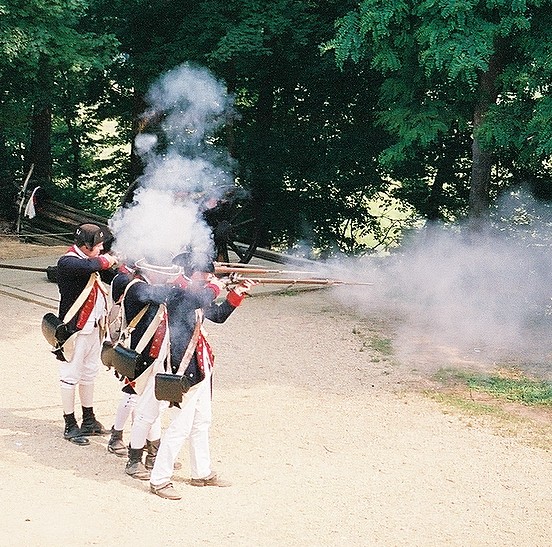
Soldiers at Yorktown

Soldiers at Yorktown (Graf, 2005)

— a maximum of FORTY (40) lines of poetry, excluding stanza breaks

— spread out in up to FOUR poems

— subject line: Poetry, YOUR NAME, # of poems, # of lines total

—  poem and bio  in the body of the email. No attachments

— at a minimum, the use of “//” to designate stanza breaks.

(I also ask for “/” at the end of each line of poetry, but that seems to confuse people.)

— People may send in their work whenever, so long as it doesn’t exceed 40 lines and four poems in any three month period. In the guidelines page of Apollo’s Lyre, I lay out this information, with examples.

Ignore these and your poems are likely to be returned or ignored, depending on the circumstances. Send something with a blank subject line, or an attachment (unless I’ve specifically requested it), and it will travel directly to “Trash”. Do yourself a favor and make it easier for the editor or publisher not to say “NO”.

I’ve received emails from some folks who send (I kid you not!):

— one long email, with over 250 lines of poetry, in multiple poems

— one long email with ONE poem of over 200 lines

— one poem per email, with over a dozen emails received in a short period of time.

— collections of poems (often a dozen or more, with around 100 lines or so)

These leave me with the feeling that I’m looking in someone’s closet, and it’s my job to decide what they should wear. Don’t send me “everything” — send me your very best poem(s).

The next part is trickier, and always amazes me, since it gives the impression that the person submitting didn’t care where or to whom, and assumed we’d figure it out:

— maybe because my name is so often misspelled, I triple-check the editor’s name, spelling, title, etc., before sending anything out. So, when I see my name spelled in any of a multitude of variations, it says someone didn’t proofread before mailing, or didn’t pay attention.

— recently, I got a spate of poems addressed to me as well as about a hundred of the poet’s nearest and dearest editors — with all of our names listed in the cc’s. This really tells me that someone was hunting with a shotgun, not a rifle, hoping to hit and slow down at least one of us without extra effort.

We’re talking about email, people! It’s not like they were worried about postage! What would an employer say to a letter like this? “To Whom It May Concern: I would really like to work for your company, but I don’t think I should have to do any research about what you do, or what you ask for. I don’t have to follow any of your rules, since I’m so incredible you’ll be in a bidding war for my services. Oh, yes, I don’t have much in the way of publishing credits, but that shouldn’t worry you.Please call me back tomorrow. Sincerely, Princess Poet OR Frog Prince.”

Believe me, every time you send your work out in the world, you are applying for a job, that of writer.

If you don’t follow general guidelines, you leave the impression you might be difficult to work with. This leads me to a third category of poems — those with potential, maybe some minor fixing or clarification to bring out their souls.

This pile is reviewed several times, under different circumstances. Some poems take more concentration to grasp, and are worth the effort. Some may need a bit of rearrangement of images, or a shift to present tense, reduction of “ing” words and unneeded articles. Poetry doesn’t have to have complete sentences, cover all gaps. I read these poems aloud for cadence, rhyme, awkwardness or smoothness of sounds.

Before you send anything in — even (in my opinion) novels or non-fiction, but especially poems — read it aloud. Hear what you’ve written, listen to how the sounds complement, contrast, enhance your intent. Where do you breathe? Is it clear from the poem? I know that my Mac desktop computer, and my Windows 7 laptop, have a text-to-voice program that will read your words to you. Usually this is part of “accessibility” options. Turn it on and try it.

There are two other general categories of poems that don’t make it into our publication:

— Those that aren’t quite the quality level yet, perhaps too cliche-driven, forced rhyme, or otherwise not appropriate for Apollo’s Lyre in subject matter. Not all poems are right for all publications. That’s where the search for publishers is important. Read back issues.

— Some incredibly wonderful poems may not be used simply because we don’t have room to publish everything we want, and/or we have other similar poems we’re using. Choosing is hard! Two poems about very similar subjects requires a decision about which one is “best” for us, at the time. I wish the poets success placing the ones I’ve passed on.

I’m as susceptible as anyone else when it comes to being treated fairly, with respect, understanding, and a willingness for a poet to work with me to edit a poem. Usually I’m right with my suggestions, since I’m approaching it with some distance; it isn’t my baby, but I care about it. Sometimes I’m wrong; I just didn’t “get it” about what was intended. When I’ve heard the background, I understand, and might suggest a few words be added to the bio, to help the reader understand, too.

I’m blown away at the talent out there, and here with our blog. I hope some of this helps you get ready for your next batch of outgoing angels. Help them fly to their destination, and not get eaten by the nasty gatekeeping trolls (like me!).

Let us know if you try this, and it works — we’ll spotlight your success. And, if you share other ideas of where to submit poems, we’ll keep an active spot here, giving you credit for it, of course.

Keep writing!

Michele


Capturing the Elusive Villanelle

Garden of the Gods, Colorado. © Graf 2006

Maybe “deconstructing” is a better word for what follows.

I love a well-constructed, nuance-laden, tension-building poem — especially one with lines or phrases repeated, each time expanding on the underlying theme. When it works, it really works. When I dabble in a structured form, I need to take it apart and put it back together in a way that makes sense to me.

Over the years, I created my own versions of “cheat sheets” — today they are usually called “templates” — for a variety of poetic forms, when it was important to have a set number of syllables or sounds per line;  control the number of lines in each stanza, especially if the stanzas are not constructed the same — like the villanelle. I’ve used them with haikus, tankas, ghazels, alternating voice layout, and for song lyrics — especially useful to bridge beats, where you want to stretch out a sound.

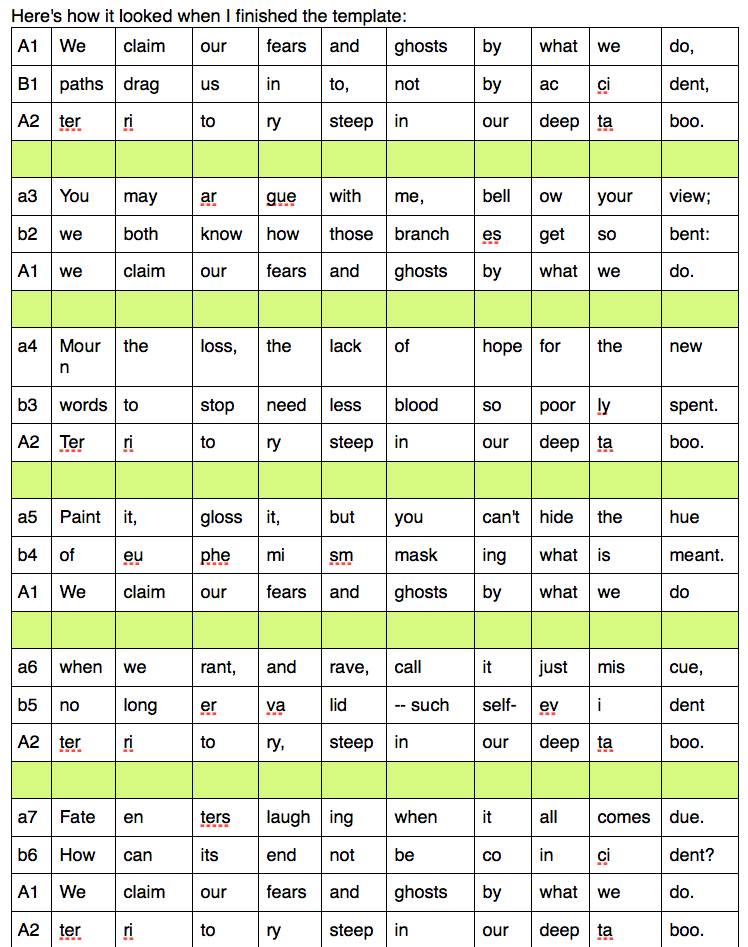
My Villanelle template and construction process are simpler than it appears at first glance.  I:

1. Took as my guide the Dylan Thomas poem “Do Not Go Gentle Into That Good Night”, which Margaret used when she introduced the form.

2. Identified the rhyme pattern alongside each line, as Margaret explained. To make it easier, I highlighted the first line and each repetition that followed, then used a different color highlighter, and did the same for the third line. Since the only other rhyme was with line 2, I highlighted the last word in each of the “B/b” lines (below is a portion)

Do Not Go Gentle Into That Good Night
Dylan Thomas (1914-1953)


… and so on.

Then, I:

3. Counted the number of syllables per line (ten); the number stanzas and lines per stanza (five stanzas of three lines each (tercets), plus one stanza of four lines (a quatrain)); the total number of lines I needed, including a blank line between stanzas (24 lines total)

Next step was to write my first three lines, using the right number of syllables or sounds, and the right pattern, knowing that the first and third lines would be repeated several times in the poem:

   We claim our fears and ghosts by what we do,
   paths drag us into, not by accident,
   territory steep in our deep taboo.

This gave me the shape of the form. Time to do the template. I:

4. Created a table with eleven columns across (one for each of the ten syllables needed in each line, PLUS a first column with the rhyme pattern), and 24 rows (for each filled and blank line in the poem)

5. Shaded in the rows that were stanza breaks (rows 4, 8, 12, 16 and 20; I didn’t create a column to number the rows — just counted down)

6. Filled in each of the first three rows, one syllable per each cell across the table, in columns 2 – 11, with my first tercet.

7. went back to column one, and, with my trusty Thomas poem, wrote in what the rhyme pattern needed to be.

8. filled in on my template where lines one and three were repeated

9. really cheated on the next step! I wrote the sound I needed to repeat (in parentheses) in the last column of each line. Yes, I’ve creatively split words as I sounded them for the cells.

… (the complete template is at the end of this post)

10. then came up with a bunch of words that rhymed with each of the endings of the two lines.

A1 and A3:  do/ taboo (DO) — view, new, clue, avenue, cue, due
B1: accident (DENT) — amazement, evident, coincident, bent, went, event, dent, sent

Then the creative process really started:

11. I wrote the poem from the last stanza forward — I knew how it started; that was already written. I decided how I wanted it to end, and, using the list of “sound alike” words, figured how to end each of the lines in the quatrain.

12. Worked my way through the poem, looking at the rhyming words I’d come up with, and moved them around.

13. wrote lines, juggled them from tercet to tercet, until they made sense to me.

And, voila! Though this is still a work in progress, you can see how each step shaped this draft of the poem’s cadence, flow, rhythm, content, and context. Now the work begins, to hone it into a sharp, complete story. Like Mary’s poem, my subject is dark. I hope to capture the same sense as hers did.

Ever Thus
by Michele M. Graf

We claim our fears and ghosts by what we do;
paths drag us into, not by accident,
territory steep in our deep taboo.

You may argue with me, bellow your view;
we both know how those branches get so bent:
we claim our fear and ghosts by what we do.

Mourn the loss, the lack of hope for the new
words to stop needless blood so poorly spent.
Territory steep in our deep taboo.

Paint it, gloss it, but you can’t hide the hue
of euphemism masking what is meant.
We claim our fear and ghosts by what we do

when we rant, and rave, call it just miscue,
no longer valid — such self-evident
territory steep in our deep taboo.

Fate enters laughing when it all comes due.
Can how its end not be coincident?
We claim our fears and ghosts by what we do,
territory steep in our deep taboo.

Events and Accolades

We’ve been busy, sharing our poetry with the world. Some highlights of our recent and future activities:

Anne Westlund:  
~had three poems published in Poetry Breakfast:
http://poetrybreakfast.wordpress.com/?s=anne+westlund
“Chivalry”  – March 11, 2012
“White-out” – March 17, 2012
“Eclipse” – March 26, 2012
~Strange Pulp – one time publication for the Oasis Sci-Fi Convention in Orlando, Fl.  Short story,  File Under “S”, May 2012

Lin Neiswender: Three poems in the anthology Love and Other Passions by the Poets of Central Florida, http://www.amazon.com/Love-Other-Passions-Central-Florida/dp/098515070X

Margaret Fieland:
~is Participating in Sequential Poetry Reading on Sat April 21st between 12 and 3 at The Omen, 184 Essex Street in Salem, MA
~ Poems published:
Boston LiteraryMagazine
“Monday Morning” Spring, 2012
http://poetrybreakfast.wordpress.com/?s=margaret+fieland
“Weather Report” February 24, 2012
“Taking a Break” March 3rd, 2012

Michele Graf: Two poems, “Chief Joseph Trail” and “Forest” were recently included in the Oregon Poetic Voices Project (OPV), a comprehensive digital archive of poetry readings to complement existing print collections of poetry across the state. Read and listen to her poems at:  http://oregonpoeticvoices.org/poet/370/

Aragman, the Fifth

As my sister Muselings have demonstrated, we’ve approached the Aragman armed with butterfly nets, howitzers, and an array of tactics. I aimed for congruity of the alternating lines, and didn’t worry about syllabic symmetry.

My seemingly serene (publicly, at least), alter ego had a lot to say about being the subject of this poem. She’s usually the Wise Woman, link to the universal. Maybe she still is — let me know what you think. Below is the revised version, followed by the original post. Comments?

Moon Spirit (Graf, 2006)

Moon Spirit

Om — is it porn?
Watch, howling, heady.
No mop I stir 
but gates I open,
Import ions
of all persuasions.

In prism, too —
treacherous harmonics
I romp to sin,
bare it all in beaming light
Impostor in?
This Goddess of the Night?

Sin pit room,
raucous pounding sound.
Imp riots on,
curses ecliptic arc.
Prison it, Om,
for its own good.

Motion rips,
I stir the brew,
Trim poison,
cast away deception.
Sip it, moron —
vintage lunacy just for you.

. . . I Trip On Oms . . .

(revised, per comments and experimentation!
This is where I started:)

Moon Spirit

I Trip On Oms,
treacherous harmonics.
No mop I stir
but gates I open,
Import ions
of all persuasions.

Sin pit room,
raucous pounding sound.
Imp riots on,
curses ecliptic arc.
Prison it, Om,
for its own good.

Motion rips,
I stir the brew,
Trim poison,
cast away deception.
Sip it, moron —
vintage lunacy just for you.

Impostor in?
Is this the Goddess of the Night?
I romp to sin,
bare it all in beaming light
minor posit —
howling loud, heady, you must ask —

Om — is it porn?

Meet Magdalena Ball, author of Black Cow

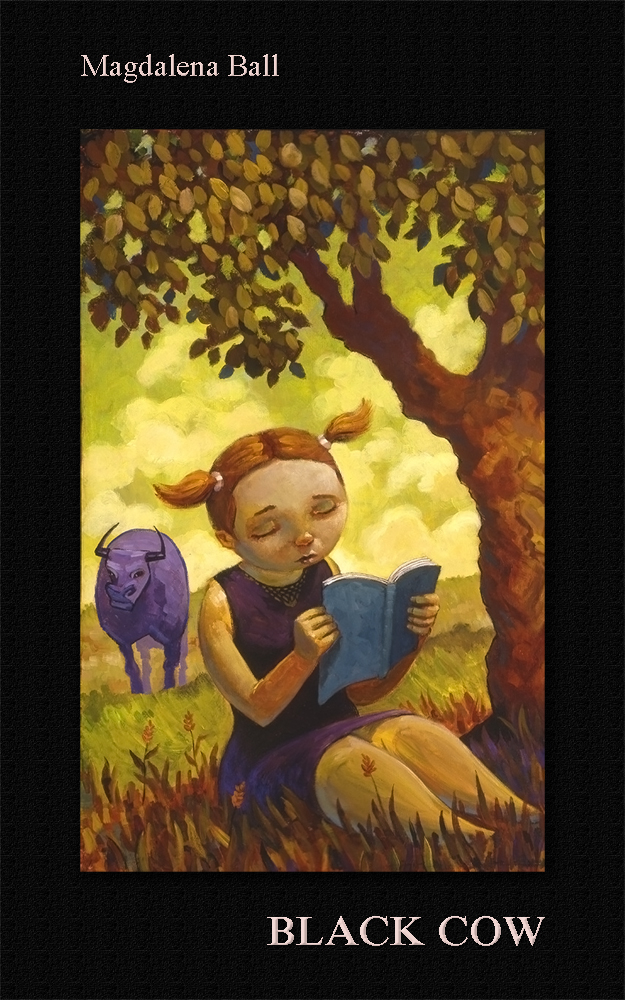
We’re excited to host Magdalena Ball — poet, fiction writer, mentor, friend we’ve not had the pleasure of meeting in person (yet) — as she travels cyberspace to share her latest book Black Cow. Most stops on her schedule focus on the novel and writing fiction. Here, she’s at home in poetry, and gave us permission to post the poem that started the story.

Poetic Muselings:  Maggie, welcome to the Poetic Muselings blog! You are to blame, you know, for what we as a group have accomplished.

Maggie Ball:  I enjoyed writing writing that blog post, and was so proud of what you’ve accomplished with Lifelines. But blame? Perhaps your readers should take a look at the post:  Am I Really to Blame?

PM: Is there anything you’d LIKE to talk about that doesn’t come up in on your book tour?

MB:  Would love to talk poetry.  I know that seems odd in the context of a fiction book tour, but for me I always start with poetry – the impression, the irritation, the itch.

I even began Black Cow as a poem many years ago (it’s published in my poetry book Repulsion Thrust) as I always do with fiction, getting the general overall feeling and theme I want clarified in poetic form before I begin to work on the formal structuring, characterisation and plotting.

So, since I know no one else will ask me if there’s anything I’d like to talk about (thank you!), I thought I’d provide the whole poem in its entirety.  When you read the book, and for anyone visiting who has read the book, I’d be interested in how close to my original conception I came.

PM: We love exclusives! Thank you. We have your poem at the end of this interview.

PM: As I began reading Black Cow, I was struck by your startling poetic images to describe the mundane. Freya, your “Mom” character scratched out a tiny bit of time for herself to workout, in an early scene. She isn’t doing it to feel better, but because it’s another thing that’s expected of her. I loved the language about grabbing a bite to eat:

“Talk about insect morphology. She felt like an arthropod right now, her mandibulate mouthparts working quickly to munch down a late lunch in the car on the way to the office.”

This is Kafka meets American Beauty! Can you share something about your process?

MB:  Well I must say I like “Kafka meets American Beauty”  (better than the “Dilbert meets The Good Life” riff I’ve been bandying about!). You know, aside from being a long time fan of Kafka’s (and Gregor Samsa was definitely on my mind when I wrote James’ character), I’m also a fan of American Beauty, and the idea of a stressed out real estate agent has been on my mind since seeing (several times) Annette Bening’s “I will sell this house today” scene followed by that amazing scream  So you’ve really nailed it, and maybe even nailed my process as well in a very tasty soundbite. 

A character or image will lodge itself in my head and won’t go away until it’s driving me crazy enough to want to write about it.  The idea of our modern obsession with ‘success’ and the way in which we’re driven harder by financial trouble rather than reorienting is something that I also couldn’t shake.  My first novel, Sleep Before Evening, was very much about youth and art as my female Portrait of the Artist.   

For Black Cow I really wanted to play around with middle-aged creativity and the work-life balance in the context of recession, financial crisis, and consumerism of the sort that is rampant in American Beauty.  So these were the motivating principles.  I always begin with a poem or two, then a story, and then I usually begin mapping out the scenes and structure and characters of the novel, getting the nitty gritty in place before I can then go and write more scenes.

PM: Do you have a favorite scene in Black Cow? If so, what makes it so?

MBI quite like the scene where the family arrives at Cradle Lake in Tasmania for their first holiday.  Mainly because it’s so beautiful there, I was able to just give in to the utter pleasure of the scene and describe it, but also because it’s a real epiphany for them all – a kind of turning point when they’re so stunned by the natural beauty of the place –the magic of reality to use Dawkins’ phrase, that it wakes them up, just a bit, becoming a catalyst for everything that happens afterwards.

PM: What else can you tell us about the poetry of Black Cow?

MBI wasn’t quite so free and easy in quoting other people’s poems as I was in Sleep Before Evening, but Wordsworth does get a look in, as does The Prose Eddas, a fairly important collection of Icelandic mythology generally thought to have been written by Snorri Sturluson in the year 1220.  This work is a combination of prose and poetry but has a rhythm, and many references to poetry and Norse mythology which also picks up on Freya’s name and background.

PM: Any other questions you wish you’d be asked as you wander around the universe?

MBI suspect that people will want to know where to pick up a copy (and will want one straightaway!), so they could just hive off right now to Amazon’s Kindle shop and be reading the book within seconds.  Apple has it too, as does Nook. It’s also available in print on AmazonBook Depository (free worldwide shipping!), BeWrite Books (my publisher) and other good bookstores (you could just ask for it in your local shop).  For anyone who wants to check out an excerpt, they can visit: this page.  Or can check out the Black Cow Book Trailer

I’m more than happy to send out custom autographed bookplates, so people should just drop me a line if they’ve got a hard copy and I’ll happily post off a bookplate, bookmark and a few other goodies.

PM: I know you’ll never be far from your vivid imagery, no matter what you write, Maggie. Thank you so much for allowing us to present the genesis of your book here.

Maggie’s Farm

when the good life calls
simplicity for loose change
pressure drop freedom
you answer

like Voltaire
lock the door
walk ten miles in fancy shoes
remove dreams from your pockets
a dozen crumpled receipts
and kiss the ground

the dirt tastes like shit
bodysore and boneache you fall asleep
each night
dead tired
no time to toss and tease
sleep matters now

it isn’t heaven
no candy floss choirs
fanning your every sweat
each serve on your battered table
reflects a cut or bruise
muscle knit tendon job
unlike anything you ever imagined
in those tower block days
glassed in tight

a pretty prison
escaped

Magdalena Ball  http://magdalenaball.com/wordpress/

http://www.magdalenaball.blogspot.com/

Six Questions for . . . the Poetic Muselings . . . Magdalena Ball, and more

Six Questions For . . .

We’re being interviewed on Jim Harrington’s blog, “Six Questions For . . .” on March 1, 2012. Jim’s guest include publishers, editors, and others in the field of writing. His goal, to paraphrase from his blog, is to:

. . . provide authors with specific information about what editors are looking for in the submissions they receive, offer editors a venue for advertising their publications and getting the word out about what, in their opinion, constitutes ‘good writing.’

We’re delighted to share ideas about what we look for, and our approach — and to be in such great company. Please read Jim’s interview and let us know what you think.

. . . Magdalena Ball . . .

will be our guest on Weds., March 14, 2012. Our interview, starting from a focus on poetry and creativity, will be quite different from the  others on her blog tour. Her recent book, Black Cow, has rave reviews.

Visit her site to learn more, including the prizes she’s offering.  “The draw is open to anyone who comments, re-tweets (please use #blackcow – it’s not mandatory, but will help me find the tweets!), or updates their status with info about anything to do with the visits.”  Magdalena Ball  http://magdalenaball.com/wordpress/

. . . and More:

Thank you for responses to my question last week about markets or guidance for our 14-year old poet. Please take a look at the post, and send your ideas. Thanks!  Mentoring and being Mentored

thank you!

Mentoring and being Mentored

This week, I am mentoring a very talented 14-year old poet, and supporting one of our Poetic Museling mentors. Interesting to be of service up and down this ladder.

First of all, congratulations to MAGDALENA BALL for Black Cow, her recently released novel. Reviews praise its depth, craftily written prose, the core subject so many of us face — is success as we’ve defined it destroying us, our families, and lives? Sometimes, desperation is the greatest motivator to force us to take the unmapped turn-off to something else. But is that other road the answer, or the path to a worse problem?

I’m anxious to read this book for several reasons:  Maggie is one of our incredible mentors, who helped make Lifelines real. Not only did she teach the chapbook workshop that brought us together to continue writing, and edited our work, but she’s an accomplished and marvelous poet. And a voracious, eclectic reader — a woman after my own heart — who’s Compulsive Reader website is a treasure of possibilities.

And Maggie is one of the most sincerely caring, compassionate people I’ve met, if only online. I value her advice, talent, and willingness to share and nurture others, and her friendship. I hope someday to have the chance to get to Australia and give her a big hug.

Here are some links to follow for more info:

Magdalena Ball –  Book Musing
Magdalena Ball – Black Cow
AMAZON (discounted!)  |   BARNES & NOBLE | BOOK DEPOSITORY (free worldwide shipping!) |   BEWRITE BOOKS
Join the book tour (for fun, prizes, and a lot of info)!
Black Cow Discussion Questions and book club visits

~~~~~~~~~~~~~~~

The other end of the spectrum is equally exciting.  I almost  never am far away from my other poetry passion, as editor of the Apollo’s Lyre poetry column. I receive poems from all over the world; from those diving into the submission pool for the first time, as well as those with pages-long credentials. All ages, forms, subjects. Some are “perfect” as they are, some need tweaking; often the most widely-published poets are the most open to editing, but not always. I plan a series of posts about the process, and publishing, from my editor view.

Recently, a young lady with an intriguing voice, nicely constructed poems, and subjects that tap into the universal, sent me her work. Unfortunately, Apollo’s Lyre contains some adult-themed subjects or words, articles, flash fiction, and poetry, as well as sillier, lighter items. We are not an appropriate venue for her work.

However, I want to help “C.” find a good place to sub her poems — I think she’s very talented, and hope some day I can publish her, and also say that I read her early work and gave her the encouragement to keep writing, exploring, and putting herself out for the world to see.

With her permission, and that of her mother, I’m contacting fellow poets, poetry publishers, and my contacts in general to ask:  Where could a 14-year old poet send her work?

If any of you have ideas I can share with “C.”, please let me know. Be part of this mentoring process — there’s plenty of room here!

Thank you —

Michele