sharing a poetic LIFELINE with the world

Posts tagged ‘Poetry’

Make Visible: Aragman

I made my anagram poem, an Aragman, from a line from “A Blessing”, a beautiful poem by James Arlington Wright.  I found 6001 anagrams for “contain their happiness.”  I chose the ones I used for the poem below from the first 1000.

Here are the basic rules for constructing an Aragman (courtesy of Mary Jensen, her post is here: Focus on Form:  Aragman).

*****************************************************************************

Rules

The poem consists of six-line stanzas, ending with a stand alone line.

The concept centers around anagrams (“aragman” is, in fact, an anagram of “anagram”). Here are the rules, as set by Buttaci:

  1. First of all, begin with a word or two, perhaps your first name or first and last name. Settle on a word or two with not too many letters.
  2.  After you settle on a word, go to the internet site http://Wordsmith.org/anagram
  3. Type in your word and click on “Get Anagrams.” Instantly, you will be provided with all the words that use the letters of your chosen word.
  4. Copy/paste all the words that are derived from your chosen word and carry it over to your Microsoft Word screen, give the file a name, and save it.
  5. Now take a look at each of the anagrams and decide on a few for your aragman. You will need three for each six-line stanza. From the list select those anagrams that can be woven into your poem.
  6. In each stanza, odd-numbered lines 1, 3, and 5 are different anagrams from your list. If it’s possible, restrict each anagram on these lines to the same number of syllables. Make these anagram lines darker than the others. Even-numbered lines 2, 4, and 6 are completions of corresponding anagram lines 1, 3, and 5. If possible, let these completion lines also conform to the same number of syllables.
  7. The poem’s last line stands alone, after the stanzas, and it is one more anagram line.

The trick for this is finding a good phrase or word that will produce enough workable anagrams. Have fun trying different word combinations until you find something you like.

******************************************************************************

Those are the rules, here’s how to break them.

Contain Their Happiness

(you are a blessing to me)

You speak to me in code, tapping on my wrist,

heartaches pinion pints

the pinions of my heart, the engines of my mouth,

apothecaries ninth spin

the bottle spins, “Drink Me” the tag reads,

piranhas cops ninetieth

he’s not like the others, for the 90th time,

partisanship once thine

I cleave you, we break apart,

pharaohs incites tenpin

like bowling in bikinis, it’s a delicate dance,

antenna choppiest irish

radio only gets U2 songs from the 80s, vinyl varieties,

passionate chip thinner

to fit into your white-picket-fence vision, let me

phantasies enrich point

enter your dreams, as you have mine,

catnap pithiness heroin

such a diabolical drug in my veins.

© Anne Westlund

Point Judith, Rhode Island

Enhanced by Zemanta

Focus on Form: Aragman

Welcome to Focus on Form. For the next three weeks, each of us Muselings will be writing a poem in the same form and sharing it here on the blog. 

Aragman

Aragman (pronounced “a rag man”) is a fairly new form, created by Sal Buttaci in 2005. All poetry forms have to start somewhere! I’m not sure where I first heard about this style, but the notes for it have been sitting in my poetry folder for years now. I figured this would be an ideal time to pull it out and try something new.

Rules

The poem consists of six-line stanzas, ending with a stand alone line.

The concept centers around anagrams (“aragman” is, in fact, an anagram of “anagram”). Here are the rules, as set by Buttaci:

  1. First of all, begin with a word or two, perhaps your first name or first and last name. Settle on a word or two with not too many letters.
  2.  After you settle on a word, go to the internet site http://Wordsmith.org/anagram
  3. Type in your word and click on “Get Anagrams.” Instantly, you will be provided with all the words that use the letters of your chosen word.
  4. Copy/paste all the words that are derived from your chosen word and carry it over to your Microsoft Word screen, give the file a name, and save it.
  5. Now take a look at each of the anagrams and decide on a few for your aragman. You will need three for each six-line stanza. From the list select those anagrams that can be woven into your poem.
  6. In each stanza, odd-numbered lines 1, 3, and 5 are different anagrams from your list. If it’s possible, restrict each anagram on these lines to the same number of syllables. Make these anagram lines darker than the others. Even-numbered lines 2, 4, and 6 are completions of corresponding anagram lines 1, 3, and 5. If possible, let these completion lines also conform to the same number of syllables.
  7. The poem’s last line stands alone, after the stanzas, and it is one more anagram line.

The trick for this is finding a good phrase or word that will produce enough workable anagrams. Have fun trying different word combinations until you find something you like.

Examples

Here are a few stanzas from Buttaci’s original poem, based off his first name:

SENDING SALVATORE SOME ANAGRAMS

A slaver to
the labor of wordplay
A travel so
vicariously thrilling
A vast lore
from which to dabble

Altas over
a hefting of strong words
A rave slot
machine to pull down poems
Area volts
zapped in poetic lines

Tear salvo
from the broken-hearted
Tears oval
and wet flow down faces
Alas, voter!
it’s time to add your name to

Art as love 

© 2005 Salvatore Buttaci

And here is my own poem. For my first attempt, I decided to make a tribute to this group:

MUSELINGS

Mingles us
in lingering chats
Less in mug
as we drink, think
In sums gel
the words we play

Lines smug
from much revision
Single sum
we come together
Smile sung
our words do ring

El Musings

Your Turn

Now I open it up to you. I welcome any feedback on my poem, as long as it is constructive and not destructive. Let’s help each other improve.

I’d love to see your own attempts at the form as well. You can post them in the comments here, on future posts, or link to your poem if it’s on a separate site. I hope you have fun with the Aragman.

Prompts: Jump-Start Your Poetry

English: harvest moon

Image via Wikipedia

Sometimes I feel like my poetic well has dried up like the middle of the Sahara desert. So I did a little sleuthing for inspiration.  I’ll pull a poem nugget from each of these sites and see if I can get a poem out of them.

http://poetsonline.blogspot.com/2009/05/random-poetry-line-generator.html which yielded the lines “In the water of discord the seasons sleep,” and “In the stillness of the soul the spirits turn, ”

http://www.languageisavirus.com/title-o-matic.html

“Shine Portrait”

http://languageisavirus.com/phrase-generator/

“It is the dying spirit.

Lost moon, velvet spirit.

Wither, decline. With sharp flames

Declining, shining.”

Here’s what I came up with:

Shine Portrait

In the stillness of the soul the spirits turn,
Lost moon, velvet spirit.

It is the dying spirit,
Declining, shining, burnt orange crescent
Tangled in purple-bruised clouds
Evening’s mantle dusted with stars
You wither, decline, disappear

In the water of discord where seasons sleep
Sister moon’s spirit stirs, sharp flames
Calling out to seasons
You shine once more
A glowing orb, reincarnating  spirit

In the stillness of the soul, spirit awakes
Found moon, craggy spirit.

©2012 Lin Neiswender


Enter the World of Haibun

The torii of Itsukushima Shrine, the site's mo...

I learned a new literary term yesterday, haibun, when I was reading a story by another writer in a group I belong to. It turns out that haibun is a relatively new literary form that combines prose and poetry, notably haiku. It’s been around since 17th century Japan but is relatively new to Westerners.

According to Wiki, “A haibun may record a scene, or a special moment, in a highly descriptive and objective manner or may occupy a wholly fictional or dream-like space. The accompanying haiku may have a direct or subtle relationship with the prose and encompass or hint at the gist of what is recorded in the prose sections.”

So I thought I’d try writing one. Here it is.

Master of Pain

A friend can block pain like turning off a light switch. I ask him, how does he do it? Easy, he says. I focus my mind completely on the task at hand, so deeply that I block out everything else. I’ve been able to do this since I was a young boy.

That explains it. How he achieved so much on playing fields, working through pain to win gold. Great success in board rooms with marriage crumbling around him. Calm and collected in storm of chaos while others cry like croaking ravens. I’m envious.  Why can’t I do that?

Hand grips glass tightly
He likes to watch birds soaring
Feelings numb like hand
Later I find out he was once a twelve-year-old, giving CPR to his dying father.
Maybe I don’t need that light switch after all.

©2012 Lin Neiswender


Imagery: Day and Night

English: Rita Dove in 2004 Polski: Rita Dove w...

Image via Wikipedia

Day and night are frequently used to create mood in poetry. Here are a few of my favorite poems that make use of day/night imagery.

In the poem below, the change from day to dark echoes the change in the narrator’s situation, the beginning of a relationship. The images of the sun rolling up her rug and night strewing salt are potent ones, and echo the domestic setting of the poem.

Flirtation

by Rita Dove

After all, there’s no need
to say anything

at first. An orange, peeled

like a tulip on a wedgewood plate
Anything can happen.

Outside the sun
has rolled up her rugs

and night strewn salt
across the sky. My heart

is humming a tune
I haven’t heard in years!

Quiet’s cool flesh—
let’s sniff and eat it.

There are ways
to make of the moment

a topiary
so the pleasure’s in

walking through.

Here is another favorite of mine:
This one uses vivid imagery to bring the story to life. The nighttime and darkness are an essential part of the story — it wouldn’t have been nearly as romantic if it had taken place in the daytime.

The Highwayman

by Alfred Noyes

Alfred NoyesThe wind was a torrent of darkness among the gusty trees,
The moon was a ghostly galleon tossed upon cloudy seas,
The road was a ribbon of moonlight over the purple moor,
And the highwayman came riding–
Riding–riding–
The highwayman came riding, up to the old inn-door.

He’d a French cocked-hat on his forehead, a bunch of lace at his chin,
A coat of the claret velvet, and breeches of brown doe-skin;
They fitted with never a wrinkle: his boots were up to the thigh.
And he rode with a jeweled twinkle,
His pistol butts a-twinkle,
His rapier hilt a-twinkle, under the jeweled sky.

Over the cobbles he clattered and clashed in the dark inn-yard,
He tapped with his whip on the shutters, but all was locked and barred;
He whistled a tune to the window, and who should be waiting there
But the landlord’s black-eyed daughter,
Bess, the landlord’s daughter,
Plaiting a dark red love-knot into her long black hair.

And dark in the dark old inn-yard a stable-wicket creaked
Where Tim the ostler listened; his face was white and peaked;
His eyes were hollows of madness, his hair like moldy hay,
But he loved the landlord’s daughter,
The landlord’s red-lipped daughter,
Dumb as a dog he listened, and he heard the robber say–

“One kiss, my bonny sweetheart, I’m after a prize tonight,
But I shall be back with the yellow gold before the morning light;
Yet, if they press me sharply, and harry me through the day,
Then look for me by moonlight,
Watch for me by moonlight,
I’ll come to thee by moonlight, though hell should bar the way.”

He rose upright in the stirrups; he scarce could reach her hand,
But she loosened her hair in the casement. His face burnt like a brand
As the black cascade of perfume came tumbling over his breast;
And he kissed its waves in the moonlight,
(Oh, sweet black waves in the moonlight!)
Then he tugged at his rein in the moonlight, and galloped away to the West.

He did not come in the dawning; he did not come at noon;
And out of the tawny sunset, before the rise of the moon,
When the road was a gypsy’s ribbon, looping the purple moor,
A red-coat troop came marching–
Marching–marching–
King George’s men came marching, up to the old inn-door.

They said no word to the landlord, they drank his ale instead,
But they gagged his daughter and bound her to the foot of her narrow bed;
Two of them knelt at her casement, with muskets at their side.
There was death at every window;
And hell at one dark window;
For Bess could see, through her casement, the road that he would ride.

They had tied her up to attention, with many a sniggering jest.
They had bound a musket beside her, with the barrel beneath her breast.
“Now keep good watch!” and they kissed her. She heard the doomed man say–
Look for me by moonlight;
Watch for me by moonlight;
I’ll come to thee by moonlight, though hell should bar the way!

She twisted her hands behind her; but all the knots held good.
She writhed her hands till her fingers were wet with sweat or blood.
They stretched and strained in the darkness, and the hours crawled by like years,
Till, now, on the stroke of midnight,
Cold, on the stroke of midnight,
The tip of one finger touched it! The trigger at least was hers!

The tip of one finger touched it. She strove no more for the rest.
Up, she stood up to attention, with the muzzle beneath her breast.
She would not risk their hearing; she would not strive again;
For the road lay bare in the moonlight;
Blank and bare in the moonlight;
And the blood of her veins, in the moonlight, throbbed to her love’s refrain.
Tlot-tlot; tlot-tlot! Had they heard it? The horse-hoofs ringing clear;
Tlot-tlot, tlot-tlot, in the distance? Were they deaf that they did not hear?
Down the ribbon of moonlight, over the brow of the hill,
The highwayman came riding,
Riding, riding!
The red-coats looked to their priming! She stood up, straight and still!

Tlot-tlot, in the frosty silence! Tlot-tlot, in the echoing night!
Nearer he came and nearer! Her face was like a light!
Her eyes grew wide for a moment; she drew one last deep breath,
Then her finger moved in the moonlight,
Her musket shattered the moonlight,
Shattered her breast in the moonlight and warned him–with her death.

He turned; he spurred to the west; he did not know who stood
Bowed, with her head o’er the musket, drenched with her own red blood.
Not till the dawn he heard it, his face grew gray to hear
How Bess, the landlord’s daughter,
The landlord’s black-eyed daughter,
Had watched for her love in the moonlight, and died in the darkness there.

Back, he spurred like a madman, shouting a curse to the sky,
With the white road smoking behind him and his rapier brandished high!
Blood-red were his spurs in the golden noon; wine-red was his velvet coat,
When they shot him down on the highway,
Down like a dog on the highway,
And he lay in his blood on the highway, with the bunch of lace at his throat.

And still of a winter’s night, they say, when the wind is in the trees,
When the moon is a ghostly galleon tossed upon cloudy seas,
When the road is a ribbon of moonlight over the pur
ple moor,
A highwayman comes riding–
Riding–riding–
A highwayman comes riding, up to the old inn-door.
Over the cobbles he clatters and clangs in the dark inn-yard;
He taps with his whip on the shutters, but all is locked and barred;
He whistles a tune to the window, and who should be waiting there
But the landlord’s black-eyed daughter,
Bess, the landlord’s daughter,
Plaiting a dark red love-knot into her long black hair.

And here’s one of mine. I find far more of my poems make use of night time imagery than they do of daytime.

In Sleep

by Margaret Fieland

Shadows creep up stairs,
whispers echo in a hall,
footsteps slither
under a door.

A floor creaks.
Blood thumps
in my ears, drowns
cries of murmuring wind.

I cross a vacant cafe
where demons dine on ashes,
enter an empty room,
rest on a floor.

Splinters stab my palms.
I’m dragged down to dark.

Enhanced by Zemanta

Make Visible: By Art Inspired

 Art sometimes inspires me to write poetry. Below are two paintings and the poems they inspired. Please read Lin’s post A New Way of Looking: Ekphrasis for an introduction to this idea. It is often not enough to just see a painting and write; sometimes research into the subject or the artist is helpful.  I researched James Joyce for the poem, “Joyce.”  The painting was incorrectly titled “Joyce in the City” on another website, where I was inspired to write the poem.  The correct name for the painting is Paris Street, Rainy Day by Gustave Caillebotte, 1877.

Paris Street, Rainy Day

Joyce

Plotting out your novel
in the rain,
or so I imagine.
I struggled with Ulysses,
didn’t get past the first five pages
to be honest.

You wouldn’t kneel
at your mother’s bedside,
standing up against Catholicism
even in death.

Your get rich quick schemes
failed, until you acquired a patron.
Still you squandered the money
every chance
on wine.

We’ll never know much about
your daughter,
the letters burned
by an overzealous relative.

Many eye surgeries later,
Joyce and an umbrella,
woman on his arm,
in the rain.

The second painting, The Little Deer by Frida Kahlo, 1946, also inspired a poem.  I dug a little deeper into the research for this painting.  The surrealism of the painting is reflected in this poem, “A Painting.”

The Little Deer

A Painting

You let your guard down
Didn’t see the hunter’s orange vest
Or didn’t care
Can the mute speak?
Still you run through the woods
You should be dead
A stag with the face of a woman
countenance as mysterious as the Mona Lisa’s
Run, deer, run
As if the plague were after you
As if followed by Roman soldiers
Aching to martyr.

What can you take away from this?  If you need inspiration, look online for paintings to inspire your writing.  They can be modern art, classical, fine art, or even photographs.  You don’t have to research the subject of the painting or photograph or the artist, but  it adds depth to the final work.


Enhanced by Zemanta

To Market, to Market- Sending Out Your Poetic Babies

Marketing Plan

So you’ve written a poem. Congratulations and job well done! But now what?

Time to polish your work till it gleams like a new copper penny, and send it out into the world.

Editing is important, as there is always a better, fresher way to word your thoughts,  fix up a place where the rhythm is off or a rhyme could be improved, add this or remove that, or rearrange some lines. Get feedback from people you trust and work until the poem feels right. Then you’re ready for phase three: marketing.

Some markets or contests require you to pay a reading fee, or buy the book of poetry if they publish your poem. My personal preference is not to send to them. Here’s why: they may not be reputable. If it’s a big, well-known market, perhaps it is worth a shot. But if not, you have just given money to someone who will just pocket it and could care less about publishing your poetry, even if it is excellent. That said, time to look at some markets.

“Where?” you cry, “I don’t know any writing markets!” Believe me, there are plenty. I recommend you sign up at Duotrope to get their weekly fiction and poetry market listings. I also recommend you join CRWROPPS Creative Writers Opportunities List at Yahoo Groups, as well as join a local poetry group. You can find some near your area in Meetup.

Read the listing you pick to submit to thoroughly and make sure they accept your kind of poetry. Look for their submissions page and be sure you follow it to the letter. Nothing will get your poem tossed in File 13 faster than thinking their rules don’t apply to you. They have to read a lot of submissions so don’t give them a reason to eliminate you from the get-go.

So what do you need besides a market listing?

First, you need a Bio. Make it a 50-or-so word biography that tells something about you –  something quirky or intriguing is good, funny is even better, as well as any relevant publishing credits. You can go the online ezine route- easier to break into than a print venue- to help you get  enough poems published to give you a good bio.

Second, you need a cover letter or email that you can modify to fit the particular market you are submitting to. Be polite and professional. Try to find out the editor’s name if you can, if not, “Dear Editor” will do.

Be brief and mention the title of the poem you are submitting for consideration and any relevent information about it. End by thanking them for their time. If they asked for contact information, give it. Then include your poem in the format they requested, which may require you to use a certain font or type of document. Sometimes this is in the body of the email, sometimes as an attached WORD or other format document. If they request a typed snail mail submission, be sure your name and email are on the poem unless they tell you otherwise- envelopes and submission letters can get lost.

Last, keep a record of what poem you sent to what venue and when. Also make a note of how soon to expect a reply from the publisher, if given in their submissions page. If you don’t hear by that time, or 3 months if no deadline is given, a polite inquiry is in order.

When it sells, make a note of the publication date and go celebrate! If it gets rejected, make a note of the date and send it right out again to your second choice. Continue till you make a sale or use up all your markets. But remember, new markets come out every month!

So here’s to your first sale! I’d love to hear about it.


Make Visible: Preditors & Editors™ Readers’ Poll Results

Preditors & Editors™ Readers’ Poll Results

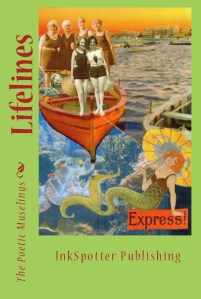
 I’m happy to announce that the cover for “Lifelines” by Lin Neiswender won third place in book/ebook cover art in the Preditors & Editors™ Readers’ Poll.

Also the Poetic Muselings placed third in poets in the same poll.

Our anthology, “Lifelines”, placed tenth in anthologies in the Preditors & Editors™ Readers’ Poll.

 Thank you, everyone who voted!

Critters / Critique.org  hosts the annual Preditors & Editors™ Readers’ Poll which honors print & electronic publications published during 2011.

Enhanced by Zemanta

A New Way of Looking: Ekphrasis

I learned a new word  recently, courtesy of a friend and Wiki:

Ekphrasis or ecphrasis is the graphic, often dramatic, description of a visual work of art. In ancient times it referred to a description of any thing, person, or experience. The word comes from the Greek ek and phrasis, ‘out’ and ‘speak’ respectively, verb ekphrazein, to proclaim or call an inanimate object by name.

Nowadays it might be a snapshot of a scene, a work of art, or any creation that puts you in the head of the participants or an object and tell’s you what is actually happening within it.

So I thought, why not pick one of my collages as a prompt and write about it?

The one I chose is called “La Fleur” and here it is:

La Fleur

©2008 Lin Neiswender

Here is my poem about the collage:

The Photograph

Rose Pink my Papa calls me, his little blossom
I smile inside but not for the photograph
The buttons on my shoes are too tight and pinch my toes

My little dogs are lucky, they can run free with bare paws
On the fresh green grass, and rush into the house
When they are tired, heads out the window
Listening to the bird sing

But even they are dressed too fine for comfort
Tight bows of Mama’s fine silk ribbon tied
Around their necks, choking them as does
My lace collar choke me

Still a little girl’s first love
Is her Papa, and so I endure
The scratching of the lace,
The tightness of the shoes

All so Papa can take his photograph
Of his La Fleur Rose

©2012 Lin Neiswender


Poetic Inspiration: Other People’s Poems

75px-Dragon_(PSF)

I love reading poetry. Not only does reading poetry expands my poetic horizons, butI constantly find inspiration in other’s work. Sometimes the subject touches a chord, sometimes I want to try out a particular poetic device, and sometimes — well — it awakens my playful side.

A couple of weeks ago, Robert Lee Brewer posted a “magic” prompt on his blog,
http://www.writersdigest.com/editor-blogs/poetic-asides
and Mark Windham wrote a rip-roaring yarn involving a dragon and a brave hero.

I read Mark’s poem. After bopping myself over the head for having overlooked such a delightful subject, I wrote a poem of my own.

Here they are: first Mark’s poem and then my own.

Mark’s Poem

 (so far untitled)

Damn, but dragon hide is sturdy stuff,
My lance broken, horse dead or run off.
My shield was busted by a swipe of tail,
Helmet went flying and left arm broken.
Our foolishly brave troop is down to me plus three.
All hiding and rethinking our chivalrous vows.
Two have died from swipes of massive claws,
Three roasted in fiery breath, one ingested I fear.
Sitting here with my back against this boulder,
Wondering how in the hell to get out of this mess,
Pledging that the monastery will be my destination;
Damsels can stay in distress, the dragon keep his gold.
What’s this? A newcomer to our futility. Oh Joy!
Much help, I am sure, this old man trudging up the hill;
Stooped against the slope, leaning mightily on his staff,
Clothed in oversized robes and wide brimmed hat.
Halfway up the hill, just below my hiding place,
He is greeted by the dragon’s challenging roar.
Stopping, as if mildly distracted by a butterfly,
He looks from under his hat and strokes his beard.
I hear the now familiar mighty beating of dragon wings,
The old man seems unperturbed, as if studying the event.
Another roar accompanies feeling the heat of belched fire;
Much like seeing the executioners axe, I cannot look away.
Suddenly straightening with unexpected speed and strength,
He thrust his staff forward as the fire engulfs him….
What?! I saw it but do not believe! The dragon’s fire parted,
Passed him by on sides and above; not a singed hair in his beard.
There is a new tone now to the dragon’s cry; rage maybe? Fear?
The sorcerer takes a step forward, staff held high in right hand,
Steely eyed he begins raising the left as he starts chanting,
A white, glowing globe begins to form in his upheld hand.
Continuing his mumbling as he slowly takes two more steps,
Coming even with my spot as the globe grows and swirls.
Beating wings are deafening now as he thrust left hand forward,
Launching his magic at his monstrous, unsuspecting foe.
A brilliant, blinding explosion of light and a piecing scream….
I awake to his gentle hand on my arm; ‘Is it over? Is it dead?’
He smiles and shakes his head. ‘No, one does not kill a dragon.
You just have to convince it that it is time for it to move on.’
He stands and takes up his staff, a helpless old man once more,
And makes his way down the hill, carefully avoiding the rocks.
My remaining companions gather round and watch him go,
All somewhat surprised that he left us the damsel and the gold.


And here’s my response. I decided to make it as unlike Mark’s poem as I could manage.


A Tale of a Poor Knight and an Old Horse

by Margaret Fieland

A man rode out one two-moon night
to win a magic sword.
He rode a horse consumed by blight.
Twas all he could afford.

His clothing, all was soiled and worn
and filled with many holes.
The folks he passed heaped him with scorn
and pelted him with rolls.

His horse was soon quite out of breath
It stopped beneath a tree.
It said, “I feel quite near to death.
Please, master, set me free.”

The man then heaved humongous sighs
and shook a shaggy head.
He felt a measure of surprise
to see his horse had fled.

“Alas,” he said, “it’s much too late
for me to set you free.
I’m much too tired, at any rate,
to dig beneath this tree.”

And so our knight meandered home,
and still without a sword
“because”, he said, “it’s hard to roam
with what I can afford.”

Oh, yes, and a note on the importance of feedback. The initial version of this poem, the one on Robert Brewer’s blog, had the horse “fall dead” at the end of stanza three, but my fellow muselings felt sorry for the horse, and I agreed. Hence now we can all picture him enjoying the grass in some sunny pasture far from poverty stricken knights.

Do check out Mark’s blog:
Mark Windham
http://awakenedwords.wordpress.com/

and let us know what you think of the poems, and if you’re inspired to write one of your own.

Enhanced by Zemanta