sharing a poetic LIFELINE with the world

Posts tagged ‘margaret fieland’

Boston Marathon

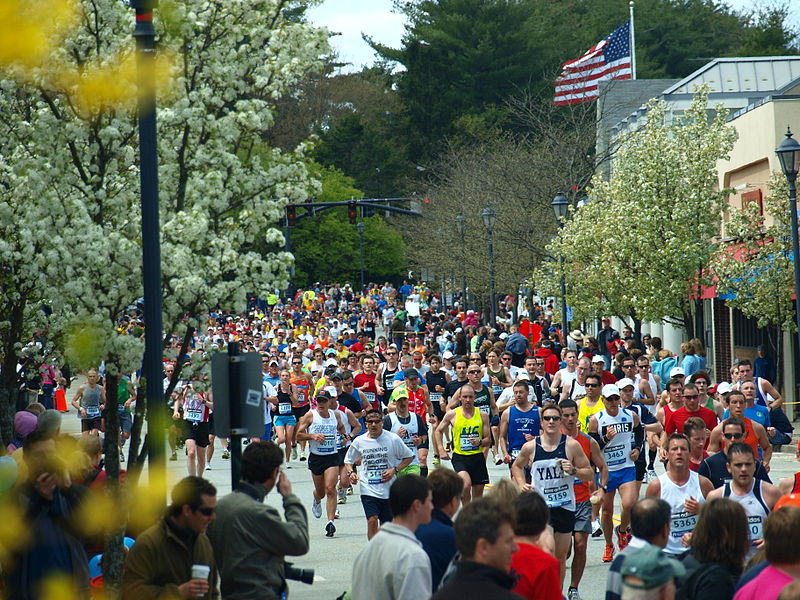
The Boston Marathon turned tragic this past Monday when two bombs went off near the finish line of the race. Two of our kids were downtown when it happened. Both are, thank God, safe, but others were not so lucky. Our hearts go out to all.

Boston Marathon

Boston_Marathon_2010_in_Wellesley

Participants in the 2010 Boston Marathon in Wellesley, just after the halfway mark (Photo credit: Wikipedia)

Blank page accuses me

but I’m wordless,
my mind stuck in the moment
I heard the explosion,

the second glass shattered,

viewing stands collapsed,
runners crashed to the street
from the bomb’s blast

A pressure cooker,
a timer,
nails and such

from the hardware store

Anyone could buy
at the Ace on the corner

put together in the garage.
No one would suspect a thing.

We have the method,
but not the motive:
neither who nor why,
and it leaves us wrecked.

We toss and turn,
wake at 2 AM,
imagined footsteps
clomp by our door.

Only a dream,

a stand-in for the worry
we are vulnerable,
fragile,

and anyone
with a few dollars,
a little know-how,
a stain on their soul,

could, in a moment,
change our lives forever.


Looking back on November: Poem a day

Again this year I participated in Robert Lee Brewer’s November Poem A Day challenge. The poems are supposed to form a chapbook, but I wasn’t aiming for that. I simply wanted to write poetry.

My muse has been in an un-serious mood most of the month. I’ve done a lot of rhyming and a lot of, well …

Here are a couple of poems:

Poetic Formless

Dust like stars. Any storm in a port. The eye of my apple. Dust the bite.  Blind a turned eye. Fuse a blow. Worm an open can. A death worse than fate. Ice the break. Knot the tie. A society of pillars.

Moons with rock piles made of diamonds, worlds of water where huge ships sail, never reaching shore, jungles full of purple cows, green tigers, and yellow elephants, dragons, fairies two feet tall, ten-foot-tall giants, magic wands, movies that turn themselves on with a blink of an eye.

My car sprouts helicopter wings. I look down on the cars lined up on route 95 as it winds through downtown Providence, and I open my mouth and sing, loudly, beautifully on pitch, remembering all the words.

The Truth about Truth

I desire a Truth
in my Christmas stocking.
Instead, in my head,
I hear a voice mocking.

“Truth’s much too fat
to be hung from a ledge
above a hot fire.”
Alas, though I pledge

she’ll never get burned,
she just shakes her large head.
Perhaps I will dream her
tonight in my bed.

She’ll plop on my blanket,
speak low in my ear.
I hope I’ll be able
to shut up and hear.

When He’s Gone

Alas, my laptop, Joe, is dead.
He tripped and fell right on his head.
The light went off. I almost cried,
the night my laptop, Joseph, died.

I had another laptop, Lou.
Unfortunately, he’s finished, too.
I spilled some coffee on his head,
and now my laptop, Lou, is dead.

Alas, I fear I’ll be offline
until November 12 at nine
AM when I return to work,
and leap onto my desktop, Kirk.

So for a time, I bid adieu
while I consider what to do:
to buy another or repair
or find someone who has a spare.


Check out the first chapter of my new novel plus Sand in the Desert free on August 27-28

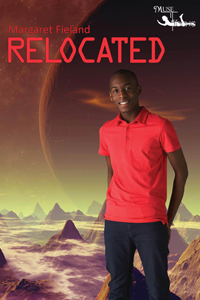
relocated-200x300sand_in_the_desert_cover_for_kindle


On Monday, August 20th,  the first chapter of my new novel, “Relocated,” was on D. Renee Bagby’s YA First Chapters blog.

Read it here:

http://ya.drb1stchp.com/2012/08/relocated-by-margaret-fieland.html

Sand in the Desert, the book of poetry that I wrote to go with “Relocated,” is free on Kindle on August  27th and 28th. Or borrow it free any time on KDP Select

http://tinyurl.com/SandPoetry

And do check out “Relocated,” available on Amazon and on the publisher’s website, http://tinyurl.com/MuseRelocated

Here’s a link to “Relocated” on the publisher’s webste:

http://tinyurl.com/Relocated


More on Limericks

Cover of "The Limerick"

Cover of The Limeric

I love rhyme. I love limericks, and I’ve written quite a few. Here, since I now have the perfect excuse,
are a few new ones.

Here’s one:

There once was a young lad from Kyoto
one evening while viewing a photo
saw a face so grotesque
it resembled a desk
and was sure he had seen Quasimodo.

and another:

One evening while cooking some rice,
a lass went to look for some ice.
When she failed to return,
the rice started to burn.
The poor lass had to cook her rice twice.

A note on meter in limerick:

The feet (metrical feet, not the things at the ends of your legs) for a limerick is typically an anapest
dum, dum, DUM or an amphibrach
dum DUM dum
with the first, third, and fifth lines consisting of three feet of three syllables each, and the third and fourth consisting of two metrical feet.

Edward Lear popularized the limerick,  but in contrast to modern limericks, they contain neither humor nor  a punch line, and the first and last lines were often the same.

http://en.wikipedia.org/wiki/Edward_Lear

Although Mr. Lear wrote some limericks
I’m thinking they really are gimmericks,
First and last lines the same
make them seem pretty lame.
and of humor there’s nary a glimmerick.

And here’s one about Massachusetts governor Deval Patrick:

Expressing intention to pass
on a third term, the governor of Mass
saw his influence ebb.
It’s all over the web.
Is he planning to seek greener grass?

Margaret’s Senryu

My Senryu, and fun with GIMP.

I’ve been having a blast lately playing with the color manipulation functions with GIMP, though I have yet to read the book I bought that goes through all the features. Consequently, I have a nice directory full of road photos, a great many of which I’ve played with using GIMP.

Last night Michele emailed me and asked me if I could take today’s blog post and create a Senryu. So I grabbed an image from my Pictures directory and wrote about it.


Night Road, photo by me, digital manipulation courtesy of GIMP

Night Road, photo by me, digital manipulation courtesy of GIMP

Night Road
Psychedelic sky
Dream made visible


Sand in the Desert: Putting Together a Poetry Collection

I am a way-back science fiction fan, but until November,  2010, I had never

written a science fiction story. The

The cover for my forthcoming poetry collection

truth is I had a phobia about it, mainly about the world-building, which in the abstract intimidated me.

Around September or October of 2010 I decided I would simply go for it and write a science fiction novel for NaNo.  I started with the world-building: the planet, the aliens, the Terran Federation, the aliens’ society, values, arts, politics (or lack thereof). I’d been mulling over several things for years: a society based on personal responsibility, and one where the “normal” relationships contained multiple partners and included same-sex relationships.  I continued happily outlining the society and the people. I noted down about a page about the plot, including the main character, his father, and a couple of others.  I decided to write a YA/MG sci fi novel.

For various reasons which I will not fully divulge, in case any of y’all decide to read the book, I needed my aliens to be distinctive but not outlandish. I needed them to have skin color that could be found here on earth, yet still be distinctive, so for this and a number of other reasons, one of them being that I was damned sick of the good guys always being white, I made my aliens, my main character, and his father Black.

I also wanted to participate in Robert Lee Brewer’s Poetic Asides November Chapbook challenge, so I conceived of a poet to tie the two together. One of my alien characters is a scholar, and my main character ends up studying the poems of my imaginary poet. Raketh Namar, the author of the poems, exists in the universe of the novel some five thousand years before the action of the book on planet Aleyne. Raketh Namar, the poet, was the author of one of the most sacred texts of my aliens, the Aleynis. I don’t usually write prayers or write about spiritual subjects, yet I found myself writing them without difficulty. Raketh Frey, the main character in the novel, studies these poems during the course of the action. Eight of the poems, noted in the acknowledgments, appear in the book.

In the universe of the novel, this collection of poems was translated into English Common Speech by two of the other characters in the novel, Ardaval Namar and Gavin Frey, the father of my main character, Raketh Frey. Aleynis do not translate their sacred texts, and this translation is therefore unusual.

 Having written the poems, I wanted to put together the collection and publish it, but having dilly-dallied for some time, I decided to self-publish. At the present time, I have a cover, designed by Karen Cioffi, and Michele Graf has edited the collection, including some valuable suggestions about the order of the poems.

All I have left to do is to hop over to CreateSpace and  put the whole thing into their system, and after that I have to decide on a price.

Here is one of the poems, one that does not appear in the book:

Ode to My Father

When I was very small child
he was as tall
as the stars.

When I was boy-high
he had shrunk
to the height of a large tree

When I became a man,
he shrank to the size
of a fist.

When I became a father,
he rose again.
His head touched the sky.

Now he is gone.
I take my small son
and point heavenward.

“There is your grandfather”

Report from the Mass Poetry Festival


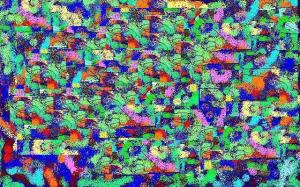
Swirls Four
Medium: Mouse on mousepad
Artist: Margaret Fieland

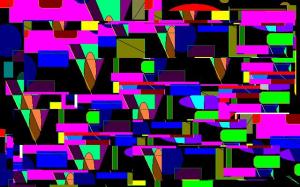
Painted Rectangles
Medium: Mouse on Mousepad
Artist: Margaret Fieland

This past weekend I attended the Mass Poetry Festival, which took place this past Friday, Saturday, and Sunday. I skipped Friday, but I did  attend both Saturday and Sunday.

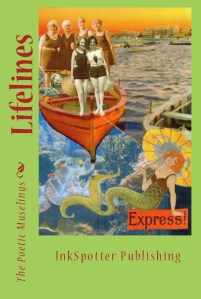
Back when the event was in the planning stages, I got an email about a reading of poetry from their books by Massachusetts authors who had published a book of poetry in 2011. I hesitated — “Lifelines” was written by six of us, and I was “sure” they’re reject me — but sent in my information anyway.

They said yes, illustrating yet again my father’s maxim, “nothing ventured, nothing gained.”  I hope I remember this: not to assume I will be rejected simply because something is a reach or is out of my comfort zone.

I was part of the Sequential Poetry Reading for poets with new books of poetry that appeared in 2011.  The reading started at Noon on Saturday and lasted until 2:40. We were told that we each would have eight minutes to read, but we had a couple of no-shows, so we each had ten minutes.

The reading went well. The audience included us poets and about an equal number of what I expect were friends or family. It was a real treat to be be able to listen to the poets reading from their own work. A good many (most) of them simply read from a copy of their book. I might have done the same except for Michele’s excellent advice to print out what I wanted to read in LARGE, DARK type, and to practice. I did both, and I was very glad I did. Michele also suggested alternating dark and light poems.  I doubt that, left to my own devices, I’d have thought of this either.

There  were a long list of workshops taking place all three days of the festival, and we were encouraged to sign up in advance. I did sign up for several things, but as it turned out, simply walking into the workshop was generally good enough. I suspect the pre-sign-up thing was to figure out expected attendance at the workshop in order to facilitate room assignments, number of handouts, and the like. Next year, I will attempt to sign up for what interests me, but I won’t be a slave to the schedule.

The workshops themselves were tremendous fun. I arrived Saturday morning, signed in, got a copy of the workshops and a map, and by that time it was a bit too late for me to get to much in the way of workshops, so I ended up going to a couple of the art activity things that had been set up with kids in mind.

I *love* art activities — my mother was an artist who specialized in portraits. I was hugely energized by the art projects, and ended up spending several hours Saturday evening after I returned home playing with MS paint. I didn’t get much sleep Saturday night — MS paint is hugely addicting, and I was pretty pumped up from the festival — so I considered skipping Sunday. In the end, I decided that I would just main line coffee and go for it.

Good decision. The first workshop I attended was given by someone I know. He’s a kick-ass teacher, and I had signed up for the workshop. Not only was the workshop very good, but the attendees, as is often the case with Tom’s workshops, were equally interesting. Several of us exchanged email addresses, and I hope we will keep in touch.

There was also a  lit mag and small press event, and I bought several journals and a book of poetry, collected flyers from some of the lit magazines. I’m reluctant to order off the internet for magazines I’ve never had a chance to look over in person, so I was delighted to have the opportunity to pick up some of the ones I was interested in. The poetry book is a book with poetry in French on one side and a translation by Marilyn Hacker on the other. I find reading modern poetry in French a challenge, so I welcome the opportunity to, first, cover up Marilyn’s translation and simply read the poems in French, and eventually, to read her translation as well.

I didn’t stay for the Saturday night headliners — they started at 7:30 — but the Sunday headliners started at 2:15, so I did go to that. The readers were Frank Bidart, Martha Collins, and Stephen Dunn. Stephen Dunn is one of my favorite poets. I  knew two of the poems he read.

What engages me as a reader and writer of poetry is conciseness and precision in language, the sound of the words themselves, their cadence. Freshness of imagery. A sense of humor. A poem that forces me to take another look at the familiar, evocation of emotion.

Here is one of the poems he read — one of the two I recognized:
What Goes On
by Stephen Dunn

After the affair and the moving out,
after the destructive revivifying passion,
we watched her life quiet

into a new one, her lover more and more
on its periphery. She spent many nights
alone, happy for the narcosis

of the television. When she got cancer
she kept it to herself until she couldn’t
keep it from anyone. The chemo debilitated
and saved her, and one day

her husband asked her to come back —
his wife, who after all had only fallen
in love as anyone might
who hadn’t been in love in a while —

and he held her, so different now,
so thin, her hair just partially
grown back. He held her like a new woman

and what she felt
felt almost as good as love had,
and each of them called it love
because precision didn’t matter anymore.

And we who’d been part of it,
often rejoicing with one
and consoling the other,

we who had seen her truly alive
 

Enhanced by Zemanta

Poetic Forms: Sestina

Arnaut Daniel.

Image via Wikipedia

The sestina is a poetic form attributed to twelfth century French troubadour Arnaut Daniel. It consists of six six-line stanzas and a three line envoy. The six end words of the first stanza cycle in a pattern thusly:

ABCDEF/FAEBDC/CFDABE/ECBFAD/DEACBF/BDFECA

and an envoy whose form varies somewhat, but which uses all six end words:

BE/DC/FA

or

FA/DC/BE

How to choose your end words

There are doubtless many ways to choose ones end words One is to write the first stanza and then lay out the pattern for the rest. The other, the one I use, is to pick six words, generate the skeleton, and start writing. I try to choose words with more than one meaning and that can be used as more than one part of speech.

Here is a link to a sestina generator: Feed it your six words and it spits out a skeleton with the six stanzas and envoy:
dilute.net/sestinas

Here is a link to sestina by Ezra Pound:

//www.poets.org/viewmedia.php/prmMID/15423

Here are the first two stanzas;

I

Damn it all! all this our South stinks peace.
You whoreson dog, Papiols, come! Let’s to music!
I have no life save when the swords clash.
But ah! when I see the standards gold, vair, purple, opposing
And the broad fields beneath them turn crimson,
Then howl I my heart nigh mad with rejoicing.

II

In hot summer have I great rejoicing
When the tempests kill the earth’s foul peace,
And the lightnings from black heav’n flash crimson,
And the fierce thunders roar me their music
And the winds shriek through the clouds mad, opposing,
And through all the riven skies God’s swords clash.

Here is one of mine:

Polemic

Workers, you are choked by the collar
of convention. Will you spare
yourselves? Will you ever tire
of the endless round of days, brave
the waters of controversy and refuse to play it safe?
Will you strike a blow

for self expression? Will you blow
down the artificial walls your white collar
has erected around you? Will you leave the safe
space you create in the spare
confines of your tiny cubicle? As you brave
each new day, do you ever tire

of the endless wheel of useless make work? The tire
of useless flesh grows round your middle. You puff and blow
climbing a single flight of stairs. How brave
are you? As you lounge, idle, the shirt collar
around your neck grows ever tighter, until there is no spare
room, and you choke. When will it be safe

to throw your old shirt away? What will jolt you from your safe
little life? What would be enough to make you tire
of the endless round of dailyness? Spare
yourself and live, not merely exist. Blow
the clouds from your eyes. White collar
workers, unite. Take a chance. Be brave.

Allow yourselves to brave
unknown waters, to give up your safe
small space, to throw away your collar
and try the new. Rise from your chairs. Retire
from the rat race. Overturn your desk. Blow
your boss’s mind and run from your office. Spare

yourselves. You have no spare
life. You have one chance to be brave.
You will never get another chance to blow
away the small, safe
walls around you before you tire
and are choked by your white collar.

You cannot spare yourself and stay safe.
Let yourself be brave. Throw away the tire
of convention. Strike a blow for life. Throw out your white collar.

Margaret Fieland


Enhanced by Zemanta

On Writing Poetry

Poetry is about truth, and writing truly exposes me, even if I am not the subject of the poem. If I pull my punches, soften my truth, or omit some detail that I feel exposes me, I stab my poem in the gut. I have to write truth, though not necessarily for publication.

The poem that propelled me, indirectly, into serious poetry writing is a case in point. I was in a meeting, listening to someone talk about his drinking, and inspiration struck. I hauled out my handy pad and pen, and, ignoring the nudges of my companion, (She: “What are you doing?” Me: “Taking notes.”), jotted down what would become one of my first published poems. But it was about a sensitive subject, and I hesitated to submit it for publication. Would people assume the narrator of the poem was me? Maybe not, but at the very least, the poem would clearly indicate that the subject was one that mattered to me. Was I willing to risk that? Ultimately I decided I was.

Some time after that,  I wrote a poem about a batch of chicken soup (I was annoyed, and I find writing poetry can be wonderfully therapeutic) and hesitated before writing, “I wanted to hit her with the soup pot.” Yes, the line ended up in the poem. Best of all, by the time I’d finished writing it, the impulse itself had passed.

Here’s the poem. It was published in the June, 2006 Humdinger (www.humdingerzine.com):

Bitter

I don’t want to hear how unhappy you are
because I didn’t buy any Roast Beef at the deli
or because I made Chili from Dave’s recipe
with the six tablespoons of Chili powder

and Minestrone
with the rind from the Parmesan cheese in the broth
just like Marcella does.

It was enough to make me want to hit you
with the soup pot.

And if you’re ever happy with my cooking,
then please tell me.

But I’m not holding my breath.