sharing a poetic LIFELINE with the world

A Young Mary

Mary, two years old

I don’t consider myself very girly. I fancy comfort over style, don’t wear make-up, and for much of my life avoided the color pink. When I was a little girl, I LOVED the color. That soft, carnation pink reminiscent of pebbles and cherry blossoms. Last year I let both the little girl and the color back into my life.

Pink won’t make me a spoiled princess. It can be fun and flirty. It’s not about wearing the color, but embracing the essence.

I love to rock out the vocals in the Rock Band video game series, so honored that expression by naming my in-game band Pink Ink.

Pink ink is also a reference to my writing. I often type up rough drafts in pink text. On a mental level, it keeps me in a more playful, creative mood. On a physical level, it’s harder to read the text so I can focus more on new words than the quality of what’s already written.

Once I decided that being associated with pink wouldn’t label me or put me in a box, it freed me to use it as inspiration, a tool of my own expression. I have an entire page in my bliss book dedicated to pink. A reminder to own pink, what the color means to me, and some fun pink stickers like a pig and a butterfly. Here’s a poem I wrote as I delved into the heart (and letters) of pink.

palace for my soul–
where I am pampered,
feel pretty;
a safe place to play,
my power and passion
come through.

Ink flows from inspiration,
introspection brings illumination,
revealing my true identity,

leaving me nude–
a natural nymph,
wild and new
as I live in the Now.

Knowledge gained
is the key to self,
to the fragile case
protecting my keepsakes.
Unlock the door.
Kiss fate
create Karma.

Do you have a color that inspires you? Or a color that you avoid?

Don’t forget to enter our contest to win a copy of Lifelines.

Next time on Mary’s Expression: A fun exercise to create unique imagery.

Friday, 12/9:  We’ve got a great start here, and thank you to those who said they’re working on their posts now! Please jump in! 

Hello, Poets and lovers of poetry (and the rest of you out there)!

From Dec. 7 – 14, 2011 we’re having a crazy contest. To win, you must provide us with the most awesome answer to a few questions:

Who is your favorite poet?

What is your favorite poem?

Why?

Now, a cool thing about this contest is that your favorite poem may be a stand-alone you discovered — not necessarily by your favorite poet. And the answer to the question “Why?” is the critical piece. Why did you choose this poet? Why this particular poem? What is it that resonates with you, or just won’t let go?

UPDATE:  Try to keep your responses to a few paragraphs. That said, if you have strong feelings and more words to say, consider whether you’d like to do a guest post on our blog to expand and  share your thoughts.

We anticipate serious arm-wrestling and shouting by the end, as we select the ONE set of responses we feel best captures the essence of why we write, what moves us, creates unforgettable imagery . . . and we’d like your help to drive us nuts in this process. The winner will receive a copy of Lifelines, mailed to your house.

And, if you have a blog or website and would be interested in connecting to us or spreading the word, please let us know. We’re starting a blogroll.

So — thank you for reading this, and we hope you will have some fun and enter our contest.

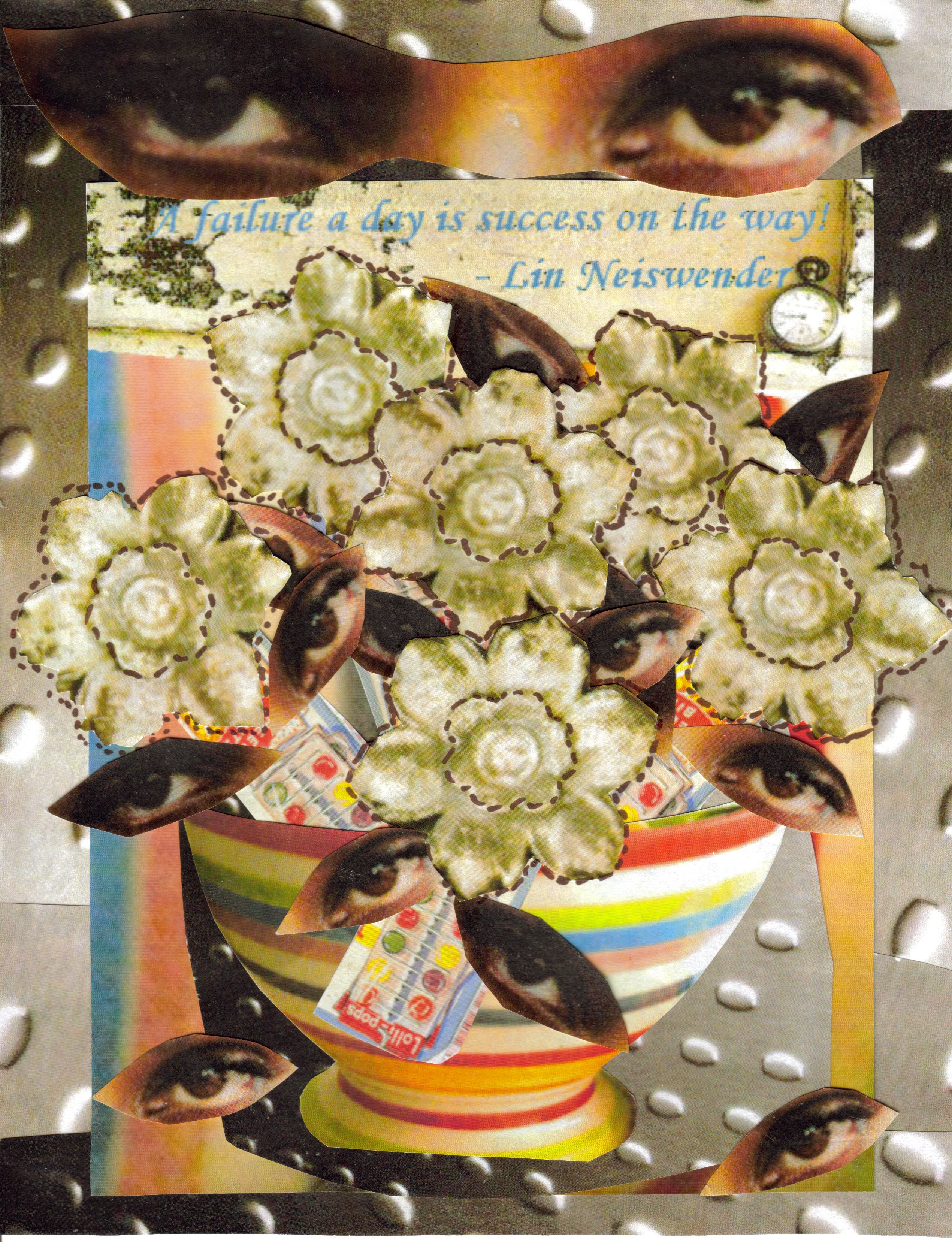
Success is Certain collage

Success is Certain ©2008 Lin Neiswender

My writing and my art are so entwined that it is hard sometimes to separate them. As with writing, I’ve been collaging since I was a child. Collage is an old art form, revived in the 20th century as modern art, consisting of portions of other works of art, text, purchased or handmade papers, embellishments or found objects glued to a background to make a new work of art.

I think of the process of creating a collage, or a poem, or any form of writing as largely intuitive and subconscious. It is in the reworking of the raw material that the new form is created.

For example, when I collage I may have a general idea of what I want to create, so I go through my boxes of clippings and images, pulling out anything that supports the idea and seems somehow to go together, or just strikes my fancy at the time. I select my surface and get my materials together- scissors, glue, anything I want to add to the work like ribbons or coins or what have you.

Then I start cutting out the images or text I like, seeing how they might go together. This influences the background I create, as there may be colors or a pattern I am especially drawn to in connection with the images.

I make the background, then select and place the items I have selected, switching them around, cutting some to combine two images into a cohesive unit. When I am satisfied, I start gluing them down. Sometimes I have to partially lift one image to place another behind it to add depth; sometimes I remove an image that just isn’t working.

The process is much like editing a piece of writing, cutting and rewriting and rearranging until it works.

I’m especially drawn to an intuitive process called Soul Collage, where 5 x 8 cards are created on mat board. It’s done entirely intuitively, usually without even a starting idea, just pulling what images appeal to me. This form of collage does not use text at all, leaving the interpretation of the card up to the viewer. The card’s creator asks and answers a series of questions about the card and it can provide some amazing insights into one’s psyche.

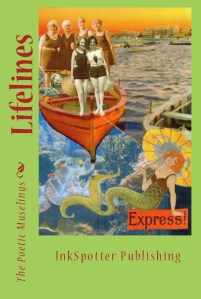
To me, that is a collage’s magic, the personal interpretation. When I made the collage that appears on the cover of the Lifelines book- long before the book was ever thought of- I was looking into the ocean of ideas for inspiration in many areas of my life, seeking the mermaid for answers. “Express!” is the only word in the collage, and that, I think, is the essence of the creative experience: express yourself, reveal yourself, and find your truth.


Enhanced by Zemanta

“Lounging” by Anne Westlund

I’m happy to share the publication of my photos and poems in “Restoration Earth:  An Interdisciplinary Journal for the Study of Nature & Civilization”.  Alongside my work are other poems embedded within scholarly articles and the photos of Katie Batten MacDowell and my brother, Chris Westlund.  This highlights how intimately wed our perception of nature and ourselves is with our thoughts about the relationship of ourselves to nature. When you read this journal, don’t see the poems and photos as discrete artwork, but as a complement to the scholarly sections, perhaps as a resting point on your journey through Restoration Earth. The sum is really greater than the individual components.

These poems reflect my spirituality along with my observations of the natural world.  Except for “My Town” these poems emerged from the class, Ecology and the Sacred, that I’m taking at Ocean Seminary College.  The photos are shots of deer and a seal, a child and her rabbit, and a drawing in the sand on the beach.  To me, they all represent impermanence, a moment in time that my eye and camera caught:  a deer resting, a seal waiting for it’s mother to come back, a young girl with her pet bunny, and a drawing of a geoglyph on the beach, soon to be washed away by the tide.  I’m thrilled to contribute to the Restoration Earth Journal and to be a part of this publication.

This journal was released in November and is available as a free download, see below.  It’s not every day that my work is featured alongside such illustrious scholars.  This journal is put out by Ocean Seminary College and edited by Katherine Batten (MacDowell), D.Th and Mark Schroll, PhD.

Here is a description of the authors and writings included in the first issue of the Restoration Earth journal:

“Our debut issue has several contributions from students as well as several leading thinkers in the field of environmental studies and ecology and philosophy, including a previously unpublished essay by Arne Naess–the founder of the deep ecology movement and ecophilosophy; Alan Drengson a world-renowned professor and writer on deep ecology, environmental studies, and ecophilosopy; Michael Caley a well-known evolutionary biologist who has been running the ecosophical journal The Trumpeter for a number of years; and Florence R. Shepard a professor of biology and a widely published writer and the editor of all her late husband, Paul Shepard’s (whom many of you have read, one of his most famous works is Nature and Madness) work. Additionally, Mark Schroll is the leading expert on transpersonal ecosophy and for shamanic students he’s a very good brain to pick if you are working on your dissertation.

Our student contributions come from Mark Glasgow who has written a qualitative study on an interventional strategy associated with ecopsychology; Anne Westlund who has been generous and contributed her photography and poetic explorations of culture and the natural world; and Molly Remer who kindly reviewed a new text by writer Ellen LaConte for us.” ~Katherine Batten (MacDowell)

My poetry and photography can be found in the journal on these pages:

Cover:  “Uffington Horse,” photo.

Title Page:  “Uffington Horse,” process notes.

p.4:  “Seal Pup,” photo.

p.33:  “Attachment,” photo.

p.34:   “A Natural Setting,” poem, biography.

p.62:   “Tall Tale,” poem.

p.78:   “The Next Layer,” poem.

p.96:   “Lounging,” photo.

p.99:   “Unbroken,” poem.

p.102:  “My Town,” poem.

p.103:   “Resting,” photo.

If you haven’t read Issue 1, Vol 1 of “Restoration Earth: An Interdisciplinary Journal for the Study of Nature & Civilization” be sure to grab your copy at http://www.oceanseminarycollege.org/RestorationEarth_1_1_2011.pdf

Restoration Earth is available as a hard copy here: http://www.lulu.com/product/paperback/restoration-earth-1%281%29-2011/18719482

What makes a poem

When I was a child, my definition of a poem was something that resembled “The Highwayman,” rhyming lines formed into stanzas, with evocative imagery, and that told a story. As I grew older, and discovered poets like Sandburg and Amy Lowell, I realized poems didn’t need to rhyme, and, as my poetic horizons expanded to include Whitman and Elliot, I realized that they didn’t have to tell a story. My definition of a poem became lines and stanzas with evocative imagery. Then I encountered prose poetry.

Now I’m not a big fan of prose poetry. For me, I need lines and stanzas to feel that it’s a poem, but modern poetry doesn’t agree with me.

So what makes a poem, beyond the let me read it, and I’ll let you know if it’s a poem? The use of language to move beyond literal meaning, to evoke a mood, a sensory image, by the way that language is used is the basis for poetry.

If you studied poetry in school, you may have studied poetic devices: rhyme, meter, alliteration, assonance, consonance, metaphor, simile, to name a few.

Rhyme is probably the most familiar: cat, hat, sat, bat, rat, with meter, the rhythm that the words form when read aloud, a close second.  Alliteration, where words begin with the same consonant sound, assonance, where words have the same vowel sound, as in black cat, and consonance, where words have the same internal or ending consonant sounds as in near cure.

Here’s a poem of mine, in the tradition of Walter De La Mare’s The Listeners: It appered in the June, 2010 issue of ezine Dark Eye Glances. Notice how the first and last stanzas are   nearly  identical —
At Midnight

Three to ride the shadowed road,
two to catch them as they slowed,
one to flee and try to warn,
none to live to see the morn.

Three rode out one moonless night
beneath the shafts of silver light
of stars above in a cloudless sky
and none of them demanded why.

Not one of them asked why they rode,
why they left their snug abode
to ride the woods that dark, dark night
beneath the shafts of silver light.

When midnight chimed they stopped and stared.
Two strangers stood with broadswords bared.
Two brothers dead without a fight,
one brother left, one to take flight.

One brother turns and flees in fright,
rides and dies that dark, dark night,
killed by strangers with broadswords bared.
Three brothers caught all unprepared.

Three to ride the shadowed road,
two to catch them as they rode,
one to flee and try to warn,
none to live to see the morn.

I first learned about a bliss book from Sylvia van Bruggen during a workshop at the Muse Online Writers Conference.

What is bliss? Complete happiness, undisturbed by gain or loss.

What is a Bliss Book? In simplicity: a book that makes you happy.

Whenever I feel my writing sucks, or am generally depressed, I can open my bliss book and bring on a smile. I have words of encouragement about my writing, quotes, lists of favorite things, and I’m always on the lookout for pictures to clip from magazines.

The most important rule is no negativity allowed.

Creating Your Own Bliss Book

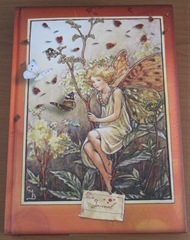
  1. Make or buy a pretty journal or notebook. I use a lovely illustrated fairy journal.
  2. Write up a purpose page. What do you want from this book? Here’s what I wrote in mine: Fears have no power here. My bliss book is my quiet place. A way to center myself and find my muse. Smile. Play Be Free. Free my muse; free my writing; free me from doubt and fear; free me from burdens that I may fly.
  3. Add something regularly. Anything that makes you happy. Ideas: lists, pictures, doodles, quotes, stickers, poems, mantras
  4. Open your book! When you’re in a slump, or forget your motivations for doing what you love (whether that be writing, or parenting, or running). Read it front to back, or open to a random page. Let it inspire you once more.

You can expand this idea of bliss into other forms. A bliss box, a bliss room. Anything or anywhere filled with things that inspire and lift you up.

In honor of the recently celebrated Thanksgiving here in the U.S.A., I’m starting a new page in my bliss book. A Gratitude Page. Anytime I lose sight of the good things in life, sucked down in negativity, I can search for something to add to this page. There is ALWAYS something to be grateful for, even in our darkest hours.

Next time on Mary’s Expression: The Poetry of Pink.

what the wind destroyed
the town cleared to rebuild as
Mother Nature smiled 

Six months ago, “the tornado,” as it’s referred to by residents, hit Joplin, MO. My cousin and her extended family were there.

One of her sons and his family were in Wal-Mart when the roof blew away; they were saved by overturned shelving, and dug out with scrapes and bruises.

Her brother-in-law and his three kids couldn’t get to a storm shelter, and sought refuge in a convenience store when the windows blew out. All fifteen people got into the cooler, which was then crushed down to a height of three feet. Layered like sardines, they got out alive.

Her grandson, his mother and step-father were home when it hit. They put a football helmet on the boy, put him in the bathtub, Mom next, hugging him, then step-dad threw a mattress over her and climbed on top. The mattress and dad were sucked out when the house blew away. He survived with a badly mangled arm that required emergency surgery. Grandson’s helmet was shattered when the wooden toilet seat ripped off and hit him in the head. Mom was injured, but all survived.

St. John’s hospital, where my cousin worked for over thirty years, was blown off its foundation. And this is just the top layer of what happened to one person’s family. My cousin had thirty-plus people staying in her storm cellar that week.

The horror and chaos of the time brought out the very best in open hearts, minds, and wallets from around the world. The next day, people  brought out grills and fixed food — whatever was available, for whoever needed it. Veterinarians provided free boarding for pets. Churches, as expected, set up shelters, babysitting, and food. Trucks began arriving from all over the country, and kept coming for weeks. People dug in and began doing what they could wherever it was needed.

Fast forward to this week, the six month anniversary.

Extreme Makeover Home Edition built 6 homes in town — one going to my cousin’s grandson and his family. The show will air in January 2012.

Habitat for Humanity built 10 homes; families got the keys to them last week.  Businesses are coming back, slowly, but surely.

The city council last week approved plans for a brand new state-of-the-art replacement hospital. Ground breaking is Jan., 2012 with completion planned for Jan., 2014.

Throughout all of this my extended family displayed grace, courage, resilience, and an abiding faith in themselves, their religion, their town, and their future. I’m awed by them, and my heart has been singing poetry ever since I got this update.

Perhaps this is a psalm of thanksgiving, crudely writ, but from the heart. There are too many hearts here, I know, but this story is about many, many hearts.

Where is the poetry in sorrow and destruction?
In the hurting heart, as always.
Where is the joy in the aftermath?
In that same heart, as healing grabs an edge.

How does it work, this healing?
With loving actions to repair the mosaic shards.
Will it ever be the same?
No, fractures form a stronger bond.
And then?
We give thanks, and promise to love even more.

How will I know?
Shhh. Your heart beats the answer.

Whale Song

If you love a good heart-warming story, you’ll enjoy this story about Sarah Richardson’s life. Eleven-year-old Sarah moves to Bamfield, Canada from Wyoming, when her dad gets a new job as a marine biologist. When she moves there, she encounters a harrowing life–she’s bullied, since she’s new and “white” in an Indian-dominant town, she has a crush on Adam, and she experiences her mom’s illness of PPH, all in part one.

In part two, her mom passed away, and her dad’s charged with her murder, when she doesn’t remember what happened that fateful day. When her dad goes to prison, she moves and lives with her Italian grandparents to Vancouver, and at eighteen, she lives alone and starts a new life.

In part three, she has an estranged relationship with her father between the visits and years go by, as she tries to remember what happened, when she’s an adult. In the end, she reunites with Goldie, her best friend, Adam her crush and new love, and her dad, when she remembers what happened and moves on. Also, it’s so informative on marine life and whales, that’s so touching and perfect for the story of forgiveness, love, loss and life. Bring your tissues!

Kristen

(posted by Michele for Kristen)

Fridge Magnets 2

Image by Pierre Nel via Flickr

We all know the adage, “Don’t sweat the small stuff”, right? Do you know it applies just as easily to writing and poetry as it does to the other important things in life?

For example, I hear people asking me “Where do you get your ideas from?” and the answer to that is “Everywhere!”

It might be in a snatch of conversation I overheard at the restaurant while we’re waiting in line. It might be in the three headlines from today’s paper that I linked together to form a writing prompt.  Perhaps that interesting documentary I watched on Discovery last night at 2 AM sparked some poem or plot ideas.  It might even be in a dramatically stormy day with lightning crashing all around me.

I mean, open your eyes and ears, folks, along with your other senses. A lingering fragrance on the breeze, the tang of Thai spices on your taste buds, the feel of your lover’s caress. Anything in your world, good or bad, can serve as inspiration.

So how do you go about capturing these things for later use?

There are things you probably have in your possession already that can do that. Your cell phone  can take a photo or record a voice memo or send an email to yourself, a thin notebook in your purse or back pocket to record ideas, and a notebook, pen and flashlight on your night stand to record those flashes of ideas that come when we are least prepared.  I keep a file of writing prompts from various sources on my computer.  I have a folder of photographs that serve the same purpose. There are many books of writing prompts, tools like Story Spinner, and writing games that can give you a heaping serving of inspiration. Let’s not forget the classic fridge word magnets either.

So don’t worry that you won’t have any ideas. All you have to do is just open your mind and it will be filled with amazing information, without even  breaking a sweat.


Make Visible

“Make visible what, without you, might perhaps never have been seen.”
~ Robert Bresson, French Film Director

This, to me is the essence of creativity, to bring forth what might have remained hidden. This gets me to write, to embroider, to do art and craft projects. There is a whole world of ideas, forms, visions and voices that have yet to be expressed. Even our poetry book, Lifelines has the word “Express!” on the cover. It’s up to us, the creative ones (and by that I include potentially everyone) to share what’s in our hearts and minds. It’s up to us to create and bring forth our truth and beauty.

By sharing what’s inside us we connect to the rest of the world. So many times I’ve heard, “I feel exactly the same way,” after a friend has read one of my poems. We are all unique and see the world differently. Go write, take pictures, craft, dance, sing, paint. Who are you to deny the world your vision?