sharing a poetic LIFELINE with the world

Garden of the Gods, Colorado. © Graf 2006

Maybe “deconstructing” is a better word for what follows.

I love a well-constructed, nuance-laden, tension-building poem — especially one with lines or phrases repeated, each time expanding on the underlying theme. When it works, it really works. When I dabble in a structured form, I need to take it apart and put it back together in a way that makes sense to me.

Over the years, I created my own versions of “cheat sheets” — today they are usually called “templates” — for a variety of poetic forms, when it was important to have a set number of syllables or sounds per line;  control the number of lines in each stanza, especially if the stanzas are not constructed the same — like the villanelle. I’ve used them with haikus, tankas, ghazels, alternating voice layout, and for song lyrics — especially useful to bridge beats, where you want to stretch out a sound.

My Villanelle template and construction process are simpler than it appears at first glance.  I:

1. Took as my guide the Dylan Thomas poem “Do Not Go Gentle Into That Good Night”, which Margaret used when she introduced the form.

2. Identified the rhyme pattern alongside each line, as Margaret explained. To make it easier, I highlighted the first line and each repetition that followed, then used a different color highlighter, and did the same for the third line. Since the only other rhyme was with line 2, I highlighted the last word in each of the “B/b” lines (below is a portion)

Do Not Go Gentle Into That Good Night
Dylan Thomas (1914-1953)


… and so on.

Then, I:

3. Counted the number of syllables per line (ten); the number stanzas and lines per stanza (five stanzas of three lines each (tercets), plus one stanza of four lines (a quatrain)); the total number of lines I needed, including a blank line between stanzas (24 lines total)

Next step was to write my first three lines, using the right number of syllables or sounds, and the right pattern, knowing that the first and third lines would be repeated several times in the poem:

   We claim our fears and ghosts by what we do,
   paths drag us into, not by accident,
   territory steep in our deep taboo.

This gave me the shape of the form. Time to do the template. I:

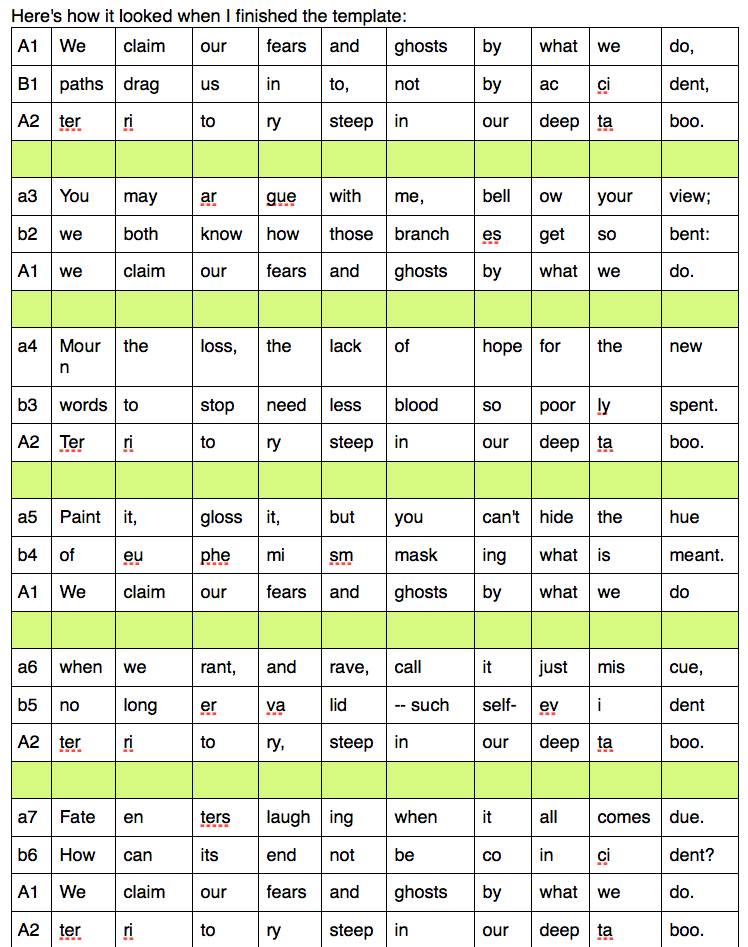
4. Created a table with eleven columns across (one for each of the ten syllables needed in each line, PLUS a first column with the rhyme pattern), and 24 rows (for each filled and blank line in the poem)

5. Shaded in the rows that were stanza breaks (rows 4, 8, 12, 16 and 20; I didn’t create a column to number the rows — just counted down)

6. Filled in each of the first three rows, one syllable per each cell across the table, in columns 2 – 11, with my first tercet.

7. went back to column one, and, with my trusty Thomas poem, wrote in what the rhyme pattern needed to be.

8. filled in on my template where lines one and three were repeated

9. really cheated on the next step! I wrote the sound I needed to repeat (in parentheses) in the last column of each line. Yes, I’ve creatively split words as I sounded them for the cells.

… (the complete template is at the end of this post)

10. then came up with a bunch of words that rhymed with each of the endings of the two lines.

A1 and A3:  do/ taboo (DO) — view, new, clue, avenue, cue, due
B1: accident (DENT) — amazement, evident, coincident, bent, went, event, dent, sent

Then the creative process really started:

11. I wrote the poem from the last stanza forward — I knew how it started; that was already written. I decided how I wanted it to end, and, using the list of “sound alike” words, figured how to end each of the lines in the quatrain.

12. Worked my way through the poem, looking at the rhyming words I’d come up with, and moved them around.

13. wrote lines, juggled them from tercet to tercet, until they made sense to me.

And, voila! Though this is still a work in progress, you can see how each step shaped this draft of the poem’s cadence, flow, rhythm, content, and context. Now the work begins, to hone it into a sharp, complete story. Like Mary’s poem, my subject is dark. I hope to capture the same sense as hers did.

Ever Thus
by Michele M. Graf

We claim our fears and ghosts by what we do;
paths drag us into, not by accident,
territory steep in our deep taboo.

You may argue with me, bellow your view;
we both know how those branches get so bent:
we claim our fear and ghosts by what we do.

Mourn the loss, the lack of hope for the new
words to stop needless blood so poorly spent.
Territory steep in our deep taboo.

Paint it, gloss it, but you can’t hide the hue
of euphemism masking what is meant.
We claim our fear and ghosts by what we do

when we rant, and rave, call it just miscue,
no longer valid — such self-evident
territory steep in our deep taboo.

Fate enters laughing when it all comes due.
Can how its end not be coincident?
We claim our fears and ghosts by what we do,
territory steep in our deep taboo.
I love the Villanelle. It’s very musical, with the rhyme and rhythm, and the repeating lines. When done right, it really rolls off the tongue when read aloud. My first two Villanelles are not in classic form with iambic pentameter. That added an additional challenge this time around. I also went a little darker than the previous Muselings… My mind has been on The Secret World, a modern day MMO of myths, legends, and conspiracies. So that is where I took my inspiration.

wendigo_C2

wendigo_C2 (Photo credit: doctorserone)

Dark Days 

She grips her sword, the battlefield looks stark,
almost too late to set the world aright;
Hold ground, dig deep, the days are getting dark.

A flock of ravens flies through the themepark,
abandoned structures gleaming in moonlight.
She grips her sword, the battlefield looks stark.

Filth clinging like a permanent birthmark,
wendigo crouches just within their sight–
hold ground, dig deep, the days are getting dark.

Her two companions circle like a shark–
once enemies, they now combine their might–
she grips her sword, the battlefield looks stark.

The monster takes first blood: claws tears a mark
through one man’s side, his face goes deathly white.
Hold ground, dig deep, the days are getting dark.

Wendigo falters at a shotgun’s bark
and blade moves in to finish off the fight.
She grips her sword, the battlefield looks stark;
Hold ground, dig deep, the days are getting dark.

mary-sig2 (1)

I wrote this Villanelle several years ago for a Valentine challenge on Poetbay.com.

The rhymes aren’t exactly right, but it does make a unique Valentine poem.


Valentine

Cupid’s arrows pierce my heart,
Despite love’s shifting sands
Never will we two part

Card stolen from Wal-Mart
More than eruptions from my glands
Cupid’s arrows pierce my heart

To get to you I took the BART *
IPOD plays my favorite bands,
Never will we two part

I feel the sting of his golden darts
Make of me any demands
Cupid’s arrows pierce my heart

Dressed up like a dime-store tart
You held me in your gentle hands
Never will we two part

Your eyes travel my Holy Lands
Ready for your commands
Cupid’s arrows pierce my heart
Never will we two part.

* BART-Bay Area Rapid Transit

February 10, 2009

© Anne Westlund

Children's Valentine, 1940–1950

Children’s Valentine, 1940–1950 (Photo credit: Wikipedia)


Enhanced by Zemanta
Cupid Cupid weather vane Pentlow, Essex.

Cupid Cupid weather vane Pentlow, Essex. (Photo credit: Wikipedia)

Here is my first villanelle,  from 2009. I found it very interesting and challenging to work in a rhymed form instead of my usual free verse.  It was also a stretch to work to  a rhyming pattern, but I managed it. I hope to see some of your villanelles posted here!

Love’s Progress

– A villanelle-
By
Lin Neiswender

Love takes wing and flies away
Shy Cupid with arrows adrift
Leaves mere mortals to seize the day

Blushing glances longings betray
Pulses beating now more swift
Love takes wing and flies away

Stem by stem a sweet bouquet
Rose and lilac scents do lift
Leaves mere mortals to seize the day

Soft low voices fears allay
Giving fear a mere short shrift
Love takes wing and flies away

New lover’s whisper, a tender play
Hearts will meet then souls uplift
Leaves mere mortals to seize the day

One kiss may give passion sway
A final tender parting gift
Love takes wing and flies away
Leaves mere mortals to seize the day

©2009 Lin Neiswender

Previously published in Love and Other Passions, 2012


Welcome to Focus on Form. For the next three weeks, each of us Muselings will be writing a poem in the same form and sharing it here on the blog. 

Welsh poet Dylan Thomas

Welsh poet Dylan Thomas (Photo credit: Wikipedia)

Form

A villanelle is a 19th century form was originally a song/dance sung by a troubadour. The modern form developed in the 19th century.

Rules

A Villanelle is a a nineteen line poem consisting of five tercets and a concluding quatrain. It contains only two rhymes. The first and third line of each of the tercets and the first and final two lines of the concluding quatrain form one, and the middle lines of the tercets and the second line of the quatrain form the second.  In addition, the first and third lines of the first tercet are refrains. Thus. let A1, B1 A2 be the first tercet, and a small a or b indicate a line that rhymes with either the A lines or the B line, the poem lays out as:

A1, B1, A2    a3, b2, A1    a4, b3,A2    a4,b4,A1   a5,b5,A3    ,b5,A1,A2

In addition to the rhymes and the refrain,  in a classic villanelle, the lines themselves should be in iambic pentameter and the repeated lines be repeated without variation.

Tip: pay careful attention to the first stanza, and especially to the end words, as you will need to find a goodly number of rhymes for them.

Examples

Do Not Go Gentle Into That Good Night
Dylan Thomas (1914-1953)

Do not go gentle into that good night,
Old age should burn and rage at close of day;
Rage, rage against the dying of the light.

Though wise men at their end know dark is right,
Because their words had forked no lightning they
Do not go gentle into that good night.

Good men, the last wave by, crying how bright
Their frail deeds might have danced in a green bay,
Rage, rage against the dying of the light.

Wild men who caught and sang the sun in flight,
And learn, too late, they grieved it on its way,
Do not go gentle into that good night.

Grave men, near death, who see with blinding sight
Blind eyes could blaze like meteors and be gay,
Rage, rage against the dying of the light.

And you, my father, there on the sad height,
Curse, bless me now with your fierce tears, I pray.
Do not go gentle into that good night.
Rage, rage against the dying of the light.


One Art
Elizabeth Bishop (1911-1979)

The art of losing isn’t hard to master;
so many things seem filled with the intent
to be lost that their loss is no disaster.

Lose something every day. Accept the fluster
of lost door keys, the hour badly spent.
The art of losing isn’t hard to master.

Then practice losing farther, losing faster:
places, and names, and where it was you meant
to travel. None of these will bring disaster.

I lost my mother’s watch. And look! my last, or
next-to-last, of three loved houses went.
The art of losing isn’t hard to master.

I lost two cities, lovely ones. And, vaster,
some realms I owned, two rivers, a continent.
I miss them, but it wasn’t a disaster.

–Even losing you (the joking voice, a gesture
I love) I shan’t have lied. It’s evident
the art of losing’s not too hard to master
though it may look like (Writeit!) like disaster.

My own try:

This poem comes from Robert Lee Brewer’s PAD challenge for April 18th: take a regional cuisine and make it the title of the poem

Southern Fried Chicken

A chicken fried in oil’s a wonderous thing
so spicy, crispy, crunchy with a golden crust
You’ll take a bite. Your mouth will want to sing.

Add salt, paprika for that special zing.
A pinch of jalapeno is a must.
A chicken fried in oil’s a wonderous thing

The spicy pepper adds a bit of bling
to penetrate the chicken’s flesh.  I trust
you’ll take a bite. Your mouth will want to sing.

The oil must be hot so you can bring
the crust to crispness. As we have discussed,
a chicken fried in oil’s a wonderous thing

Keep clear of boiling oil. It will sting.
If oil becomes too hot it may combust.
You’ll take a bite. Your mouth will want to sing.

At last the chicken’s ready, and you spring
to action, find the flavor most robust.
A chicken fried in oil’s a wonderous thing
You’ll take a bite. Your mouth will want to sing.

Your Turn

Now I open it up to you. I welcome any feedback on my poem, as long as it is constructive and not destructive. Let’s help each other improve.

I’d love to see your own attempts at the form as well. You can post them in the comments here, or on future posts, or link to your poem if it’s on a separate site.


Enhanced by Zemanta

It’s almost May…

On the Story a Day website it boldly says: StoryADay.org is home to an annual Extreme Writing Challenge:

Write a story every day in May.

Still confused.  Want more info.  Here are “The Rules” from StoryADay.org.

The Rules

You must stay drunk on writing so reality cannot destroy you. ~Ray Bradbury

The Story A Day Challenge is a creativity challenge.

It came about when I (Julie) needed to prove to myself that I could still actually write stories — not just talk about writing, read about writing or even write about writing!

I needed bootcamp.

I declared May 2010 to be StoryADay May and set about telling the world (to keep myself honest).

As other writers started to hear about it, they clamored to sign up. They got excited. They challenged themselves. They challenged their friends. They wrote a lot. And some of them went on to do great things.

So here we are, declaring May 2012 to be:

The 3rd Annual Story A Day May

The rules:

  • Write (finish) a story every day in May.

The details:

  • Stories may be any length (50 words? 5,000?) but they must be stories (they must take us or the characters somewhere).
  • Stories may be fiction or non-fiction (but if you’re already blogging in non-fiction or keeping a journal, consider trying fiction)
  • You get to decide what “every day” means. If you need to take Sundays off, go for it. You make your own rules, but you are encouraged to set them up early, and stick to them!
  • Sign up as part of the community here. Get a username and join in the groups and comments. (sign-ups open soon. join the StoryADay Advance Notice List to be first in line)
  • You can post your story at your site, or in the forums here or you can simply post an update in the Victory Dance Group saying that you completed that day’s story.

The point:

  • To foster creativity
  • To come out with 31 first drafts, nuggets, chapterettes, ideas, and
  • To prove that you can craft a story. Lots of stories. To practice that craft

What Should You Do Next?

  • Get on the Advance Notice List to find out when sign-ups open (I only open it up sporadically, to combat spam sign-ups) PLEASE email me at editor at story a day dot org or contact me on twitter @StoryADayMay if you have questions. Really sorry for any inconvenience.
  • Take a look at the Inspiration and Productivity links on the Resources page.
  • When you have a username, Make some friends,, Join or create a group.
  • Most of all, gather your ideas between now and May 1. You’re going to need at least 31 of them.

This story a day business sounds intriguing and challenging!  If you are interested please go to the Story A Day website to find out more.

The Stories of Ray Bradbury

The Stories of Ray Bradbury (Photo credit: Wikipedia)


Enhanced by Zemanta


Swirls Four
Medium: Mouse on mousepad
Artist: Margaret Fieland

Painted Rectangles
Medium: Mouse on Mousepad
Artist: Margaret Fieland

This past weekend I attended the Mass Poetry Festival, which took place this past Friday, Saturday, and Sunday. I skipped Friday, but I did  attend both Saturday and Sunday.

Back when the event was in the planning stages, I got an email about a reading of poetry from their books by Massachusetts authors who had published a book of poetry in 2011. I hesitated — “Lifelines” was written by six of us, and I was “sure” they’re reject me — but sent in my information anyway.

They said yes, illustrating yet again my father’s maxim, “nothing ventured, nothing gained.”  I hope I remember this: not to assume I will be rejected simply because something is a reach or is out of my comfort zone.

I was part of the Sequential Poetry Reading for poets with new books of poetry that appeared in 2011.  The reading started at Noon on Saturday and lasted until 2:40. We were told that we each would have eight minutes to read, but we had a couple of no-shows, so we each had ten minutes.

The reading went well. The audience included us poets and about an equal number of what I expect were friends or family. It was a real treat to be be able to listen to the poets reading from their own work. A good many (most) of them simply read from a copy of their book. I might have done the same except for Michele’s excellent advice to print out what I wanted to read in LARGE, DARK type, and to practice. I did both, and I was very glad I did. Michele also suggested alternating dark and light poems.  I doubt that, left to my own devices, I’d have thought of this either.

There  were a long list of workshops taking place all three days of the festival, and we were encouraged to sign up in advance. I did sign up for several things, but as it turned out, simply walking into the workshop was generally good enough. I suspect the pre-sign-up thing was to figure out expected attendance at the workshop in order to facilitate room assignments, number of handouts, and the like. Next year, I will attempt to sign up for what interests me, but I won’t be a slave to the schedule.

The workshops themselves were tremendous fun. I arrived Saturday morning, signed in, got a copy of the workshops and a map, and by that time it was a bit too late for me to get to much in the way of workshops, so I ended up going to a couple of the art activity things that had been set up with kids in mind.

I *love* art activities — my mother was an artist who specialized in portraits. I was hugely energized by the art projects, and ended up spending several hours Saturday evening after I returned home playing with MS paint. I didn’t get much sleep Saturday night — MS paint is hugely addicting, and I was pretty pumped up from the festival — so I considered skipping Sunday. In the end, I decided that I would just main line coffee and go for it.

Good decision. The first workshop I attended was given by someone I know. He’s a kick-ass teacher, and I had signed up for the workshop. Not only was the workshop very good, but the attendees, as is often the case with Tom’s workshops, were equally interesting. Several of us exchanged email addresses, and I hope we will keep in touch.

There was also a  lit mag and small press event, and I bought several journals and a book of poetry, collected flyers from some of the lit magazines. I’m reluctant to order off the internet for magazines I’ve never had a chance to look over in person, so I was delighted to have the opportunity to pick up some of the ones I was interested in. The poetry book is a book with poetry in French on one side and a translation by Marilyn Hacker on the other. I find reading modern poetry in French a challenge, so I welcome the opportunity to, first, cover up Marilyn’s translation and simply read the poems in French, and eventually, to read her translation as well.

I didn’t stay for the Saturday night headliners — they started at 7:30 — but the Sunday headliners started at 2:15, so I did go to that. The readers were Frank Bidart, Martha Collins, and Stephen Dunn. Stephen Dunn is one of my favorite poets. I  knew two of the poems he read.

What engages me as a reader and writer of poetry is conciseness and precision in language, the sound of the words themselves, their cadence. Freshness of imagery. A sense of humor. A poem that forces me to take another look at the familiar, evocation of emotion.

Here is one of the poems he read — one of the two I recognized:
What Goes On
by Stephen Dunn

After the affair and the moving out,
after the destructive revivifying passion,
we watched her life quiet

into a new one, her lover more and more
on its periphery. She spent many nights
alone, happy for the narcosis

of the television. When she got cancer
she kept it to herself until she couldn’t
keep it from anyone. The chemo debilitated
and saved her, and one day

her husband asked her to come back —
his wife, who after all had only fallen
in love as anyone might
who hadn’t been in love in a while —

and he held her, so different now,
so thin, her hair just partially
grown back. He held her like a new woman

and what she felt
felt almost as good as love had,
and each of them called it love
because precision didn’t matter anymore.

And we who’d been part of it,
often rejoicing with one
and consoling the other,

we who had seen her truly alive


Enhanced by Zemanta

“To see the world for a moment as something rich and strange is the private reward of many a discovery.”
~ Edward M. Purcell

“We live in a wonderful world that is full of beauty, charm and adventure. There is no end to the adventures that we can have if only we seek them with our eyes open.”
~Jawaharlal Nehru

“The world is full of strange phenomena that cannot be explained by the laws of logic or science.”
~Dave Barry

This world is an amazing place. There are many natural phenomena that could almost come from a fantasy novel. I’m going to describe some of these for you, focusing on the ‘wow’ factor rather than the science behind them. Links provided show pictures and more info. Most of these can also be seen on YouTube if you search. Perhaps some of these wonders can inspire you.

The Auroras (Northern and Southern Lights): This effect is probably the most well-known of those I’m going to mention. Glorious light shows in the sky, green and red curtains of light above the horizon. Known by the Cree as the Dance of the Spirits.
http://www.exploratorium.edu/learning_studio/auroras/

Aurora Borealis observed in Norway on 2006-10-28.

Aurora Borealis observed in Norway on 2006-10-28. (Photo credit: Wikipedia)

Broken spectre: A rainbow halo surrounding a shadowy figure. Also known as a Glory Ring or Brocken Bow. An effect of light and fog. It seems as if a ghost comes through a tunnel of light.
http://www.atoptics.co.uk/droplets/globrock.htm

Broken Spectre Looking Northeast from Stob Dubh

Broken Spectre Looking Northeast from Stob Dubh (Photo credit: Wikipedia)

Ball lightning: Balls of light, traveling through the sky. Wrath of a thunder god? Or chariots of fire? No short lived streak of light, but a life determined to continue.
http://www.daviddarling.info/encyclopedia/B/ball_lightning.html

Attributed to: Scott McMan

300px-Senegal_Pink_Lake

Fire rainbow: The sky on fire, wisps of cloud as flame and smoke. A wide rainbow band.
http://news.nationalgeographic.com/news/2006/06/060619-rainbow-fire.html

“Relámpago del Catatumbo” (Catatumbo lightning): ” Arcs of light in the sky, messages between the clouds, never-ending storm. This almost permanent storm has been used as light for ship navigation, giving it another name – Maracaibo Beacon. The lightning has no thunder, as if you were watching a window into another world.
http://fogonazos.blogspot.com/2007/06/catatumbo-everlasting-storm.html

The Rain of Fishes: In Honduras, the Lluvia de Peces, or Rain of Fishes, occurs a couple times each year. A huge storm blesses the people with living fish, inspiring a yearly festival to celebrate the phenomena. A modern manna from the heavens.
http://en.wikipedia.org/wiki/Lluvia_de_Peces

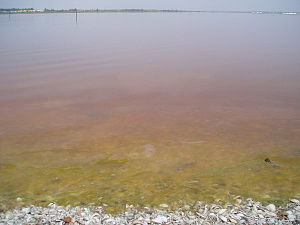
Pink lake: This is one that inspired a location in my own story, a blushing lake filled with a goddess’ tears. Shallow waters, filled with salt, shimmering shades of pink and purple.
http://www.galenfrysinger.com/senegal_pink_lake.htm

Senegal Pink Lake

Senegal Pink Lake (Photo credit: Wikipedia)

Some say that magic is merely science that has yet to be explained. But even those with solid science explanations retain their awe, their magic. Let a little of this world’s magic influence your own.

(Originally posted 05/29/08 on my personal blog, Feywriter)

Many novelists have heard of Scrivener, a software for writers. Initially it was available only for Mac, but last year a version for Windows became available. While editing one of my novels lately, I became frustrated with keeping all my documents and Excel charts updated, and trying to reorder scenes or chapters for a major revamp is a big pain in Word. So I finally decided to download the 30 day free trial for Scrivener. The next day, my husband told me to go ahead and buy it, since we had both read a lot of great things about the software, and I couldn’t stop gushing about all the tools and features.

Scrivener and My Novels

I’ve imported that manuscript I’m revising, and have a newer WIP (only a few scenes written) transferred over to work on mostly from scratch. It’s a very different process for each.

One of the biggest features of Scrivener is that it you break each scene into its own document, but it can still be easily viewed in chapters, or the entire project. It’s been a LOT of work breaking my manuscript into individual scenes, and filling out the attached notecards with updated summaries, but it is SO worth it.

I can easily drag and drop a scene into a new location, I’ve used keywords which color the notecards so I can see POV at a glance, and the time I spent summarizing scenes has given me a basis for an updated outline and synopsis. I love having everything in one place. I used to have documents for characters, world building, different drafts; Excel sheets for keeping track of word count, Point of View, chapter length. Timelines and chapter outlines were a number of drafts out of date. With the ease of having all my info readily available, in one program, I can easily keep everything up to date, find what I need, and move things around.

But that’s not all! I had the brilliant idea while fiddling with my manuscript that I can use these same features for my poetry.

Scrivener and My Poetry

I can use keywords to categorize my poems, put them in collections, and easily reorder poems for compiling into a chapbook. No more copy/paste in a giant word document. If I want to work on an individual poem, I can. If I want to see how it fits into a larger body of work, I can do that too.

My old method: Over a dozen folders, sometimes with a poem in multiple locations. Separate Excel sheets for information like theme. Not only a mess, but I never seem to have everything up to date. I forget to add a poem to my themes list. I have poems in my “new poems”  folder for as far back as 2006 that I haven’t gotten around to categorizing (pure laziness, as I do have a miscellaneous folder).

Now: I write a new poem, tag it with themes, and mark it as a rough draft. I could even list in the notes, or keywords, which poems I’ve shared with whom. I never can remember which ones I’ve shared with my husband, or my critique group. I love being able to have all that information in one place. If I can’t view it at a glance, it’s only a quick click away. 

For comparison, here’s my Excel sheet I used to keep track of themes in my poetry: (click on pictures to biggify)

And here’s my collection of color poems, with their keywords (themes, in this case), in corkboard view:

In this same folder, all I have to do is click on the Scrivenings button up top (highlighted in yellow below) to see the composite of all the text. I’ve circled in red the binder on the left, where I can drag documents to rearrange them, which would update the composite text, as well as the corkboard and other views.

If you can’t tell, I LOVE Scrivener. It’s become such a useful tool, not only for my novels, but for my poetry as well. I’m super excited to put together a new chapbook now. What writing software have you tried?

We’ve been busy, sharing our poetry with the world. Some highlights of our recent and future activities:

Anne Westlund:  
~had three poems published in Poetry Breakfast:
http://poetrybreakfast.wordpress.com/?s=anne+westlund
“Chivalry”  – March 11, 2012
“White-out” – March 17, 2012
“Eclipse” – March 26, 2012
~Strange Pulp – one time publication for the Oasis Sci-Fi Convention in Orlando, Fl.  Short story,  File Under “S”, May 2012

Lin Neiswender: Three poems in the anthology Love and Other Passions by the Poets of Central Florida, http://www.amazon.com/Love-Other-Passions-Central-Florida/dp/098515070X

Margaret Fieland:
~is Participating in Sequential Poetry Reading on Sat April 21st between 12 and 3 at The Omen, 184 Essex Street in Salem, MA
~ Poems published:
Boston LiteraryMagazine
“Monday Morning” Spring, 2012
http://poetrybreakfast.wordpress.com/?s=margaret+fieland
“Weather Report” February 24, 2012
“Taking a Break” March 3rd, 2012

Michele Graf: Two poems, “Chief Joseph Trail” and “Forest” were recently included in the Oregon Poetic Voices Project (OPV), a comprehensive digital archive of poetry readings to complement existing print collections of poetry across the state. Read and listen to her poems at:  http://oregonpoeticvoices.org/poet/370/