sharing a poetic LIFELINE with the world

wp_20130517_002
A recent post  on MuseItUp Publishing’s blog on using music  to set a mood set me to considering the subject. Although I don’t usually listen to music when I write — I’m a serious amateur musician and often find myself listening to the music — I do make use of musical references in the poems I write.

I’ve written more than one poem containing references to popular songs. In Crack Up, the first poem below, I was listening to the radio when a Kenny Chesney song came on, and I started composing the poem below in my head. I ended up on Kenny’s website looking for the songs I needed to complete the poem as I envisioned it.

In the second poem, Green Peas, I was already very familiar with the songs involved, and hopefully y’all are, too.

Do you listen to music while you work? How do you use musical references in your own writing, and how do you react to them in the writing of others? Leave a comment and let me know.

Crack Up

Swish through car-lit darkness
Past squares of light,
street signs sparkling green and white.
Roll down your window,
feel the lemon air
ruffle what’s left of your hair.
Kenny Chesney blaring on the radio
loud enough to silence the thoughts in your head
waiting to be drowned in a cold beer.

Your wheels slide through ghosts of clouds,
past skeleton trees waving bare arms,
past lighted windows with families eating
roast chicken, green beans, potatoes
while the letter from your daughter
crinkles in your back pocket,
your seat belt chafing as
Kenny croons Who you’d Be Today.

The smell of leaf smoke drifts
through the window
as you drive at twenty-five miles per hour
past the cop in the turn-out on your left,
as the rain starts dripping down your windshield
and your windshield wipers quit.
You reach for a beer
as Kenny starts singing Keg in the Closet.

Your car drifts into the center of the road
as you drop the empty on the floor,
reach behind you for another,
one hand on the wheel.
The car skids on wet leaves
going around that curve in the road
you forgot was there
and Kenny sings Steamy Windows.

The sweat drips down your neck
as you wrestle with the steering wheel,
brake on the empties,
your seat belt unfastened.
Skid into the tree.
Glass arrows your cheek your eye.
You’re bleeding from your ear.
Somewhere Kenny’s singing How Forever Feels.


Green Peas, A poem-song

1. Mom: Tune: Greensleeves

Alas my son you know it’s wrong
to leave the table discourteously.
Don’t give me “pretty please,” come along.
Sit down and finish your green peas.

2: Son: Tune: Red River Valley

How can you serve these peas, knowing
I hate them; I’ve told you six times.
Don’t give me that stuff about growing.
You must think that I’m still a child!

3: Sister: Tune: Sixteen Tons

Sixteen year old, is this what I get?
If you want to chase me out, well, now you’re all set.
If Peter calls, just say I’m out, that’s all you know.
Can’t stay another minute, Mom, I’ve got to go.

4: Dad: Tune: Good King Wenceslas

What’s this fighting all about?
Please give me a reason.
Everyone can hear you shout
clear over at the Gleason’s.

Give him a break just for tonight,
you are being cruel.
All you do is scream and shout.
I think you’re a fool.

5: Mom: Tune: Greensleeves

Green peas were for the boy,
but green peas aren’t worth a fight.
Green peas have brought no joy.
Forget about eating those green peas.


On June 1 and 8 this year, I co-presented a two-part poetry workshop at the Eugene Public Library, as part of their Summer Series. I described the method of my madness about a couple of poems I’d written recently, and some of my Poet’s Toolbox techniques that helped me polish the poems. Let me know what you think, and any other tools you could share to help others. I finished this portion of the workshop with a very different poem — much lighter.

Inside My Head:

I see the world in images, flashes that bounce around in my head, the equivalent of “ear worms” – a brilliant term I read recently that describes snatches of songs that pop into consciousness and won’t let go – usually until shoved aside by a new ear worm.

I also feel the world viscerally. Words can choke me, make the hair on my arms stand up, surge through my gut like a gallon of bile, leave me speechless with tears – any number of physical, emotional, and/or mental reactions that sneak up to replay unexpectedly, any time, anywhere.

Words and images power my life, clutter my brain, and beg to be put to paper if I ever hope to understand and process them. I will share three poems, the first two described below. Poem #3 is a change-of-pace / true slice-of-life about the bossiest member of my family.

About these Poems:

In April, Annette Funicello, died. I watched the Mickey Mouse Club as a kid, but I had no fan connection to Annette, and read the first obits without any sense of loss of someone I’d miss.

I knew she had MS, but no clue about how completely her form of the disease devastated. Then I followed a link and watched a short clip showing what her life had been like, having lost most of her ability to even communicate. She resembled a sloppy rag-doll version of her former self.

After the clip was made, she went into a coma and was kept in that state for “several years”. I was haunted by the images, her extended coma, and why, ultimately, the plug was pulled. Two poems, Why No Mercy? and And The Answer Is …, are my attempt to make sense of it.

The Tool Box:

1. My CRITIQUE GROUPS said my images were confusing, when I shared my original poem; they didn’t know if I was talking about a person or an animal. Didn’t get the terrible core – how I was now aware of yet one more way we can die while being forced to keep breathing. After my revision and edits, I read them again to my Crit Groups to see if I’d fixed the problems.

2. I used a partial “LEAPFROG” or “LEAPING POETRY” effort with the poems, looked at each line, image, phrase; the sequence and flow; to dig deep for the truth of what I was trying to say. Sometimes I must write so I can excavate the words for the critical essence, figure out how the parts fit, and fashion bridges to connect what is known with what is missing. Sometimes the results have little in common with the original poem, except the heart.

(There are multiple approaches to Leaping Poetry – most bordering on deep surrealistic juxtapositioning of images, the conscious and unconscious minds, etc. The simpler one, my method, is to look inside each image and phrase, then “leap” to what it conjures up, to see if that’s closer to what I want to say. The new image or phrase replaces the previous one, thus “leaping” closer to my target.)

3. “…Mercy…” became a PERSONA poem, written from the narrator’s point of view, changed from third-person (outside) to first-person (inside the poem).

4. Where possible, I edited to present tense for a sense of immediacy.

5. These are PHOTO/ART poems, inspired by the video described above.

6. Both were written for PROMPTS (to write a Hunter poem and a Hunted poem) during the April 2013 Poem A Day (PAD) Challenge on Robert Brewer’s Poetic Asides. (Link below)

7. I REVISED for content, then EDITED to polish the poems.

8. I READ MY POEMS ALOUD several times before they reached the current version, to see how the words flowed (or didn’t), pacing, and “mouth feel”.

Revise and Conquer: 

 Revision is not a dirty word – it’s the first step to clarity. None of the tools in my arsenal could be used until the words were down on paper. Think of it as a Treasure Hunt; you gotta start your search somewhere. Take what you write today and explore where it wants to go.

I had to admit to myself that the poems clearly were not about Annette. Her life and death were merely the vehicle for an emotional overload of my inner, stinging terror at losing control of my life, unable to make my decisions or wants or needs known. Perhaps it’s a form of claustrophobia, fear of being locked into a tight space, unable to think or help myself, not knowing who holds the key, why I’m being held, or if I’ll ever be released.

So, as you read the poems, know that I’m sharing my own nightmare, and attempting to reason with my own psyche. The poems are still works in progress, delving deep into the whispered realms we seldom share.

Resources:

1. A version of the video about Annette: http://www.youtube.com/watch?v=6VbaLzo–ds

2. Robert Brewer’s Poetic Asides blog:
http://www.writersdigest.com/editor-blogs/poetic-asides


First Draft Opening Lines:

The Hunted:  Why No Mercy?

Last night, in voyeur garb,
I saw the ravaged carcass
of what was once a beautiful creature
the image of wholesome grace . . .

(I include a reference to Oregonian Ken Keysey’s 1962 novel (and 1975 movie) One Flew Over The Cookoo’s Nest. The revised poems follow.)
~~~~~~~~~~~~~~~~~~~~~~~~~~~~~~~~~~~~~~~~~~~~~~~~~~~~~~~~~~~~~~~~~~~

A Dream Is a Wish Your Heart Makes . . .”
Title of former Mouseketeer Annette Funicello’s 1994 autobiography, named after the song from Cinderella.


Why No Mercy?

Last night, my gauzy,
sooty voyeur’s shroud
snagged, ruthlessly tangled,
caught on demon’s flypaper,
sucked into someone else’s life

a once beautiful creature,
the image of wholesome grace,
now a ravaged carcass

tortured, slowly, methodically,
prisoner entombed,
hidden away allegedly with love,

but shown no mercy

Locked in a body no longer mine,
I rage in limbo, not dead, perhaps,
but surely not alive

How long did they keep me
in that madness?
— several years, I heard –
tethered to the eternal drip
of excruciating, painful optimism

For whom, I wonder. Who gained
as I wasted away
to less than nothingness?
Why NOW did they release me?
Why not before?

Ken Kesey had it right.
My Cookoo’s Nest needed a fly-by
many moons earlier, someone
to give me passage by pillow,
admit, like the Indian,
it wasn’t me any more.

May my memory be a blessing
and a warning, give pause.
This is not the dream,
the wish my heart made.


And The Answer Is …

‘Twas done for love
The chance we’d find
That bit of magic,
The only thing left,
To bring you back

 Agony does not do justice to
our hopes dashed, crashed
repeatedly on the rocks
as we prayed to any deities
on call who would, could, respond

We conjured spirits
begged them
for a sign we’d been heard,
acknowledged by the cosmos,
… A single candle’s flicker …

Something, anything, to show
there is — or was — a reason
to believe in belief itself

If only we held on long enough,
prayed hard enough,
sacrificed whatever was required,
perhaps . . .

Finally we knew
No One was home,
wherever home was,
to take the call

Our only mercy
was to let you go.

Perhaps your molecules of pain
were all we had left
to pray with, be heard
not by Gods on high,
but creatures of the earth.
Michele M. Graf



write-picI’m a poet with a particular point of view. In these next blog posts I’ll post poems on different subjects from my point of view. Each poem is an expression, through me, of inspiration or Spirit or emotion. What you see in this light is what you bring to the poem.

Home is where the heart is. Home is where you hang your hat. Whatever your definition of home is, I’d like to hear it. Here is one of mine. Like a snapshot, it’s more of a fleeting impression than a textbook definition.

My Town

Above the hum of machinery
the sound of cars rushing by
I can hear the birds
in defiance.

There are still bugs
despite all the disinfectants,
weed-killer, napalm.

Dogs roam free
in our neighborhood.
They come up to say hello
or bark their freedom
at their fellows behind fences.

There are more slugs every year
it seems like.
The rain brings them
in the morning, in the grass
a convention.

And the deer
not hunted here
in this unnatural setting
eat weeds next to the post office
four of them, a family portrait.
Frustrated hunters
with gun racks in their trucks
have to stop
as they cross the road.

© Anne Westlund

Photo by Chris Westlund

Photo by Chris Westlund

Come back on Friday, June 28th for Make Visible: Childhood

“Make visible what, without you, might perhaps never have been seen.”~Robert Bresson, French Film Director

nitesky7A couple of months ago, I signed up for the first of four parts of an online course in mythic structure. We’re now partway through part two, and I find myself working on a long, narrative poem about a warrior who goes to Hell to seek revenge for his slain fellows.  I started this particular poem as a homework assignment, and in spite of my feeling that the poem was complete in itself, the comments by my fellow students (“what happens next?”) led me to continue it.  I don’t usually write horror stories — in fact, I’ve never written one — but the poem does have its grisly elements. Here’s the first stanza from Part II:

Jovan  strode down a narrow path
where walls gave off an eerie light
and crunch of bones beneath his feet
sent screams of souls to demon’s blight.

If I had to write about this in prose, I doubt I would have come up with anything close to this, but somehow writing in rhyme freed me.   The  poem is the longest I’ve written, and it’s far from finished.  It’s about 26 four-line stanzas so far.

I worked on a number of poems for part one of this course, including another where a soul goes down to hell.

Of all the story structure types I’ve studied, this one — the hero’s journey — feels the most natural. I read lots of Robin Hood, King Arthur, fairy tales, Greek and Roman mythology, and the like growing up, and apparently absorbed a lot about about the scaffolding without being aware of it.  All in all, a fascinating subject, and a rich source, for me, of poetic inspiration.

The Gates of Hell

He stood before the gates of hell
to bargain with a shade.
He drew a breath, then struck the bell
and drew his heavy blade.
The gate was formed from primal fire,
glowed with a steady flame.
But in that hell, his heart’s desire,
and on his head, the blame.
The shadow slipped between the glow
that formed the fiery gate.
Dar raised his sword to strike his foe.
The shadow murmured, “Wait.
“If you would see your love once more,
then listen now to me.
While men have entered hell before,
no man has broken free.”
“And yet I, too, must take a chance,
so shadow, stand aside.
The shadow bowed, and with a glance,
let hell’s gates open wide.
“I’m going now to meet my love.
Though I’ll remain in hell,
my story will be know above.”
Then did the death-bells knell.

I was very pleased with my poetic productivity in April. Here’s the breakdown.

I competed in daily challenges on the Sims 3 forums. These consisted of weekly themes, and daily styles/forms. Not all poems had to be newly written for the contest.

  • Wrote 19 new poems, and entered all but one day.
  • Won twelve days (half of those were ties).
  • Earned 2600 points ($26 of Simpoints which I got in stuff for my game).
  • 1332 words of poetry written.
  • Compliments on my poems, as well as small gifts from other contestants.
  • Four new Sims friends (fellow poets).
  • Overall winner (most wins and points).
  • Eight poems packed with potential that need polishing.

I’m so glad I participated in the Sims 3 Forums rather than the Poetic Asides blog this year. It was much more intimate, and I think that helped to inspire me as the month went along.

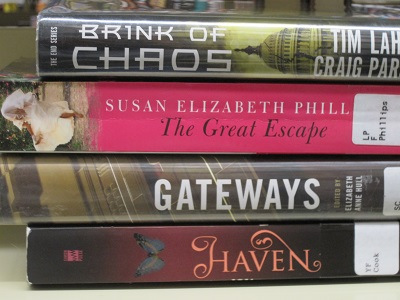
I also composed two Book Spine poems, one which I shared in my last post. The other is one I did for the library contest. Below is my poem showing what the library means to me. It was a finalist (top ten of over 100 entries).

marys-library-poem

Brink of Chaos
The Great Escape
Gateways
Haven

Doing the book spine poem at the library also had another benefit. See that bottom book? I grabbed it solely for the title. I glanced at the front cover blurb due to the butterfly. Went on instinct, and checked out the book. Read it in two days. LOVE. The book is HAVEN by Kristi Cook. It’s a YA about a girl with precognition, who transfers to a school where everyone has some sort of psychic ability. In the author’s own words: Think X-Men meets Twilight.  Loved the characters, the fresh spin on the plot. Could not put the book down. Immediately checked out book two, MIRAGE. Now eagerly waiting for book three to come out (this fall!).

To end the post, I will share with you one of the poems I wrote last month. A Villanelle.

The Author

A goddess, many worlds do I create
to fill with danger, passion, magic, flight,
with words alone manipulating fate.

A lonely princess on a grand estate,
a dragon in his lair just out of sight,
a goddess, many worlds do I create.

Each character is given a strong trait
then thrown into some unforgiving plight;
with words alone manipulating fate.

When countless suitors seek to procreate,
the dragon takes them out with just a bite.
A goddess, many worlds do I create.

A hero uses wit to then debate
and keeps the dragon occupied all night,
with words alone manipulating fate.

The dragon tricked to eat some poisoned bait,
the princess freed to her own tale rewrite.
A goddess, many worlds do I create,
with words alone manipulating fate.

mary-sig2


Enhanced by Zemanta

write-picI’m a poet with a particular point of view. In these next blog posts I’ll post poems on different subjects from my point of view. Each poem is an expression, through me, of inspiration or Spirit or emotion. What you see in this light is what you bring to the poem.

What is it about staying organized? It’s a noble pursuit, so they say. It’s so hard to get and stay organized. A poem can be about anything, anything at all, or even nothing at all. This is my poem about organization.

Disorganized

If I was truly organized
I’d know where everything was
every last paper
every last book.

I’d pay my bills on time,
find the keys
and my favorite lipstick.

But bills pile high on the dresser
my desk has layers to excavate
can’t find my slippers.

You tell me organizing is easy.
In a minute I’ll lose my pen,
then this poem will be over.

© Anne Westlund


Disorganized a huge mess

Disorganized a huge mess (Photo credit: Yuba College Public Space)

Come back on Friday, May 31 for Make Visible: Home

“Make visible what, without you, might perhaps never have been seen.”~Robert Bresson, French Film Director


Enhanced by Zemanta

I promised myself I would memorize Henry Wadsworth Longfellow’s poem, “Paul Revere’s Ride” by the time I reached my ninth birthday.

I’d already mastered the spelling of “antidisestablishmentarianism” — I had no clue of its meaning, but someone bet my third grade teacher that she couldn’t teach at least one of her students to spell it. My memory is that she asked me, the star speller in our class, if I’d like to give it a try.

I loved school, loved Miss Elliott, was an obsessive reader well beyond my grade level, and was excited to be picked. To this day, I can rattle off the letters correctly, as long as I do it quickly and don’t over-think.

When we read “Paul Revere’s Ride” in class, it was immediately my favorite because that famous ride happened on my birthday, “the eighteenth of April”. I mean, how cool is it to share my day with Paul Revere and his horse? I still remember several stanzas.

This past birthday occurred in the middle of a critical week in Boston. Broken-hearted, I watched, read and listened to more news reports than I’d done for several years. The courage and resilience Boston and the rest of the country showed touched me deeply.

I had planned to post a wacky “coming of age” poem, about what it means to turn sixty-five. (That’s 455 dog years, if you we’re wondering.) I’ll hold that for another time.

Instead, I decided to share Longfellow’s poem, written in 1860, at another critical point in our history. Yes, Longfellow took some poetic liberties in this work, but his message shines through. As you read it, see if the strong spirit that moved me nudges you a bit, too — especially the first and last few stanzas.

Michele

Paul Revere’s Ride

Listen, my children, and you shall hear
Of the midnight ride of Paul Revere,
On the eighteenth of April, in Seventy-five;
Hardly a man is now alive
Who remembers that famous day and year.

He said to his friend, “If the British march
By land or sea from the town to-night,
Hang a lantern aloft in the belfry arch
Of the North Church tower as a signal light,–
One, if by land, and two, if by sea;
And I on the opposite shore will be,
Ready to ride and spread the alarm
Through every Middlesex village and farm,
For the country folk to be up and to arm.”

Then he said, “Good night!” and with muffled oar
Silently rowed to the Charlestown shore,
Just as the moon rose over the bay,
Where swinging wide at her moorings lay
The Somerset, British man-of-war;
A phantom ship, with each mast and spar
Across the moon like a prison bar,
And a huge black hulk, that was magnified
By its own reflection in the tide.

Meanwhile, his friend, through alley and street,
Wanders and watches with eager ears,
Till in the silence around him he hears
The muster of men at the barrack door,
The sound of arms, and the tramp of feet,
And the measured tread of the grenadiers,
Marching down to their boats on the shore.

Then he climbed the tower of the Old North Church,
By the wooden stairs, with stealthy tread,
To the belfry-chamber overhead,
And startled the pigeons from their perch
On the sombre rafters, that round him made
Masses and moving shapes of shade,–
By the trembling ladder, steep and tall,
To the highest window in the wall,
Where he paused to listen and look down
A moment on the roofs of the town,
And the moonlight flowing over all.

Beneath, in the churchyard, lay the dead,
In their night-encampment on the hill,
Wrapped in silence so deep and still
That he could hear, like a sentinel’s tread,
The watchful night-wind, as it went
Creeping along from tent to tent,
And seeming to whisper, “All is well!”
A moment only he feels the spell
Of the place and the hour, and the secret dread
Of the lonely belfry and the dead;
For suddenly all his thoughts are bent
On a shadowy something far away,
Where the river widens to meet the bay,–
A line of black that bends and floats
On the rising tide, like a bridge of boats.

Meanwhile, impatient to mount and ride,
Booted and spurred, with a heavy stride
On the opposite shore walked Paul Revere.
Now he patted his horse’s side,
Now gazed at the landscape far and near,
Then, impetuous, stamped the earth,
And turned and tightened his saddle girth;
But mostly he watched with eager search
The belfry-tower of the Old North Church,
As it rose above the graves on the hill,
Lonely and spectral and sombre and still.
And lo! as he looks, on the belfry’s height
A glimmer, and then a gleam of light!
He springs to the saddle, the bridle he turns,
But lingers and gazes, till full on his sight
A second lamp in the belfry burns!

A hurry of hoofs in a village street,
A shape in the moonlight, a bulk in the dark,
And beneath, from the pebbles, in passing, a spark
Struck out by a steed flying fearless and fleet:
That was all! And yet, through the gloom and the light,
The fate of a nation was riding that night;
And the spark struck out by that steed, in his flight,
Kindled the land into flame with its heat.

He has left the village and mounted the steep,
And beneath him, tranquil and broad and deep,
Is the Mystic, meeting the ocean tides;
And under the alders, that skirt its edge,
Now soft on the sand, now loud on the ledge,
Is heard the tramp of his steed as he rides.

It was twelve by the village clock,
When he crossed the bridge into Medford town.
He heard the crowing of the cock,
And the barking of the farmer’s dog,
And felt the damp of the river fog,
That rises after the sun goes down.

It was one by the village clock,
When he galloped into Lexington.
He saw the gilded weathercock
Swim in the moonlight as he passed,
And the meeting-house windows, blank and bare,
Gaze at him with a spectral glare,
As if they already stood aghast
At the bloody work they would look upon.

It was two by the village clock,
When he came to the bridge in Concord town.
He heard the bleating of the flock,
And the twitter of birds among the trees,
And felt the breath of the morning breeze
Blowing over the meadows brown.
And one was safe and asleep in his bed
Who at the bridge would be first to fall,
Who that day would be lying dead,
Pierced by a British musket-ball.

You know the rest. In the books you have read,
How the British Regulars fired and fled,–
How the farmers gave them ball for ball,
From behind each fence and farm-yard wall,
Chasing the red-coats down the lane,
Then crossing the fields to emerge again
Under the trees at the turn of the road,
And only pausing to fire and load.

So through the night rode Paul Revere;
And so through the night went his cry of alarm
To every Middlesex village and farm,–
A cry of defiance and not of fear,
A voice in the darkness, a knock at the door,
And a word that shall echo forevermore!
For, borne on the night-wind of the Past,
Through all our history, to the last,
In the hour of darkness and peril and need,
The people will waken and listen to hear
The hurrying hoof-beats of that steed,
And the midnight message of Paul Revere.

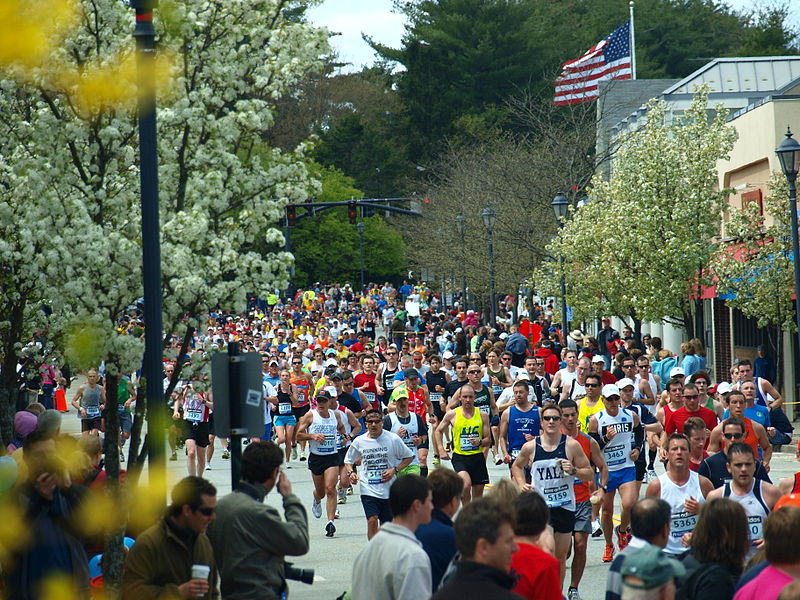
Boston Marathon

The Boston Marathon turned tragic this past Monday when two bombs went off near the finish line of the race. Two of our kids were downtown when it happened. Both are, thank God, safe, but others were not so lucky. Our hearts go out to all.

Boston Marathon

Boston_Marathon_2010_in_Wellesley

Participants in the 2010 Boston Marathon in Wellesley, just after the halfway mark (Photo credit: Wikipedia)

Blank page accuses me

but I’m wordless,
my mind stuck in the moment
I heard the explosion,

the second glass shattered,

viewing stands collapsed,
runners crashed to the street
from the bomb’s blast

A pressure cooker,
a timer,
nails and such

from the hardware store

Anyone could buy
at the Ace on the corner

put together in the garage.
No one would suspect a thing.

We have the method,
but not the motive:
neither who nor why,
and it leaves us wrecked.

We toss and turn,
wake at 2 AM,
imagined footsteps
clomp by our door.

Only a dream,

a stand-in for the worry
we are vulnerable,
fragile,

and anyone
with a few dollars,
a little know-how,
a stain on their soul,

could, in a moment,
change our lives forever.


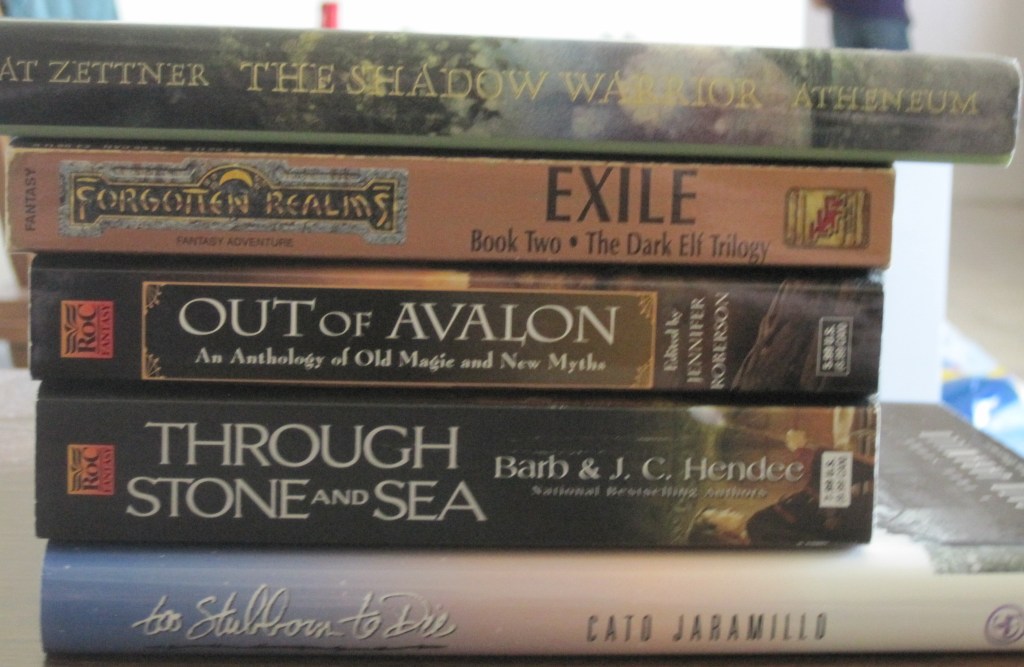
If you’re not aware, April is National Poetry Month. Next week is also National Library Week. AtYourLibrary.org is celebrating both with a contest. Use the books from your library to compose a Book Spine Poem telling why the library matters to you (deadline April 20). I haven’t made it out to my library yet, but wanted to make my own book spine poem. This isn’t themed about the library, and was made using my personal library.

A book spine poem is made by stacking book spines so the titles make a free verse poem.

book-spine-poem-e1365800953188

Mary’s Book Spine Poem

In case that’s hard to read, or the image doesn’t load, it reads:

The Shadow Warrior
Exile

Out of Avalon
Through Stone and Sea
Too Stubborn to Die

It was a fun challenge going through all my books, pulling and mixing and shifting trying to find something I liked and that told a story. I’d lvoe to see what you come up with from your own libraries.

mary-sig2 (1)

write-picI’m a poet with a particular point of view. In these next blog posts I’ll post poems on different subjects from my point of view. Each poem is an expression, through me, of inspiration or Spirit or emotion. What you see in this light is what you bring to the poem.

This particular poem, “Valentine,” was written in response to a challenge to write a Villanelle, a form of poetry. It was also written as a Valentine for someone I was attracted to at the time. Poetry, classically, portrays love and attraction. It’s not unusual to write a love poem. Some of our first attempts at writing poetry are love poems. Please try your hand at love poetry if you haven’t already.


Valentine (Villanelle)

Cupid’s arrows pierce my heart,
Despite love’s shifting sands
Never will we two part

Card stolen from Wal-Mart
More than eruptions from my glands
Cupid’s arrows pierce my heart

To get to you I took the BART *
IPOD plays my favorite bands,
Never will we two part

I feel the sting of his golden darts
Make of me any demands
Cupid’s arrows pierce my heart

Dressed up like a dime-store tart
You held me in your gentle hands
Never will we two part

Your eyes travel my Holy Lands
Ready for your commands
Cupid’s arrows pierce my heart
Never will we two part.

* BART-Bay Area Rapid Transit

© Anne Westlund

Come back on Friday, May 3 for Make Visible: Organization.

“Make visible what, without you, might perhaps never have been seen.”~Robert Bresson, French Film Director


~~~