sharing a poetic LIFELINE with the world

Archive for the ‘Inspiration’ Category

Poetic Forms: Sestina

Arnaut Daniel.

Image via Wikipedia

The sestina is a poetic form attributed to twelfth century French troubadour Arnaut Daniel. It consists of six six-line stanzas and a three line envoy. The six end words of the first stanza cycle in a pattern thusly:

ABCDEF/FAEBDC/CFDABE/ECBFAD/DEACBF/BDFECA

and an envoy whose form varies somewhat, but which uses all six end words:

BE/DC/FA

or

FA/DC/BE

How to choose your end words

There are doubtless many ways to choose ones end words One is to write the first stanza and then lay out the pattern for the rest. The other, the one I use, is to pick six words, generate the skeleton, and start writing. I try to choose words with more than one meaning and that can be used as more than one part of speech.

Here is a link to a sestina generator: Feed it your six words and it spits out a skeleton with the six stanzas and envoy:
dilute.net/sestinas

Here is a link to sestina by Ezra Pound:

//www.poets.org/viewmedia.php/prmMID/15423

Here are the first two stanzas;

I

Damn it all! all this our South stinks peace.
You whoreson dog, Papiols, come! Let’s to music!
I have no life save when the swords clash.
But ah! when I see the standards gold, vair, purple, opposing
And the broad fields beneath them turn crimson,
Then howl I my heart nigh mad with rejoicing.

II

In hot summer have I great rejoicing
When the tempests kill the earth’s foul peace,
And the lightnings from black heav’n flash crimson,
And the fierce thunders roar me their music
And the winds shriek through the clouds mad, opposing,
And through all the riven skies God’s swords clash.

Here is one of mine:

Polemic

Workers, you are choked by the collar
of convention. Will you spare
yourselves? Will you ever tire
of the endless round of days, brave
the waters of controversy and refuse to play it safe?
Will you strike a blow

for self expression? Will you blow
down the artificial walls your white collar
has erected around you? Will you leave the safe
space you create in the spare
confines of your tiny cubicle? As you brave
each new day, do you ever tire

of the endless wheel of useless make work? The tire
of useless flesh grows round your middle. You puff and blow
climbing a single flight of stairs. How brave
are you? As you lounge, idle, the shirt collar
around your neck grows ever tighter, until there is no spare
room, and you choke. When will it be safe

to throw your old shirt away? What will jolt you from your safe
little life? What would be enough to make you tire
of the endless round of dailyness? Spare
yourself and live, not merely exist. Blow
the clouds from your eyes. White collar
workers, unite. Take a chance. Be brave.

Allow yourselves to brave
unknown waters, to give up your safe
small space, to throw away your collar
and try the new. Rise from your chairs. Retire
from the rat race. Overturn your desk. Blow
your boss’s mind and run from your office. Spare

yourselves. You have no spare
life. You have one chance to be brave.
You will never get another chance to blow
away the small, safe
walls around you before you tire
and are choked by your white collar.

You cannot spare yourself and stay safe.
Let yourself be brave. Throw away the tire
of convention. Strike a blow for life. Throw out your white collar.

Margaret Fieland


Enhanced by Zemanta

How 750 words Freed Me

Swirling thoughts

Swirling Thoughts Image via Wikipedia

Today I’m going to share with you my favorite tool for dealing with writers block.

You may already be familiar with Morning Pages. This started with Julia Cameron, creator of The Artist’s Way. “Morning Pages are three pages of longhand writing, strictly stream-of-consciousness.” The idea is to, first thing in the morning, get out a notebook and write three pages of whatever is in your head. No overthinking. This clears your head for the rest of the day, opening you to inspiration, happiness, opportunity.

My problems with this system? I don’t function first thing in the morning. And I’ve been burned before by someone finding and reading stream-of-consciousness pages, and I don’t have a convenient place to keep these close and yet secret.

The solution? 750words.com. This takes the same concept online. It’s easier to sit down at your computer than find a pen or pencil and write by hand. (At least for some of us.)

The site is completely private. No one will be reading your words, you can do them at any time in the day, and there are incentives! Streaks and different statistics can earn animal badges. Amazing how motivating it is to get them. There are also monthly challenges to write daily for a special badge and bragging rights. A point system keeps track of how many days you’ve started and completed your 750 words. Sometimes it’s an incentive, especially if I have a streak going that I don’t want to break. But I never get reprimanded if I go too long without visiting.

My first month was brutal. My brain wanted to edit my words, censor, plan. I had a hard time simply opening my consciousness and writing whatever. Now, even if I’ve gone a month without writing anything, it’s so easy to get back into.

Since starting on the site (just over a year now!), my thoughts are clearer, my ideas more frequent, I’m less bogged by negativity. Even my typing speed has gone up with all the speed typing to keep up with my thoughts. I spend less time worrying about issues, which frees my subconscious to other ideas. I wish I was more consistent in using the site, as I know the results are positive.

750 words is: 
My rambling,
brainstorming,
venting,
planning,
documenting,
a bit of creative writing,
pure randomness.

No worries about it being read.
Safe.
Unfiltered.

Some people use the site for their regular creative writing. Some use it as a serious journal. Others following the guidelines of Morning Pages. Whatever purpose you want. This is completely for you alone. No one else. The site is completely free, so no reason not to give it a try.

Next on Mary’s Expression (March19): a poetry prompt.

Make Visible: Find Your Tribe

It is so important as creatives that we find a group of people that we feel comfortable with.  They share our values, our interest in creating and inspire and challenge us. Or maybe we just like to hang around with them, have fun and do fun things with them.  Groups offer us a chance to make friends, learn and share.  All this applies to both online and offline groups.

Online Groups:

Where do you start?

Tribe                                      many interests

Yahoo Groups                          many interests

Google Groups             many interests

Image representing Tribe as depicted in CrunchBase

Image via CrunchBase

CoachCreativeSpace                all creative interests

Writer’s Digest Community       writers

Wet Canvas                             visual artists

For Tribe, Yahoo and Google groups there’s a box to put in your interest (keyword), a list of groups will come up that you may want to join.

Offline Groups:

Where do you start?

This depends on the size of your community.  You may be able to find groups through Meetup.com, your local newspaper, Weekly, or posted at your library or grocery store.  These groups may be related to interests, like writing, activities, like yoga, or church or self-help groups.

What next?

Join the group, post an introduction or go to the first meeting and introduce yourself, be friendly, become involved, participate.

It’s that simple.


Enhanced by Zemanta

Make Visible: Capture Your Ideas

This post was inspired by Michele’s wonderful post:  Never Forget Your Dreams.

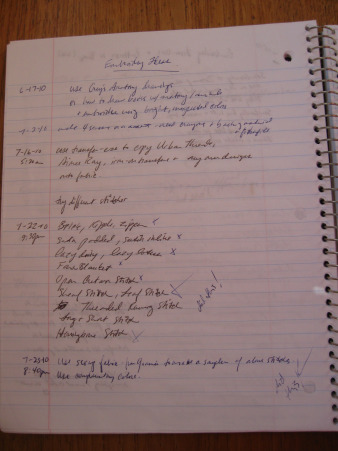
If you capture your ideas you’ll actually have more of them.  For one thing, you will have a record of the ideas you do have! This applies to writing, art and even things like organizing your garage.  I use a Scanner Daybook (from Barbara Sher’s Refuse to Choose) for my craft, organization, school, and other ideas.  Some pages below:

100 Dreams

Click on photo to enlarge.

For writing ideas I have a small notebook in my purse, but any piece of scratch paper will do.  Then I transfer the writing ideas to 4 x 6 notecards that I keep in a “recipe” box.  I also keep notes on my computer desktop using Stickies (a computerized version of yellow sticky notes).  Other methods of capturing your ideas include leaving pens and notepads around the house, using voice-activated software for computer, voice recorders or saving notes on your phone or blackberry.


img_16631

Embroidery Ideas


Why capture your ideas?  Not only will you have a record of ideas that you can refer to later for inspiration or planning;  you will free your brain up from trying to remember them.  This leaves you space to use your imagination and bring your ideas to fruition in the form of a story, artwork or clean garage.  🙂


Enhanced by Zemanta

So, You’re a Creative Genius… Now What?: A review

“I contend that if you’re not actively creating something, you’re not entirely alive.” ~Carl King

You’re inspired, you’ve released your creative genius. What do you do with it? This is where Carl King’s book, So, You’re a Creative Genius… Now What?, comes into power.

I first tuned into this book by following links about introverts, ending up on Carl King’s blog post 10 Myths About Introverts (a good read, but another topic). I liked King’s way of thinking, and saw that he had a book. The publisher, MWP, has a sample from the book on their website. I devoured all seventeen sample pages, and filled up a page in my bliss book with quotes and inspirations from that alone. I was sold, and bought the book next chance I got.

King doesn’t mince words. Every sentence, every page, has impact. You won’t find repetition or filler here. He has a quirky humor, and tells it straight.

This book covers so many topics relating to creativity. From your personal workspace (spacestation), to social interactions, the business, and daily routines. It’s a survival guide for the creative soul. About making the most of that wonderful brain you’ve got, not wasting your imagination and creativity.

As I’ve traveled the path of submitting my writing, both fiction and poetry, in the hopes for publication, I really liked how King compared us to salesman. The salesman gets fired every day. “And at the end of the day, even if you do a great job, you get fired. Because you’re paid to wake up and look for work each and every day.” Definitely something I can relate to. But then he turns it around, shows how we can learn from this state of being. “The flip side of this paradox is that a salesman is never unemployed, because he creates his own destiny.”

I recommend this book for anyone whose hobby or work is creative.

Next time on Mary’s Expression: writers groups.

Make Visible: By Art Inspired

 Art sometimes inspires me to write poetry. Below are two paintings and the poems they inspired. Please read Lin’s post A New Way of Looking: Ekphrasis for an introduction to this idea. It is often not enough to just see a painting and write; sometimes research into the subject or the artist is helpful.  I researched James Joyce for the poem, “Joyce.”  The painting was incorrectly titled “Joyce in the City” on another website, where I was inspired to write the poem.  The correct name for the painting is Paris Street, Rainy Day by Gustave Caillebotte, 1877.

Paris Street, Rainy Day

Joyce

Plotting out your novel
in the rain,
or so I imagine.
I struggled with Ulysses,
didn’t get past the first five pages
to be honest.

You wouldn’t kneel
at your mother’s bedside,
standing up against Catholicism
even in death.

Your get rich quick schemes
failed, until you acquired a patron.
Still you squandered the money
every chance
on wine.

We’ll never know much about
your daughter,
the letters burned
by an overzealous relative.

Many eye surgeries later,
Joyce and an umbrella,
woman on his arm,
in the rain.

The second painting, The Little Deer by Frida Kahlo, 1946, also inspired a poem.  I dug a little deeper into the research for this painting.  The surrealism of the painting is reflected in this poem, “A Painting.”

The Little Deer

A Painting

You let your guard down
Didn’t see the hunter’s orange vest
Or didn’t care
Can the mute speak?
Still you run through the woods
You should be dead
A stag with the face of a woman
countenance as mysterious as the Mona Lisa’s
Run, deer, run
As if the plague were after you
As if followed by Roman soldiers
Aching to martyr.

What can you take away from this?  If you need inspiration, look online for paintings to inspire your writing.  They can be modern art, classical, fine art, or even photographs.  You don’t have to research the subject of the painting or photograph or the artist, but  it adds depth to the final work.


Enhanced by Zemanta

Zen in the Art of Writing: A Review

“You fail only if you stop writing.” ~Ray Bradbury

The above quote has long been my mantra for writing. I keep it at the top of my daily writing document. So, as inspired as I am by this one statement of Bradbury’s, I was delighted to come across an entire book of such words. Zen in the Art of Writing is a collection of essays that Ray Bradbury has written, ranging in publication date from 1961 to 1986. The collection, published in 1990, is still relevant today. The messages just as true.

The essays are as follows:

  • The Joy of Writing
  • Run Fast, Stand Still, Or, The Thing at the Top of the Stairs, Or, New Ghosts from Old Minds
  • How to Keep and Feed a Muse
  • Drunk, and in Charge of a Bicycle
  • Investing Dimes: Fahrenheit 451
  • Just This Side of Byzantium: Dandelion Wine
  • On the Shoulders of Giants
  • The Secret Mind
  • Zen in the Art of Writing
  • … On Creativity

In these, Bradbury shares his experiences with life and writing, and shows how entwined the two are. He takes inspiration from his own life, his own passions.

When I picked up this book and started reading, it was impossible to put down. It spoke to my own passions, reignited my zest for writing. A reminder of why I do what I do. He does share advice, some how-to for writers, but what I took most was the underlying celebration of the art. The book’s subtitle is Releasing the Creative Genius Within You, and it lives up to that task.

“When honest love speaks, when true admiration begins, when excitement rises, when hate curls like smoke, you need never doubt that creativity will stay with you for a lifetime.”

~Ray Bradbury, from How to Keep and Feed a Muse

I definitely recommend this book, both for aspiring writers and those who’ve been long in the trenches. It is a joy to read, and will take you back to the roots of not just the how-to write, but the why. If you’ve lost that love, found the passion dimming, rediscover it here.

Next time on Mary’s Expression: More on the Creative Genius.

A New Way of Looking: Ekphrasis

I learned a new word  recently, courtesy of a friend and Wiki:

Ekphrasis or ecphrasis is the graphic, often dramatic, description of a visual work of art. In ancient times it referred to a description of any thing, person, or experience. The word comes from the Greek ek and phrasis, ‘out’ and ‘speak’ respectively, verb ekphrazein, to proclaim or call an inanimate object by name.

Nowadays it might be a snapshot of a scene, a work of art, or any creation that puts you in the head of the participants or an object and tell’s you what is actually happening within it.

So I thought, why not pick one of my collages as a prompt and write about it?

The one I chose is called “La Fleur” and here it is:

La Fleur

©2008 Lin Neiswender

Here is my poem about the collage:

The Photograph

Rose Pink my Papa calls me, his little blossom
I smile inside but not for the photograph
The buttons on my shoes are too tight and pinch my toes

My little dogs are lucky, they can run free with bare paws
On the fresh green grass, and rush into the house
When they are tired, heads out the window
Listening to the bird sing

But even they are dressed too fine for comfort
Tight bows of Mama’s fine silk ribbon tied
Around their necks, choking them as does
My lace collar choke me

Still a little girl’s first love
Is her Papa, and so I endure
The scratching of the lace,
The tightness of the shoes

All so Papa can take his photograph
Of his La Fleur Rose

©2012 Lin Neiswender


An Exercise in Imagery

Dreigiebelhaus (three-gables-house) Am Laien i...

I hope everyone had a wonderful holiday. As my gift to you, I’d like to share a fun exercise to create unique imagery.

Sometimes I find myself getting stuck using the same descriptions and phrases in my writing. Especially in poetry, it loses that pop. One of my favorite exercises to get out of this rut is one I learned in high school.

1. Come up with a list of common adjective/noun combinations. Since it’s the day after Christmas, I’m going to choose some season appropriate terms. The more you come up with, the better a chance you’ll get an awesome description out of this. I like to come up with 10-12, but for teaching purposes I’ll do six. Adjectives in green, nouns in red:

white Christmas
evergreen tree
falling snow
slick roads
gold rings
hot cocoa

2. English: Six dice of various colours. 4-sided ... Now choose a number. Any will do as long as it’s not a multiple of the list you have. Since I have six items, I would not use the number six. You can use virtual dice to give a random number, or roll an actual die. Since I have six phrases, I’ll use a regular die and re-roll if I get a 6. I rolled a 4.

3. This number is the shift number. Leave the adjectives where they are, and shift the nouns down the number rolled. Christmas would shift down 4 to match with gold. My resulting list:

white snow
evergreen roads
falling rings
slick cocoa
gold Christmas
hot tree

4. These are now your prompts! Use any that inspire you in a poem or story. As you can see, some combos are definitely better than others. White snow isn’t very original, but evergreen roads excites me. If you get a dud, and none of the results speak to you, pick a new shift number.

Another variant: write a bunch of adjectives and nouns on pieces of paper, and put them in separate bowls or bags. Mix them up, and grab one from each. A grab bag of inspirational imagery.

Here’s my poem inspired by the above. I have the start of an evergreen poem, but ended up on a tangent and wrote this one instead.

What color is your Christmas?

White with snow
and frosted branches?

Blue with longing
for romances?

Mine is one of gold
as I snuggle down with slick cocoa
and listen to the joy around me.

A child’s laughter making
all those purchases worthwhile

The Carol of the Bells
echoing like falling rings

And at the end of the day
the family gathers round
to watch a movie

As a child I never could have known
Mothers have the best Christmas,
with memories of gold.


For another example, see my very first poem written using this technique.

I’d love to see the poems you come up with, using either my list or one of your own.

Next time on Mary’s Expression: A book review.

Let’s Write a Holiday Poem

English: Modern Bubble light

In honor of  the winter holidays, let’s write a poem celebrating one. Stumped for ideas? You won’t be for long.

Jot down your very brief answers to the following questions:

  1. What is the first time you remember celebrating this holiday?
  2. Who was there with you?
  3. Which was your most memorable celebration of this traditional holiday?
  4. What is the favorite scent you remember from this holiday?
  5. What was the most special gift you received during this holiday?
  6. What is your favorite sound associated with this holiday?
  7. What is the favorite food or beverage you associate with this holiday?
  8. What is the holiday decoration you remember best from this holiday?
  9. What texture or tactile memory do you have of this holiday?

My answers were:

  1. The year my Dad hung balloons and streamers from the ceiling for Christmas morning.
  2. My little sister and two older brothers and our parents.
  3. The first one I remember.
  4. The smell of the blue spruce tree branches.
  5. A huge stuffed panda bear.
  6. The metal bells we got to hang from the lower branches that would tinkle as we swept by.
  7. Pumpkin pie topped with whipped cream.
  8. The angel hair spider webs that diffused the light around the oil-bubbling candle tree lights.
  9. The cozy feel of red and white candy-striped flannel nightgowns

Now, work these memories into a free-verse poem. Nothing has to rhyme. You can rearrange or delete or add more ideas as you go along. Try for a natural flow and pleasing sound of the words you choose.

Here’s my poem:


The Big Christmas

Santa came! Santa came! I shout with my four-year old squeal

Streamers cascade from the ceiling where balloons hover,
Held in place by static electricity and pieces of tape
The room, to me, a fairyland of bubble lights and halos
Pungent scent of  blue spruce tree, needles sticky

Tinkling bells as we pull out presents
My package wrapped in bright paper so big I ask,
Is it a horse?
No horse, better yet, a giant panda, black and white
Contrasting with the chaos of color around me

The memory of my sister and me, in our peppermint-striped
Flannel nightgowns as we hug our new stuffed animal friends
My brothers follow two strings leading outside,
To discover bicycles hung in the trees

Our excitement intoxicating my parents as they share
A Christmas hot toddy and  slice of pumpkin pie
Smiles tired but satisfied,
At this big Christmas
©2011 Lin Neiswender

When you are satisfied with your poem, print it out or email it to the people with whom you share these memories. It will be a holiday gift to them like no other. Perhaps you’ll inspire them to write their special poems too.