sharing a poetic LIFELINE with the world

Archive for the ‘Creativity’ Category

Douglas Adams Was Right

dscn2333-copy-e1346813656376For the past several weeks, I’ve suffered computer meltdown — and I do mean I, personally, suffered from it. Seemed to do everything I could to not go with the flow (except bile, which ran freely through my system). Even my incredible Standard Poodle, Harlee, tuned in to my angst with a vengeance. By Saturday night, we were both howling at the moon most of the night.

What started as a bit of quirkiness grew into anarchy by my home devices. The iMac, recently upgraded to Mountain Lion, apparently decided it didn’t “do” wifi anymore, certainly not with the old D-Link router. If it stood its ground and absolutely refused to allow me internet access, or to network with the other computers in the house, I would have wrapped it up and taken it directly to the Computer Hospital.

It preferred to toy with me, like the cat it is. It would work “sometimes” for a few minutes; occasionally it did this when I first turned it on during the day. Then, obviously it was bored and checked out. The intermittent aspect drove me nuts. It loved to pretend we were buddies again, let me get into something important, and then — nothing. Pleading and threats were about as effective as you might expect.

The iMac also figured it had nothing in common with our five-year-old HP printer, either. Refused to acknowledge that a driver even existed that would allow them to work together. Nope. No way. I couldn’t check for updates, because — wait for it — guess who was not able to get online . . . ?

The Windows 7 laptop got in on the act. It, too, refused to communicate with the Mac. It did pretend it liked the printer, and spit out test page after test page when asked, but nothing else. So, if I needed eighteen original test pages, it would be happy to accommodate me.

As someone who straddles two worlds, Apple and Microsoft, I’m continuously pulled off balance. Documents created or updated on the Mac refuse to hold formatting when exported to Word. Spreadsheets designed for XLS will not open properly on the Mac unless uploaded or created on the laptop first, saved in DropBox, or (when it works) pulled from one to the other via the in-house network/wifi.

My husband’s old XP desktop was still functioning, probably best of anything, until we got our tech-person out; he fixed a lot, but put a password onto Len’s computer, which threw him out of whack.

It seems that my iMac has a faulty wifi card, which needs to be replaced — when I’ll have the “right time” to do it is a mystery. The D-Link fought a good fight, but had to be retired; failing eye-wire-circuit coordination gets to the best of them. The new router, a spiffy Air Express (I think) is sleek, and capable — but, in exquisite irony — can only function well right now to deal with wifi when it’s actually plugged in to the Mac. Um, a hard-wired wifi; I’m sure someone’s made a fortune on a joke about this already.

The laptop also seems to be answering to a higher authority than me — or Mr. Tech Man. He finally took it away with him to find out who’s the boss, telling it to ignore what it needs to do, and stop doing what it shouldn’t — like spitting out test pages.

Only the iPad behaved itself, relatively speaking, during this time. It opened most of the email (but not all of it); let me get into the internet much of the time, as the only sane device around here that at least thought it was supposed to be able to use the wifi system to do it. If only it could have accessed some of the material I desperately needed from the Mac. If it knew how to do that, it decided not to upset the Big Mac, so played dumb.

For the better part of these three weeks or so, I’ve tried all kinds of tricks to get into my documents to deal with crazy deadlines for the Muse Online Writers Conference next month, the next issue of Apollo’s Lyre, posts for this blog, and material pertaining to my car accident from almost two years ago. Time is running out on all of them. In order to use them, they have to be converted to Word or XLS, pulled into the laptop, and handled from there.

I’ve tried to see the humor in all of this, at least today, now that I’ve been able to get most of what I needed for the car accident paperwork at least. I can see a good country music song tangled in the lyrics, or the sixth volume in the Hitchhiker’s Guide to the Galaxy Trilogy — imagine Arthur Dent, waking up one Thursday morning, knowing he hates Thursdays because everything goes wonky those days. Imagine he opens his front door and Deep Thought, the infamous computer, burps at him. Take it from there into absurdity.

avalanche-64-copy

So, Douglas Adams was right when he said, back around 1978, that the Earth is a giant computer, and white mice run experiments on humans all the time. If you don’t believe this, then give me a better explanation of the behavior exhibited around my house lately.  No prissy ideas about hardware and software. No, I want you to get to the heart of this thing.

And write about it in verse, any form you choose. (Hey, gang, what’s crazier than Limericks to deal with the absurd?)


Make Visible: The Muse Online Writers Conference

write-picThe Muse Online Writers Conference

The next MuseCon will be held October 8-14,2012.

Although registration for this fabulous and free online writers conference isn’t open yet, it soon will be.

The Poetic Muselings will be hosting a poetry workshop at the 2012 Muse Online Writers Conference!!!

Hope to see you there!

Just read this Mission Statement! (from the website, home address is:  http://themuseonlinewritersconference.com/joom/)


Mission


Our Online Writers Conference is aimed to offer you, the writer, whatever resource we can to give you the opportunity to enhance and improve your craft, to offer the opportunity to make contacts to reach that next level all writers seek – publication!

Our vision for organizing this online and very FREE writers conference as an annual event is to bring the writing world a bit closer for you. I understand many writers out there do not have the monetary resources to attend face-to-face conferences, or perhaps they are situated far, and even some writers may be incapacitated making it difficult for them to travel.

Within the world of the Internet, everything is possible and with this in mind we offer you this chance to come out, chat with our Presenters, ask them questions and even attend a few of our FREE workshops to be held throughout the week.

And remember…this is a smoke-free environment.

If you have any questions, please feel free to email me at:

lea at themuseonlinewritersconference dot com


Writing

Writing (Photo credit: jjpacres)


“Make visible what, without you, might perhaps never have been seen.”~Robert Bresson, French Film Director


Enhanced by Zemanta

My Voice

I’ve been thinking about voice a lot lately. Voice, as in writer’s voice, what is it, where does it come from, what influences it. As a writer, I love words and word play, have a good knowledge of English grammar, can speak, read and write French well enough to carry on a conversation, read a book, and appreciate some of the differences in the grammars. I enjoy humor and like writing all kinds of humorous poetry.

Many things have influenced me as a writer, but one of the biggest was my father. An attorney who appeared twice before the Supreme Court, he love the English language and was adamant about correct usage. Every time my sister or I would make a mistake, he would repeat the whole rule and its explanation. Not simply the correction. The whole, blasted thing. He also refused, generally, to give us the meaning of a word; he made us look them up ourselves. At the time I found the whole thing beyond annoying. Now I view it as one of the biggest gifts he could have given me.

He also encouraged us to read widely. I recall reading Damon Runyon and O’Henry among others at about age twelve, and having to look up about one word in every sentence. Talk about vocabulary building! And I can still recall discussions about points of grammar around the dinner table.

The New York Times crossword puzzle was another big influence, in that it led to my developing my own algorithm for generating rhymes. I am an auditory learner, and one day while doing the puzzle, searching for a word where I had the first letter, I realized that there were a very limited selection of sounds that could follow:
Consonant plus L sound: for example C plus L as in clap
Consonant plus R sound: for example C plus L as in crap
For some, Consonant plus W sound:   C plus W sound would be cwap — nope, that one’s not a word.
For S, C, and T: consonant plus H
For letter q: KW is the sound
Special case : S : S plus most of the others: S plus C , S plus C plus L, S plus C plus R…

But NOTE well.  We’re talking about SOUNDS, not spelling. I use C for the K sound.
If you’re visual and this throws you off, this system might not work for you. fat frat flat

I’ve used this algorithm for years. I love to rhyme, and although I now occasionally look up the rhymes using rhymezone.com, I can go through my own algorithm pretty quickly. I do better that way, because it forces me to contemplate each word and whether or not it would fit in the poem.

Although I love music and play the flute and the piccolo, I don’t listen to music as I write, nor do I see images when I listen to music. When I listen to music, I listen to music. It evokes emotions, but I don’t see pictures unreeling in my brain. I know some writers are inspired by music, like to write to music, and the like. I don’t, not in the way most people mean. I do find music to be very freeing when I’m letting my mind wander, contemplate plot, character, or whatever.

I have written several poems that were music-inspired. In  the cases I can remember, I was in my car listening to the radio when a particular song — or songs — got me started on a poem. Here is one of them. The first part of the first stanza was what was happening when the Kenny Chesney song started to play on the radio. I did have to go search out the titles of some of his other songs in order to fill out my conception of the poem. I’m nobly resisting the urge to revise it. It was published in an ezine:

Crack Up

Swish through car-lit darkness
Past squares of light,
street signs sparkling green and white.
Roll down your window,
feel the lemon air
ruffle what’s left of your hair.
Kenny Chesney blaring on the radio
loud enough to silence the thoughts in your head
waiting to be drowned in a cold beer.

Your wheels slide through ghosts of clouds,
past skeleton trees waving bare arms,
past lighted windows with families eating
roast chicken, green beans, potatoes
while the letter from your daughter
crinkles in your back pocket,
your seat belt chafing as
Kenny croons Who you’d Be Today.

The smell of leaf smoke drifts
through the window
as you drive at twenty-five miles per hour
past the cop in the turn-out on your left,
as the rain starts dripping down your windshield
and your windshield wipers quit.
You reach for a beer
as Kenny starts singing Keg in the Closet

Your car drifts into the center of the road
as you drop the empty on the floor,
reach behind you for another,
one hand on the wheel.
The car skids on wet leaves
going around that curve in the road
you forgot was there
and Kenny sings Steamy Windows.

The sweat drips down your neck
as you wrestle with the steering wheel,
brake on the empties,
your seat belt unfastened.
Skid into the tree.
Glass arrows your cheek your eye.
You’re bleeding from your ear.
Somewhere Kenny’s singing How Forever Feels.


True to My Nature

“Musicians must make music, artists must paint, poets must write if they are to be ultimately at peace with themselves. What humans can be, they must be. They must be true to their own nature.” — Abraham Maslow

Art Supplies

A R T

I pull the cardboard box off the shelf
too long dusty
set it on the cleared table
trace my finger over the markered three letters
and open
creation in a box

I remove the items one by one
too long neglected
set them in their proper place
next to water, canvas, towel
and tally
creation in a box

I see pencils, paints, stencils,
too long idle
set by projects incomplete
search for a paint brush
and initiate
creation in a box

I wet the brush and moisten paints
too long dried out
set colors to a scantily clad canvas
bringing life to the scene
and treasure
creation in a box

Though I like to dabble in art, and do crafts with my son, I don’t consider myself much of an artist. That’s Lin‘s territory. I’m more comfortable with the written word. Over the years, I’ve learned that even when I am not writing, I still need to be creating to feel alive. Whether a poem, a story, a craft project, a dessert, or even a house in Sims 3. As Maslow says, I must be true to my nature. I must create.

We are all creators… not just of art, but relationships, homes, personal space, etc. What do you create? Why do you create?

Lisa Gentile, Mentor and Moxie Maverick

We’re delighted to spend some time today with
Lisa Gentile,
the “Moxie Maverick”,
career coach, writer, poet, creative artist,
and mentor to
the Poetic Muselings.

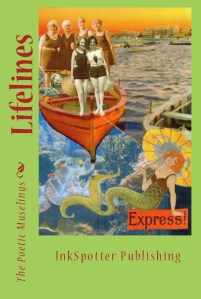
 Michele: Well, Lisa, we’ve had a bit of history since meeting in cyberspace at the October 2007 Muse Online Writers Conference. So much has changed for all of us! Your poetry workshop in 2008 was so powerful, it literally burned out your internet connection on that last day of chats. As I tap-danced my way through a room full of writers from all over the world, we decided to let you know what we were taking back with us from the intense week. Last November, Lifelines was published, the culmination of our efforts following the workshop.

 Did you ever think we’d be having this conversation, in this way, and this time?

Lisa: I had no idea what I was starting when I signed into that first workshop. I never expected that we would later meet up in various states. Now it makes perfect sense that  we are writing to each other, with each other, and in one another’s spaces.

 What do you think helped us succeed when so many drop by the wayside?

It seemed to me that you all immediately appreciated the potential of your sharing. Our workshop exercises asked you to step back and really listen to your work, yourselves, and each other. But you trusted each other, or at least wanted the possible outcomes enough to take risks together.

 We learned so much from you — what might we have taught you in return?

I was humbled to hold an early version of your manuscript, which would eventually become Lifelines, in my hands. It was the culmination of your shared perseverance and vulnerability. I was grateful to have witnessed its creation, even from afar. You taught me to remain open-minded with respect to what others may achieve.

As you know, I see connections in even the not-so-obvious places. When people “take root” in each others’ lives, all kinds of things are possible.

For me, connection has always meant to witness another person, to see, acknowledge and respect what’s important to them. I like how Dr. Brené Brown defines connection as ‘the energy that exists between people when they feel seen, heard, and valued; when  they can give and receive without judgment; and when they derive sustenance and strength from the relationship.’ I find her use of the word ‘sustenance’ compelling. It seems like an important part of the connection between the Poetic Muselings that became Lifelines.

Tell us about Moxie Mavericks — how does one “become” one? And why should one?

Moxie Mavericks is the name of my company, my professional life coaching practice. Moxie means gumption, derring-do, etc. But for me it’s a family value with which I was raised. I come from several generations of people who stand by their principles, whether they make us heroes, antiheroes, or observers. We enjoy each other’s stories. And those stories don’t even have to be spectacular, as long as they are real. We simply witness each other’s moxie when we see it. So people with similar values tend to feel at home here.

Mavericks are the sorts who get very serious about creating personal meaning in their lives. They are, by definition, out on the very edge of the frontier. It’s important to note that the landscape might be internal. People have special needs when they shift to maverick mode. It gets lonely out/in there. Very often others in their lives don’t see the singular vision that a maverick might have or initially understand the actions he or she chooses. So in coaching we build a space where mavericks can get customized support and feel safe to experiment with ideas.

We all have access to moxie and can be a maverick. It’s in there.

I know you are passionate about the concept of transition in an individual’s life. What does this mean to you? What are you seeing that’s so exciting?

People usually expect life coaching to be about defining their dreams, about setting and reaching goals, and about overcoming challenges like procrastination. Indeed, these are some of the tactical aspects of the work we do in coaching. But what I see over and over in my clients is a desire to make meaning out of a transition, to understand what’s being lost and gained by moving. In some cases, if we rush into goal setting we miss the opportunity to slow down and reflect. Forced goals lack authenticity. They are burdensome rather than enriching. Giving clients space and time for this reflection has deepened and enlivened the experiences my clients and I share.

As we talked recently, I envisioned transition as trying to figure out what you need to put in your backpack for a journey — and more importantly, what you must take out and leave out in order to make a transition. That’s the hard part — letting go of what only weighs you down. Any guidance on this? 

We often don’t know that we are entering the journey of a transition when it begins. Sometimes we realize we are far from “home” only when we feel lost. Something has changed but we don’t know what. We also might not know where we are going next. So it can be tricky to pack in advance. Either way, it helps to have a stash of compassion, for oneself and for others. We are all doing the best we can. We need to be patient with ourselves. This is how we can safely look at what’s holding us down. I won’t pretend that it’s easy work. The second handy item is appreciation for ourselves and others. I work with clients on spotting signature strengths–the ones that offer us the most pleasure and personal meaning when expressed. They make for an internal compass of sorts, one that can be recalibrated as interests change.

Where are you going with projects and other aspects of your life these days? 

People have been asking for retreats so I’m working that out. I understand more fully now how they might be of service. This fall two plays that my husband, Nick, and I wrote will be performed at the San Francisco Fringe Festival. Our program is called “Weird Romance”. We have a wonderful director, cast, and crew bringing our characters to life. It’s quite a treat to have others see your imagination walking and talking under the lights. We love hearing the audience laugh.

And what about your future? What’s coming up? 

I am exploring the vulnerability of stillness. It’s a wild ride.
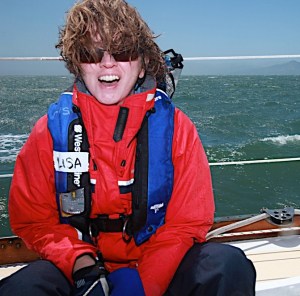
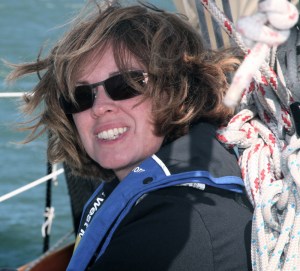
You can’t get away from here without a few words about one of the strangest boat stories I’ve heard in years — and I’m a (somewhat) experienced sailor!

What is the project that made you take to the seas, what’s happening with it now, and where do you see it going?

You are talking about Spirit of the Sea, a new youth sailing program for which I volunteer. This year we acquired a very special boat as our flagship, S/V Ocean Watch. In February we splashed her, cleaned her up, and sailed her from Anacortes, WA, to San Francisco, CA.

We take youth sailing on the San Francisco Bay at not cost to them. Just participating in the sailing of a boat and experiencing the marine environment can be powerful to our youth. But we’re taking it a step further by offering activities that incorporate experiential education, citizen science, and service learning to connect these kids with critical thinking, mentors, and possible career paths. We hope to instill these young sailors with a sense of agency that will transfer to other domains.

“No one makes that trip at that time by choice.” 

That’s exactly what half a dozen insurance agents said.

Why did you do it?

I no longer know why we delivered the boat at that time. To get it done, I suppose. I did it because it was a once-in-a-lifetime opportunity to sail with an incredible group of experienced and moxie-rich sailors, some of whom had become my dear friends. I did it because I had earned it. We had worked hard to get the program to that point and sharing this adventure was a celebration. Also, I was ready for a new way to access information about myself in the world. This is the point of the adventure coaching that I do with some of my clients. This adventure was an opportunity for me to exercise different strengths outside of my daily routine.

Any highlights?

I witnessed first-hand the value of a “game-face” in sailing leadership. It keeps everyone calm and focused. There were many perfect moments. There was a perfect hour of a perfect afternoon. I felt secure with my fellow crew so I was free to marvel at the ever-changing shapes of the waves, patterns of the bubbles, and colors of the waters. And I had some chocolate. I think I felt deeply myself and connected at the same time. But I find that the more I try to look back at these moments squarely, the more they seem to shimmer and dissolve. They are prismatic.

So my work now is to remember how these moments felt and stay open to those sensations in the future.

Was this a transitional journey for you?

It offered key moments in a larger transition. The engine died one morning at dawn, just before a shift change. So everyone was up, exhausted, and busy. While others tracked the problem and rebuilt parts I stayed on watch alone at the helm. We had no wind so we were especially vulnerable. Even once we started moving again, my job was relatively simple: monitor the radar, watch for hazards, make course adjustments, and scan the horizon through the binoculars. But I was absolutely satisfied. I loved that no one checked on me. As the sun came up I studied the beautiful sky and coastline and faced the notion that I had fulfilled, in one way or another, just about every promise that I had made to myself as a kid. I decided to not even review the list, to just let it all be. Now I’m shifting my focus from doing to being.

They say you never return from a journey to the same place. 

When I left I was thrilled that I didn’t know when I would return. I don’t think I’ve quite yet returned. I am practicing patience and expressing my curiosity.

Your websites are as eclectic as you are, Lisa — so much more to talk about at a later date! 

Glad to see that Spirit of the Sea is a recognized 501 tax-exempt Public Charity  — which means that donations not only go to a very good cause, but are tax deductible. I encourage our readers to look at this site and consider a donation to the worthy cause. (Hint: the price of a couple of lattes could help float the boat.):    www.spiritofthesea.org

Your theater production is a hoot! How I’d love to be in San Francisco on Sept. 8, 9, 11 or 14 to see “Weird Romance”:   http://www.sffringe.org

Thank you so much for joining us today! As always, we appreciate your generosity of spirit, wisdom, humor, and that sense of connection we cherish. Good luck with all your adventures.

Thanks, Michele. My pleasure, and I look forward to sharing more soon.

To learn more about what Lisa does, check out:  www.moxiemavericks.com


Sand in the Desert: Putting Together a Poetry Collection

I am a way-back science fiction fan, but until November,  2010, I had never

written a science fiction story. The

The cover for my forthcoming poetry collection

truth is I had a phobia about it, mainly about the world-building, which in the abstract intimidated me.

Around September or October of 2010 I decided I would simply go for it and write a science fiction novel for NaNo.  I started with the world-building: the planet, the aliens, the Terran Federation, the aliens’ society, values, arts, politics (or lack thereof). I’d been mulling over several things for years: a society based on personal responsibility, and one where the “normal” relationships contained multiple partners and included same-sex relationships.  I continued happily outlining the society and the people. I noted down about a page about the plot, including the main character, his father, and a couple of others.  I decided to write a YA/MG sci fi novel.

For various reasons which I will not fully divulge, in case any of y’all decide to read the book, I needed my aliens to be distinctive but not outlandish. I needed them to have skin color that could be found here on earth, yet still be distinctive, so for this and a number of other reasons, one of them being that I was damned sick of the good guys always being white, I made my aliens, my main character, and his father Black.

I also wanted to participate in Robert Lee Brewer’s Poetic Asides November Chapbook challenge, so I conceived of a poet to tie the two together. One of my alien characters is a scholar, and my main character ends up studying the poems of my imaginary poet. Raketh Namar, the author of the poems, exists in the universe of the novel some five thousand years before the action of the book on planet Aleyne. Raketh Namar, the poet, was the author of one of the most sacred texts of my aliens, the Aleynis. I don’t usually write prayers or write about spiritual subjects, yet I found myself writing them without difficulty. Raketh Frey, the main character in the novel, studies these poems during the course of the action. Eight of the poems, noted in the acknowledgments, appear in the book.

In the universe of the novel, this collection of poems was translated into English Common Speech by two of the other characters in the novel, Ardaval Namar and Gavin Frey, the father of my main character, Raketh Frey. Aleynis do not translate their sacred texts, and this translation is therefore unusual.

 Having written the poems, I wanted to put together the collection and publish it, but having dilly-dallied for some time, I decided to self-publish. At the present time, I have a cover, designed by Karen Cioffi, and Michele Graf has edited the collection, including some valuable suggestions about the order of the poems.

All I have left to do is to hop over to CreateSpace and  put the whole thing into their system, and after that I have to decide on a price.

Here is one of the poems, one that does not appear in the book:

Ode to My Father

When I was very small child
he was as tall
as the stars.

When I was boy-high
he had shrunk
to the height of a large tree

When I became a man,
he shrank to the size
of a fist.

When I became a father,
he rose again.
His head touched the sky.

Now he is gone.
I take my small son
and point heavenward.

“There is your grandfather”

Forms of the Muse

When we Poetic Muselings first approached the idea of putting together a poetry collection, our initial theme was that of the muses. It didn’t work out, and you can read about that journey here. However, I still think the Muses is a good topic.

The origin of the muse goes back to the nine muses of Greece. There are four different versions of their parentage, so I won’t delve into that. It is said that all tales and songs, all inspired knowledge, come from the Muses. Each has their own specialty and associated emblem. These are the most common names and attributes:

Calliope, muse of epic song, carries a wax tablet. Clio, muse of history, carries a scroll. Euterpe, muse of lyric song, plays a double flute. Thalia, muse of comedy and bucolic (characteristic of the countryside or pastors) poetry, is seen wearing a comic mask and ivy wreath, holding a shepherd’s staff. Melpomene, muse of tragedy, wears a tragic mask and ivy wreath. Terpsichore, muse of dance, is seen dancing while playing a lyre. Erato, muse of erotic poetry, plays a maller lyre. Polyhymnia, muse of sacred song, is depicted veiled and pensive. Urania, muse of astronomy, is pictured with a celestial globe.

The nine canonical Muses. From left to right: ...

The nine canonical Muses. From left to right: Clio, Thalia, Erato, Euterpe, Polyhymnia, Calliope, Terpsichore, Urania, and Melpomene. Drawing of a sarcophagus at the Louvre Museum. (Photo credit: Wikipedia)

Mousa, in addition to being the greek word for “muse”, literally means “song” or “poem”.

In modern day, the word muse has a much broader meaning. It no longer refers to the original nine. Much more personalized, everyone can have their own muse, the source for his/her inspiration.

The muse comes in different forms. For some, it is a creature – perhaps a fairy or a dragon. For others, it is something specific in their life that inspires them – nature, walking, music. Perhaps it is an actual person – a friend, sibling, or spouse that you speak to and come away re-enthused and inspired.

My muse is more likely to show up if I play Celtic music. It can come in the form of a woman, or a dragon, or merely magic in the air that blocks out the rest of the world.

Stephen King has a muse, which he writes about in his book “On Writing: A Memoir of the Craft.”

There is a muse, but he’s not going to come fluttering down into your writing room and scatter creative fairy-dust all over your typewriter or computer station. He lives in the ground. He’s a basement guy. You have to descend to his level, and once you get down there you have to furnish an apartment for him to live in. You have to do all the grunt labor, in other words, while the muse sits and smokes cigars and admires his bowling trophies and pretends to ignore you. Do you think this is fair? I think it’s fair. He may not be much too look at, that muse-guy, and he may not be much of a conversationalist (what I get out of mine is mostly surly grunts, unless he’s on duty), but he’s got the inspiration. It’s right that you should do all the work and burn all the midnight oil, because the guy with the cigar and little wings has got a bag of magic. There’s stuff in there that can change your life.

Later he writes about the importance of having a regular writing schedule, and how it is for the muse as much as for yourself.

Don’t wait for the muse. As I’ve said, he’s a hard-headed guy who’s not susceptible to a lot of creative fluttering. … Your job is to make sure the muse knows where you’re going to be every day from nine ’til noon or seven ’til three. If he does, I assure you that sooner or later he’ll start showing up, chomping at his cigar and making his magic.

If you’re always waiting for inspiration to write, you won’t get much done. Is it not better to exercise your writing muscles while you wait for your muse to come to you? Even if all you do is stare at a blank screen, you are opening yourself for it to come.

What form does your muse take?


(Bulk of article was originally written for a Writing.com Fantasy Newsletter in 2008)


Thank You for the Publication Leads

Hands put over another, palms down.

I have several poems and art works published lately.

First is Issue 1, Volume 2 of the Restoration Earth Journal, http://www.oceanseminarycollege.org/RE_May_2012.pdf. My collages and poems appear on pages  21 (“Hathor’s Chorus”), page 79-80 (“La  Fleur” and  “The Photograph” ) and page 95 (“Lady in Red”). I appreciate Anne Westlund for suggesting I submit to that journal, which she is published in as well.

Next, three poems are published in Love and Other Passions by the Poets of Central Florida, http://www.amazon.com/Love-Other-Passions-Central-Florida/dp/098515070X.  This came about because of a poetry group I belong to. You can find such groups on MeetUp.

Last, I had my poem A Painful Wait and its art work published in Quarter After, http://quarterafter.org/2012/03/19/issue-no-1/.

I’d like to thank all those who recommended these venues to me. The power of friends helping friends with publication leads can’t be overestimated. So thank you, everyone!


Focus on Form: Villanelle

Welcome to Focus on Form. For the next three weeks, each of us Muselings will be writing a poem in the same form and sharing it here on the blog. 

Welsh poet Dylan Thomas

Welsh poet Dylan Thomas (Photo credit: Wikipedia)

Form

A villanelle is a 19th century form was originally a song/dance sung by a troubadour. The modern form developed in the 19th century.

Rules

A Villanelle is a a nineteen line poem consisting of five tercets and a concluding quatrain. It contains only two rhymes. The first and third line of each of the tercets and the first and final two lines of the concluding quatrain form one, and the middle lines of the tercets and the second line of the quatrain form the second.  In addition, the first and third lines of the first tercet are refrains. Thus. let A1, B1 A2 be the first tercet, and a small a or b indicate a line that rhymes with either the A lines or the B line, the poem lays out as:

A1, B1, A2    a3, b2, A1    a4, b3,A2    a4,b4,A1   a5,b5,A3    ,b5,A1,A2

In addition to the rhymes and the refrain,  in a classic villanelle, the lines themselves should be in iambic pentameter and the repeated lines be repeated without variation.

Tip: pay careful attention to the first stanza, and especially to the end words, as you will need to find a goodly number of rhymes for them.

Examples

Do Not Go Gentle Into That Good Night
Dylan Thomas (1914-1953)

Do not go gentle into that good night,
Old age should burn and rage at close of day;
Rage, rage against the dying of the light.

Though wise men at their end know dark is right,
Because their words had forked no lightning they
Do not go gentle into that good night.

Good men, the last wave by, crying how bright
Their frail deeds might have danced in a green bay,
Rage, rage against the dying of the light.

Wild men who caught and sang the sun in flight,
And learn, too late, they grieved it on its way,
Do not go gentle into that good night.

Grave men, near death, who see with blinding sight
Blind eyes could blaze like meteors and be gay,
Rage, rage against the dying of the light.

And you, my father, there on the sad height,
Curse, bless me now with your fierce tears, I pray.
Do not go gentle into that good night.
Rage, rage against the dying of the light.


One Art
Elizabeth Bishop (1911-1979)

The art of losing isn’t hard to master;
so many things seem filled with the intent
to be lost that their loss is no disaster.

Lose something every day. Accept the fluster
of lost door keys, the hour badly spent.
The art of losing isn’t hard to master.

Then practice losing farther, losing faster:
places, and names, and where it was you meant
to travel. None of these will bring disaster.

I lost my mother’s watch. And look! my last, or
next-to-last, of three loved houses went.
The art of losing isn’t hard to master.

I lost two cities, lovely ones. And, vaster,
some realms I owned, two rivers, a continent.
I miss them, but it wasn’t a disaster.

–Even losing you (the joking voice, a gesture
I love) I shan’t have lied. It’s evident
the art of losing’s not too hard to master
though it may look like (Writeit!) like disaster.

My own try:

This poem comes from Robert Lee Brewer’s PAD challenge for April 18th: take a regional cuisine and make it the title of the poem

Southern Fried Chicken

A chicken fried in oil’s a wonderous thing
so spicy, crispy, crunchy with a golden crust
You’ll take a bite. Your mouth will want to sing.

Add salt, paprika for that special zing.
A pinch of jalapeno is a must.
A chicken fried in oil’s a wonderous thing

The spicy pepper adds a bit of bling
to penetrate the chicken’s flesh.  I trust
you’ll take a bite. Your mouth will want to sing.

The oil must be hot so you can bring
the crust to crispness. As we have discussed,
a chicken fried in oil’s a wonderous thing

Keep clear of boiling oil. It will sting.
If oil becomes too hot it may combust.
You’ll take a bite. Your mouth will want to sing.

At last the chicken’s ready, and you spring
to action, find the flavor most robust.
A chicken fried in oil’s a wonderous thing
You’ll take a bite. Your mouth will want to sing.

Your Turn

Now I open it up to you. I welcome any feedback on my poem, as long as it is constructive and not destructive. Let’s help each other improve.

I’d love to see your own attempts at the form as well. You can post them in the comments here, or on future posts, or link to your poem if it’s on a separate site.


Enhanced by Zemanta

Make Visible: Story a Day

It’s almost May…

On the Story a Day website it boldly says: StoryADay.org is home to an annual Extreme Writing Challenge:

Write a story every day in May.

Still confused.  Want more info.  Here are “The Rules” from StoryADay.org.

The Rules

You must stay drunk on writing so reality cannot destroy you. ~Ray Bradbury

The Story A Day Challenge is a creativity challenge.

It came about when I (Julie) needed to prove to myself that I could still actually write stories — not just talk about writing, read about writing or even write about writing!

I needed bootcamp.

I declared May 2010 to be StoryADay May and set about telling the world (to keep myself honest).

As other writers started to hear about it, they clamored to sign up. They got excited. They challenged themselves. They challenged their friends. They wrote a lot. And some of them went on to do great things.

So here we are, declaring May 2012 to be:

The 3rd Annual Story A Day May

The rules:

  • Write (finish) a story every day in May.

The details:

  • Stories may be any length (50 words? 5,000?) but they must be stories (they must take us or the characters somewhere).
  • Stories may be fiction or non-fiction (but if you’re already blogging in non-fiction or keeping a journal, consider trying fiction)
  • You get to decide what “every day” means. If you need to take Sundays off, go for it. You make your own rules, but you are encouraged to set them up early, and stick to them!
  • Sign up as part of the community here. Get a username and join in the groups and comments. (sign-ups open soon. join the StoryADay Advance Notice List to be first in line)
  • You can post your story at your site, or in the forums here or you can simply post an update in the Victory Dance Group saying that you completed that day’s story.

The point:

  • To foster creativity
  • To come out with 31 first drafts, nuggets, chapterettes, ideas, and
  • To prove that you can craft a story. Lots of stories. To practice that craft

What Should You Do Next?

  • Get on the Advance Notice List to find out when sign-ups open (I only open it up sporadically, to combat spam sign-ups) PLEASE email me at editor at story a day dot org or contact me on twitter @StoryADayMay if you have questions. Really sorry for any inconvenience.
  • Take a look at the Inspiration and Productivity links on the Resources page.
  • When you have a username, Make some friends,, Join or create a group.
  • Most of all, gather your ideas between now and May 1. You’re going to need at least 31 of them.

This story a day business sounds intriguing and challenging!  If you are interested please go to the Story A Day website to find out more.

The Stories of Ray Bradbury

The Stories of Ray Bradbury (Photo credit: Wikipedia)


Enhanced by Zemanta