sharing a poetic LIFELINE with the world

Archive for the ‘Creativity’ Category

My Birthday and Paul Revere’s Horse

I promised myself I would memorize Henry Wadsworth Longfellow’s poem, “Paul Revere’s Ride” by the time I reached my ninth birthday.

I’d already mastered the spelling of “antidisestablishmentarianism” — I had no clue of its meaning, but someone bet my third grade teacher that she couldn’t teach at least one of her students to spell it. My memory is that she asked me, the star speller in our class, if I’d like to give it a try.

I loved school, loved Miss Elliott, was an obsessive reader well beyond my grade level, and was excited to be picked. To this day, I can rattle off the letters correctly, as long as I do it quickly and don’t over-think.

When we read “Paul Revere’s Ride” in class, it was immediately my favorite because that famous ride happened on my birthday, “the eighteenth of April”. I mean, how cool is it to share my day with Paul Revere and his horse? I still remember several stanzas.

This past birthday occurred in the middle of a critical week in Boston. Broken-hearted, I watched, read and listened to more news reports than I’d done for several years. The courage and resilience Boston and the rest of the country showed touched me deeply.

I had planned to post a wacky “coming of age” poem, about what it means to turn sixty-five. (That’s 455 dog years, if you we’re wondering.) I’ll hold that for another time.

Instead, I decided to share Longfellow’s poem, written in 1860, at another critical point in our history. Yes, Longfellow took some poetic liberties in this work, but his message shines through. As you read it, see if the strong spirit that moved me nudges you a bit, too — especially the first and last few stanzas.

Michele

Paul Revere’s Ride

Listen, my children, and you shall hear
Of the midnight ride of Paul Revere,
On the eighteenth of April, in Seventy-five;
Hardly a man is now alive
Who remembers that famous day and year.

He said to his friend, “If the British march
By land or sea from the town to-night,
Hang a lantern aloft in the belfry arch
Of the North Church tower as a signal light,–
One, if by land, and two, if by sea;
And I on the opposite shore will be,
Ready to ride and spread the alarm
Through every Middlesex village and farm,
For the country folk to be up and to arm.”

Then he said, “Good night!” and with muffled oar
Silently rowed to the Charlestown shore,
Just as the moon rose over the bay,
Where swinging wide at her moorings lay
The Somerset, British man-of-war;
A phantom ship, with each mast and spar
Across the moon like a prison bar,
And a huge black hulk, that was magnified
By its own reflection in the tide.

Meanwhile, his friend, through alley and street,
Wanders and watches with eager ears,
Till in the silence around him he hears
The muster of men at the barrack door,
The sound of arms, and the tramp of feet,
And the measured tread of the grenadiers,
Marching down to their boats on the shore.

Then he climbed the tower of the Old North Church,
By the wooden stairs, with stealthy tread,
To the belfry-chamber overhead,
And startled the pigeons from their perch
On the sombre rafters, that round him made
Masses and moving shapes of shade,–
By the trembling ladder, steep and tall,
To the highest window in the wall,
Where he paused to listen and look down
A moment on the roofs of the town,
And the moonlight flowing over all.

Beneath, in the churchyard, lay the dead,
In their night-encampment on the hill,
Wrapped in silence so deep and still
That he could hear, like a sentinel’s tread,
The watchful night-wind, as it went
Creeping along from tent to tent,
And seeming to whisper, “All is well!”
A moment only he feels the spell
Of the place and the hour, and the secret dread
Of the lonely belfry and the dead;
For suddenly all his thoughts are bent
On a shadowy something far away,
Where the river widens to meet the bay,–
A line of black that bends and floats
On the rising tide, like a bridge of boats.

Meanwhile, impatient to mount and ride,
Booted and spurred, with a heavy stride
On the opposite shore walked Paul Revere.
Now he patted his horse’s side,
Now gazed at the landscape far and near,
Then, impetuous, stamped the earth,
And turned and tightened his saddle girth;
But mostly he watched with eager search
The belfry-tower of the Old North Church,
As it rose above the graves on the hill,
Lonely and spectral and sombre and still.
And lo! as he looks, on the belfry’s height
A glimmer, and then a gleam of light!
He springs to the saddle, the bridle he turns,
But lingers and gazes, till full on his sight
A second lamp in the belfry burns!

A hurry of hoofs in a village street,
A shape in the moonlight, a bulk in the dark,
And beneath, from the pebbles, in passing, a spark
Struck out by a steed flying fearless and fleet:
That was all! And yet, through the gloom and the light,
The fate of a nation was riding that night;
And the spark struck out by that steed, in his flight,
Kindled the land into flame with its heat.

He has left the village and mounted the steep,
And beneath him, tranquil and broad and deep,
Is the Mystic, meeting the ocean tides;
And under the alders, that skirt its edge,
Now soft on the sand, now loud on the ledge,
Is heard the tramp of his steed as he rides.

It was twelve by the village clock,
When he crossed the bridge into Medford town.
He heard the crowing of the cock,
And the barking of the farmer’s dog,
And felt the damp of the river fog,
That rises after the sun goes down.

It was one by the village clock,
When he galloped into Lexington.
He saw the gilded weathercock
Swim in the moonlight as he passed,
And the meeting-house windows, blank and bare,
Gaze at him with a spectral glare,
As if they already stood aghast
At the bloody work they would look upon.

It was two by the village clock,
When he came to the bridge in Concord town.
He heard the bleating of the flock,
And the twitter of birds among the trees,
And felt the breath of the morning breeze
Blowing over the meadows brown.
And one was safe and asleep in his bed
Who at the bridge would be first to fall,
Who that day would be lying dead,
Pierced by a British musket-ball.

You know the rest. In the books you have read,
How the British Regulars fired and fled,–
How the farmers gave them ball for ball,
From behind each fence and farm-yard wall,
Chasing the red-coats down the lane,
Then crossing the fields to emerge again
Under the trees at the turn of the road,
And only pausing to fire and load.

So through the night rode Paul Revere;
And so through the night went his cry of alarm
To every Middlesex village and farm,–
A cry of defiance and not of fear,
A voice in the darkness, a knock at the door,
And a word that shall echo forevermore!
For, borne on the night-wind of the Past,
Through all our history, to the last,
In the hour of darkness and peril and need,
The people will waken and listen to hear
The hurrying hoof-beats of that steed,
And the midnight message of Paul Revere.

Poetry Month: Book Spine Poetry

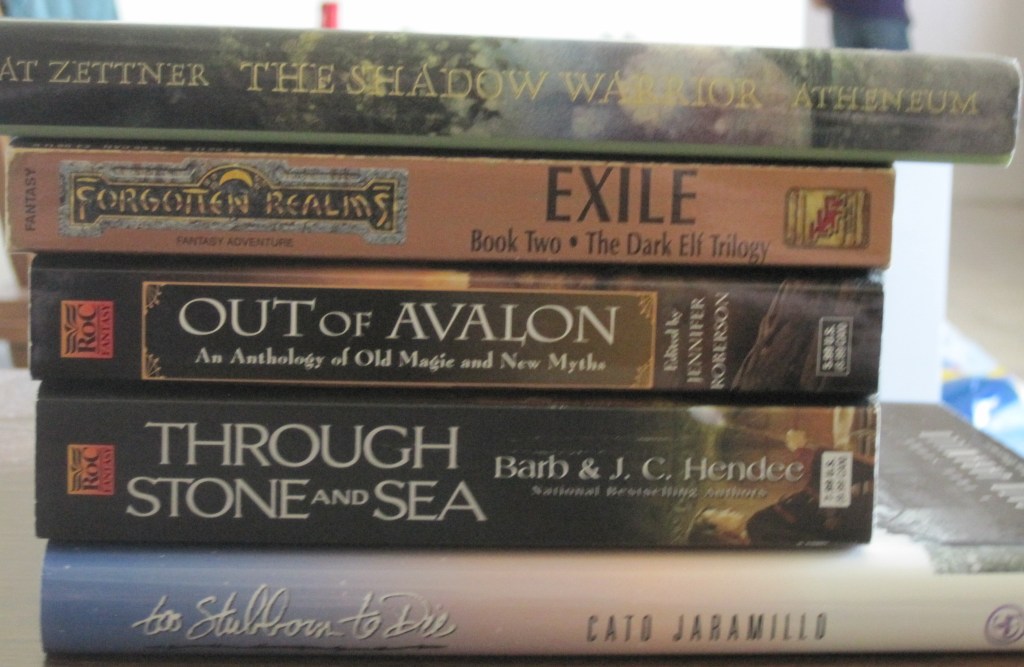
If you’re not aware, April is National Poetry Month. Next week is also National Library Week. AtYourLibrary.org is celebrating both with a contest. Use the books from your library to compose a Book Spine Poem telling why the library matters to you (deadline April 20). I haven’t made it out to my library yet, but wanted to make my own book spine poem. This isn’t themed about the library, and was made using my personal library.

A book spine poem is made by stacking book spines so the titles make a free verse poem.

book-spine-poem-e1365800953188

Mary’s Book Spine Poem

In case that’s hard to read, or the image doesn’t load, it reads:

The Shadow Warrior
Exile

Out of Avalon
Through Stone and Sea
Too Stubborn to Die

It was a fun challenge going through all my books, pulling and mixing and shifting trying to find something I liked and that told a story. I’d lvoe to see what you come up with from your own libraries.

mary-sig2 (1)

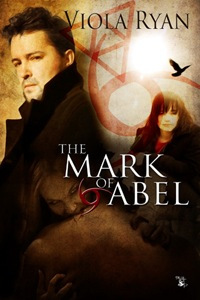
The Mark of Abel, by Viola Ryan

mark-of-abelSo exciting to introduce you to Viola Ryan, an amazing woman in her own right, plus two of her Main Characters who insisted on getting in on the act today to discuss their new book, The Mark of Abel, (details below) the first book in her series. I’ve heard about these MC’s, read some of their words, but this is the first time they’ve been let loose in our blog.

Some teasers before the interview:

Is a frustrated artist Lucifer’s ticket back to heaven or will falling in love with her reawaken the compassion that got him expelled?

Lucifer is fed up with humanity. He created hell to deter evil, but man’s inhumanity is only escalating. He just wants to return home to heaven, but ever since that little problem in the Garden of Eden, the Pearly Gates remain firmly shut to him. It doesn’t help that he’s the first vampire, an abomination in God’s sight.

Fortunately, two thousand years ago Lucifer’s estranged brother, Jesus, gave him a prophecy. To fulfill it, all Lucifer has to do is find the right artist, study her artwork and the path back to heaven will be revealed. The artist even bears a symbol so he knows who she is. Too bad she is murdered every time he finds her.

Janie’s a frustrated artist and college art teacher who wants two things—a guy she can show her paintings to and a night without nightmares. Each nightmare plagues her until she paints it. She doesn’t realize these paintings are key to unlocking her destiny, one that could redeem the original fallen angel.

Wow! Ready to meet the gang?

Michele: Welcome, Viola! You and I have talked about your artistic and poetic characters, and I know you’ve all had quite a busy month. I’m going to let you play lion-tamer here, and be your spotter during this interview. So, the stage is yours, to mix my metaphors . . .

Viola Ryan:  Thank you for inviting us! Both Lucifer and Janie are anxious to explain why they are each right and the other is . . . not-so-on-track. They promised to behave, mostly, so we’ll see. So, I’d like to welcome Lucifer and Janie, the stars of my debut release The Mark of Abel, to The Poetic Muselings.

Lucifer: Roses are red, Violets are blue, Hell is hot, and so are you.

Janie: Luke! Shame on you. Michele was nice enough to let us be here and Viola took time aside from writing the sequel. (aren’t you dying to find out what she’s going to do to us next?) Poetry is important.

Lucifer: What do you know about poetry? You’re an artist. A picture speaks a thousand words.

Janie: But that’s what a poem does. It isn’t the sum of its words. It paints a picture every bit as much as my paintings do.

Lucifer: So no dirty limericks?

Janie: NO! Viola please continue. 

Viola: Thank you, both. You can see why he’s so much fun to write.

Janie: When he’s not brooding over how God has wronged him.

Lucifer: God wronged you, too. And I don’t brood.

Janie. Sulk? Pout? Whine?

Lucifer: Not funny. 

Janie: Not even a little bit?

Viola: (laughing), more than a little bit. Back to the interview you guys. Geeze, it’s like I’m  writing The Mark of Abel again. You two like to go on your own little paths regardless of what I want you to do. 

Lucifer: And you love every minute of that.

Viola: Maybe.  Back to the interview. Since we are at the Poetic Muselings, I thought we’d talk a bit about Janie’s art and art in general. Janie’s been reincarnated many times, but she’s always an artist of some sort. Why do you think that is?

Janie: Art always speaks to something deep in me. I have to paint or express myself someway or I’ll explode.

Lucifer: You are creative and a priestess. Put those together and you get some type of artist. Poets, too.

Viola: What do you mean a priestess?  You aren’t exactly chummy with God anymore. 

Lucifer: There is a greater truth to this universe that supersedes even God. Janie’s art helps people reach that. That’s what good art does.

Janie: I didn’t know you felt that way. I’ve always believed that. Art is a way to reach a deeper understanding. That’s why I teach art appreciation at Archer College. Art speaks a language that lives deep inside us. A picture does more than speak a thousand words. It speaks things words themselves cannot. It reaches our souls. It feeds our souls, something modern society starves for. That’s why society needs artist of all sorts, including poets.

Viola: You mentioned you’d explode. Can you go into this?

Janie: I have horrible nightmares. If I don’t paint them, they build up inside me. The pressure is intense. For awhile I tried to resist painting them. I want to paint happy paintings, like Renoir. First, my muse fled. She wasn’t going to let me paint anything pretty. Then I felt tingles in my extremities. I was constantly flexing my hands to try and shake this off. It didn’t work. Eventually, I felt like I was having a heart attack, like my heart was actually being crushed. I had to give in. As soon as I started painting my nightmares, the pain went away.

Lucifer: It’s a good thing you kept painting them or we never would have figured things out. They were–

Janie: No spoilers.

Viola: Thank you. Your paintings are one of the most important twists in the book.

Lucifer: Hey, what about me? I’m not the red horned, pitchfork wielding Devil everyone knows and hates.

Viola: I know. I said, ONE of. Of course the reimagining of Judeo-Christian stories is the most important twist and a lot of fun to write.

Lucifer: I like being the first vampire.

Viola: I’m glad. It’s getting to be dinner time here for me, so do either of you have anything else you’d like to say?

Lucifer: Ladies first.

Janie: Isn’t he cute? He really is a gentleman in many respects. What I’d like your reader to do is give him a chance. A lot of what you’ve heard is wrong. He’s no teddy bear, but he’s not a bad guy.

Lucifer: Thanks. I should say something nice here about Janie, but she’s laid her heart out and there is nothing more beautiful than that. Words would just mess things up. I  wish I could write a poem demonstrating how wonderful she is, but I can’t. Maybe your readers can do that.

Viola: Thank you both for coming. Thank you Michele for having us. Feel free to ask us anything in the comments. We’ll be around if you want to chat.

Michele: Thank you, Viola, Lucifer, and Janie. I love the intricacy of your story, the intensity, and creative re-presenting of issues. Things are never what they seem. I know you are all working madly on the next book, and hopefully, working together! We’re so glad you joined us.

Our readers can add their comments to this post, and we’ll make sure you have a chance to respond.

holy-hell-blog-tour-mark-of-abel

We’re including links to your awesome Book Trailer, (LOVE the soundtrack!) and publishing details. The Mark of Abel is in ebook now, and will be in print in September 2013.

MuseItUp Publishing:  http://museituppublishing.com/bookstore2/index.php?page=shop.product_details&flypage=flypage.tpl&product_id=516&category_id=69&manufacturer_id=250&option=com_virtuemart&Itemid=1&vmcchk=1&Itemid=1

Amazon: http://www.amazon.com/The-Mark-of-Abel-ebook/dp/B00B0FSH9A/ref=sr_1_4?ie=UTF8&qid=1358130524&sr=8-4&keywords=The+Mark+of+abel

 Trailer Link: http://www.youtube.com/watch?v=UayqdSPMFMQ&feature=youtu.be

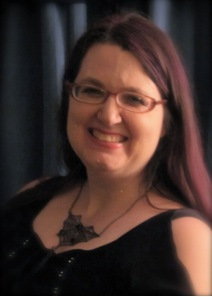
viola-ryan
And a bit about Viola Ryan:

A very good friend of Viola Ryan in high school said, “You don’t think outside the box. You blow the thing up.” Sometimes boxes need exploding. That’s why she’s here. She has a whole bag of C4 and isn’t afraid to use it. She’s blessed with people who treasure her eccentricities or at least put up with them.

Sometimes the box can be a cozy place. Without some sort of stability, her two daughters’ and her life would be unmanageable. That stability comes from her husband. He’s the rock holding her family together.

On the flip side, his career is anything but stable. He’s a Chief Marine Safety Technician in the US Coast Guard. They’ve lived from Kittery, Maine to Yorktown, Virginia. Fortunately, the moves have all been on the east coast. Then again, the Coast Guard tends to guard the coast.

Her oldest daughter (16) was born on Cape Cod, not far from Plymouth. Massachusetts. Her youngest (12) was born in Yorktown, Virginia, down the road from Williamsburg. Viola jokes they’re doing the colonial America tour.

Social Media Links:
Website: http://www.violaryan.com/ 
Blog: http://violaryanauthor.blogspot.com/
Facebook: http://www.facebook.com/jeanie.ryan.9
pinterest: http://pinterest.com/violaryan/
Goodreads: http://www.goodreads.com/author/show/6922260.Viola_Ryan
Amazon Author Page: http://www.amazon.com/author/violaryan


Make Visible: Criticism

write-picI’m a poet with a particular point of view.  In these next blog posts I’ll post poems on different subjects from my point of view.  Each poem is an expression, through me, of inspiration or Spirit or emotion. What you see in this light is what you bring to the poem.

Criticism of your writing, your looks, or your personality, whether positive or negative, has an impact.  As “sensitive poets,” perhaps we react even more strongly than others.  Remember, when life gives you lemons, make lemonade (or lemon bars)!


Today, I offer you this poem about criticism.


Made lemon squares today. The crust is similar...

(Photo credit: Wikipedia)


Lemon Bars Deluxe

Bitter with the sweet

Criticism unasked for
Compliments as well

Sprinkled with powdered sugar
Melting in my mouth

How much honey
Will take away the sting?

Your words sweeter
With every bite of lemon.

© Anne Westlund


Come back on Friday, April 5, for Make Visible: Love and Attraction

“Make visible what, without you, might perhaps never have been seen.”~Robert Bresson, French Film Director

Enhanced by Zemanta

The Mystery- Dealing with Grief

The  Mystery

By Lin Neiswender

You were the cutest thing
So happy with a simple toy like green grass
A carpet to comfort your feet
Leaves blowing down sidewalks

Yours to track  by scratchy sound
When  wind blew stone-cold
Sharing a snack with the rest of the pack

Barking fiercely while picking goodies
from kitchen trash bin with no one home
Quick to guard me like a Rottweiler

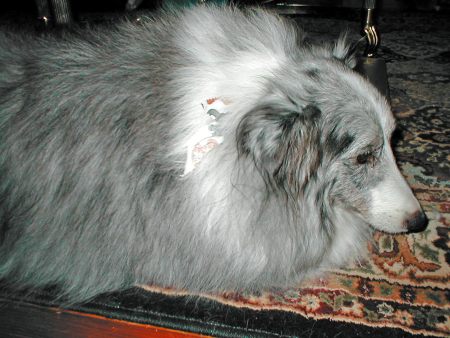
But actually just a Shetland Sheep dog
Who then dashes behind me for protection
Mysterious fur shiny white, gray, black and silver

White lion’s mane, stripes  on face, back, chest, feathers on legs
He could have been a show dog if he was a little shorter
You are a shy but beautiful boy

But I know that someday
We will meet again, all of us,
Humans and dogs and cats  and everyone

As we dance our way


OLYMPUS DIGITAL CAMERA

I had to put my sweet Sheltie Smokey to sleep last Saturday.When I saw the suffering in his eyes and it seemed to say Mom, please do something for me. So I did the right thing and had him put to sleep. Cancer has taken another of my sweet dogs. I’m across the Rainbow Bridge still expecting to see him when I first come in. When thoughts come like that, I know I can find comfort about my decision. He is out of pain. What a good dog he was. So now life goes on with me and the cat.


Enhanced by Zemanta

Make Visible: Light Through a Window

Stained glass window 2

Stained glass window 2 (Photo credit: Wikipedia)

There’s the poet, then there’s the poem. One cannot exist without the other. Every poet has their own particular point of view. Like light through a stained-glass window, the poet filters inspiration. The poet is the stained glass. The light is inspiration or Spirit or emotion. The light and the stained-glass together create a special kind of light. That light becomes the poem.

I’m a poet with a particular point of view. In these next blog posts I’ll post poems on different subjects from my point of view. Each poem is an expression, through me, of inspiration or Spirit or emotion. What you see in this light is what you bring to the poem.

For without an audience we are just playing to an empty room.

Anne Westlund


Today’s subject is Paper (and writing).

To a Piece of Paper

Here is the dance floor
parqueted with words,
Here is the curtained bed,
Here is the blank blueprint
where dreams find their architect,
Here is the cloudbank
from which God’s hand emerges,
Here is the egg,
from which tall tales are birthed.
Here is the wide field
of my imagination.

© Anne Westlund


Come back on Friday, March 22, for Make Visible:  Criticism.


“Make visible what, without you, might perhaps never have been seen.”~Robert Bresson, French Film Director


Boundaries and Compassion: Relationships

Our thanks once again to mega-mentor Lisa Gentile, for this follow-up to Boundaries and Compassion (Part 1).

harlee-sketchLisa’s thoughtful response to the questions at the end of the post were what I needed recently to reframe a situation with someone I trust and worked closely with in the past. We hit a couple of communication and expectations bumps that left us both at odds. (Continued at the end of Lisa’s post). 

How do you choose your confidant?

In general, confidant candidates appear randomly in my life. A client of mine recently said that when she shares a little, enters a vulnerable space, and her conversation partner then shares a little bit in that vulnerable space they can begin to build trust. It starts with a risk. It takes trust to build trust.

I am grateful to have a handful of confidential relationships. We can go to each other to share aspirations, successes, confessions, and challenges without fear of eliciting resentment or judgment from each other. But these feelings do come up, we’re only human. We try to be compassionate toward ourselves and each other and say, “Hey, this topic is awkward for me right now. I’m not up to this.”

When I need to share something specific I consider who is physically, emotionally, and mentally available and maybe who is already close to the topic at hand. I suspect that I also consider which of my friends seems to reflect the image of myself that I want to live up to through the matter of the moment. That gives me a sense of safety when I’m vulnerable. This bias is natural. However, I do trust my confidants to hold me accountable and to call me out on flawed logic or restrictive thinking.

How do you recognize and communicate the type of feedback you need? 

First I spend some time in my “cave”, in the swim lane, or on the trail trying to figure out whether and where I am stuck. I try to notice which thoughts are circling in my mind, where I draw blanks, or what I feel I need to express. The researcher in me likes to determine what information I need in order to reach an actionable decision. Then I can go to a friend and say, “I need your help in looking at blank.”

But it’s not always so simple to reach a clear hypothesis. So more and more I do myself the favor of realizing earlier in the process that I can explore these very questions with a confidant or, depending on the topic, my coach. I can bring in support sooner rather than later.

How do you recognize unjust and/or inappropriate comments or actions from others?

It starts in the gut, the heart, or the brain. Pick an organ. We all want to feel appreciated for who we are. If I feel unheard, used, or otherwise discounted I hold back. If I think that the other person is determined to project his or her own agenda rather than respect my effort to share myself and reach out, I am discouraged from sharing more at that time. It might be that the timing is bad for one or both of us. It might be habitual.

But we can be more methodical about identifying unsafe harbors. One approach is to be aware of I-statements that are really you-statements in disguise. I-statements are meant to be assertive or declarative without being offensive. An example of an I statement is, “I feel that my share of the work is too large.” This opens the conversation up for empathy, problem solving, and collaboration. An example of a cloaked you-statement is, “I feel that you are not a team player.” This statement bypasses the opportunity to solve the practical problem, puts the receiver on the defensive, and further isolates the sender. Few people will warm up to hearing “I feel that you . . . “

Especially in the creative world, I-statements can be pivotal in providing constructive criticism and even in giving compliments. The Wikipedia article on I-messages gives a nice example of feedback: “ . . . one might say, ‘I had to read that section of your paper three times before I understood it,’ rather than, ‘This section is worded in a really confusing way,’ or ‘You need to learn how to word a paper more clearly.’ (http://en.wikipedia.org/wiki/I-message)

When it comes to compliments, I would much rather hear, “I like it when you synthesize and reflect what I’ve said. I know you are listening,” than, “You are good.” The former is specific and describes a connection. The latter is a judgment.

Of course confidants can get away with more because they have trust equity. They are not evaluating the entire relationship after every sentence and they have time to elucidate messages. Furthermore, our interpretation of language is filtered by our beliefs and cultural norms so it makes sense to not be too quick to rule someone out. Deborah Tannen developed an interesting theory that we care about how the information we pass effects the receiver as much as we care about the information that we pass.

It would be nice if we all had the time, energy, and presence of mind to polish our communication skills from time to time. Short of that, if we continually encounter someone who doesn’t match our expectations of personal responsibility, it might be a good idea to keep a polite distance.

Does it happen repeatedly with the same person or people?

Difficult people have good days and easy people have bad days. I have grown close to people who initially offended me. I hope that others have given me a second, third, and fourth chance. But when it’s a recurring issue, I detach.

Specifically, what tactics have you developed to protect yourself in these situations, separating you (the recipient) from the message and sender of that message?

No kidding, when a comment catches me off guard I sometimes visualize an aikido turn that is designed to let the offending gesture roll past me and return me to my center stance.

If I must socialize or work with someone who probably means well but with whom I don’t feel mutual trust, I try to limit our interaction to group activities where there is not much pressure on one-to-one experience.

How and what do you communicate in this scenario?

It depends on the context and our relationship. Sometimes it’s helpful to “check-in.” I might ask whether there is something specific on the speaker’s mind. I might say I need a time out to sort out the issues. I might ask whether we can separate the issues together.

One conflict resolution technique that I use in the Moxie Mavericks Team Strengths Builder workshop can be useful here. Conflict often leads to mutual feelings of disrespect. Sometimes it helps to stop and share what we each value most in the situation—which signature strengths we are trying to express. Then we can appreciate each other and find a way for both objectives to be met.

How do you remain compassionate, but protect your personal boundaries?

Oh, the forgiveness I have received!

Life can be hard for all of us. At times people have assumed things about my life and therefore how I should behave. I’ve learned to try to not assume things about the lives of others. I don’t know what I don’t know. Hopefully, we don’t have to condemn others to protect ourselves. We need to nurture our own emotional resiliency.

Contracts are helpful. My sister and I are both business owners and sometimes we collaborate. When we do, we write and sign a contract. Some people think we’re silly. But we clarify and document our expectations so we can focus on collaboration. We define our boundaries for that particular aspect of our relationship.

How do you heal yourself after such an encounter?

To sustain performance, we have to manage our energies through a regular cycle of expenditure and recovery. Emotional energy is one of the four types that requires special attention. To recover my emotional energy after a difficult encounter, I acknowledge my negative feelings and show myself a little compassion. I use Dr. Kristen Neff’s guided meditations for self-compassion. They are available for free at www.self-compassion.org.

Sometimes it helps to make an effort to empathize and forgive, to consider the situation from the other person’s perspective. Then I do something that I enjoy in order to move toward positive feelings again.

What form of creativity helps you re-center and move forward again?

I like working in the yard or at the workbench because the projects require decisive action and the results are somewhat immediate. There are usually half a dozen projects that I can sand, paint, saw, drill, or dig at a moment’s notice. I like a walk in the woods, a swim, or a sail to really refresh. Knitting works in a pinch. These activities help me discharge energy from adrenaline and cortisol. Journaling and sketching help me sort out residual thoughts.

Lisa Gentile, M.S.
Moxie Mavericks Life Coaching
www.moxiemavericks.com
www.facebook.com/moxiemavericks
www.twitter.com/moxiemavericks
lisa@moxiemavericks.com

—–

Thank you, Lisa!

Identifying your own responsibility in these interactions, and engaging with coping skills to deal with the flow –  rather than reactive response – is something I need to remember. . . at the time of encounter. I need to also remember to breathe OUT without words or monkey mind thoughts to get my bearings.

Trying to get it all figured out before asking for help is another biggie — I’m really glad you stated that here. Too often, we — the helper types — think we should be able to handle “it” ourselves, and can waste precious time, psychic energy, and generate huge amounts of destructive worry and adrenal overload when we don’t consider our resources (like trusted confidants).

I’m glad I had your wisdom before I talked to my colleague. I addressed, and cleared the air, about one of our issues in a way that was constructive for both of us. My gut kept me silent about the other at that time; something wasn’t “right” about how I wanted to talk about it. Rereading this post made me realize I was approaching the problem with pseudo-“I” statements that were really “you” criticism.

Boundaries, Compassion, and Relationships — the very heart of so much of our poetry, no?

Michele


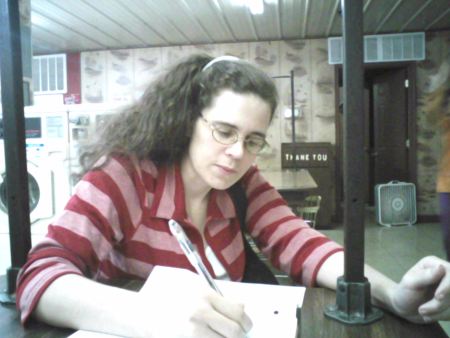
Meet Carla Girtman


Carla lives in Central Florida with her family and three cats (who claim they write better than she does). She has been writing since sixth grade (and
image00
still has most of her handwritten work in a box somewhere), but didn’t really have anything formally published until 1996 when her story “Me? I’m No Writer” was published in the Phoenix (Valencia Community College) magazine. She received her BA in English in 2000 and her MA in Technical Writing in 2005.

When she isn’t working undercover at an international airport or teaching online, she manages to write speculative flash fiction and especially enjoys writing microflash. Her flash stories have been published in Clockwise Cat, Flashshot, Demonic Tome, Flashes in the Dark, Short Humor Site, Blink Ink, 101 Fiction, and her work has appeared in two print anthologies, The Zombie Cookbook and Vicious Verses and Reanimated Rhymes. Carla is spearheading the anthology: Midnight Tarot: A Fool’s Journey; Mermaids, Zombies, and Vampires – O My! A collection of published and new fiction; and Fits and Starts: 102 Prompts For Story Inspiration. Carla has participated in the  National Novel Writing Month four successful times. Her first Nano novel When Elves Return has actually sold copies she didn’t buy herself.

She doesn’t really consider herself a poet and generally writes when the Muse stabs her with a pen.  Her poem, “When God Awakens,” appeared in The Corner Club Press and the poem “The Ring” found a home in Dark and Dreary Magazine. Her friend Linda, got her involved with the Muse Poetry Workshop which she helped develop the participant’s workbook. Carla mostly lurked in the Muse Conference due to restraints of grading 15 thousand-word rough drafts for her online composition class. Her favorite part of the Muse Conference was working with the Poetic Muselings and creating the workbook! She also enjoyed creating an aragman poem which did get into the workshop, and of course, it was about cats.

What kind of advice would she give to writers and poets? Set aside a regular time to devote to writing. (She’s also not very good at taking her own advice!) Don’t be afraid of rejection or be discouraged by it. A word written today is one less written tomorrow.

She enjoys reading, watching movies, and collecting antique books and the McDonald’s Madame Alexander miniature dolls.

Below are some poems that I have written.

Alarm! Tracing
the cat who hides
Alarm! Crating
The cat who snarls and yowls.
Alarm! Carting
The cat to the vet.

Alarm! Cat grin!

Aragman for the Muse Conference Poetry Workshop

Break Up

Upon the tin roof
Rain drums its tantrum.
Silver pillows of clouds
mound the sky.

Flashes of lightning
Flit like knives of fireimage01

Following the trail
To where my love lies.

Charting the storm
Which roils my heart,
I weep from loss
And wait for dawn.

(Photo is from Microsoft word’s clip art file.)
Poem was inspired by specific words for an anthology and was eventually withdrawn.

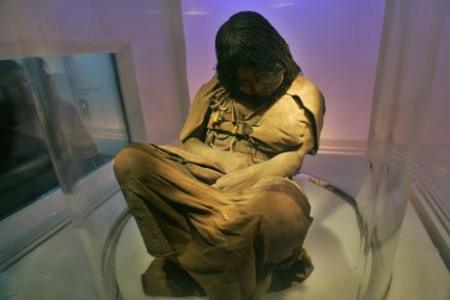
To the Young Mummy Recently Found

Atop an ancient volcano
Buried hundreds of years agoimage02

In a sanctuary shrouded in ice
a girl child was found below.
What thoughts went through your head
When to the altar led
To become the sacrifice?

Photograph by Maria Stenzel/NGS

Were you proud or full of dread?
You were ten, maybe twelve years old
Too young to shed your innocent blood.
The priests had hoped it would suffice
And appease their angry god.

You were frozen and preservedimage03

Your body to the god reserved.
Only once again to become a sacrifice
On the altar of science to be observed
And solve the riddle that would show
Why was a young novice
Buried hundreds of years ago
Atop an ancient volcano.

Photograph by Natacha Pisarenko/AP

Written for UCF poetry class inspired by a news story. Glose form.

Pictures found on http://news.nationalgeographic.com/news/2007/09/photogalleries/mummy-pictures/photo6.html
Shadow of Demons

With shadows of dread
In stillness dark, I alone
wrestle the demons.

Haiku – poetry group challenge

Ocean Song image04

Under the window, near the sea
Trembling lip sings sad stories
By mermaids who pluck strings
Of harps against a bare shoulder.
I sit by the window, bow against fiddle
Harmonize with the mermaid’s harp
Joining songs. Seductive dreams
Invade my sleep until morning’s rays
Chase the splash of a fish tail
Beneath the ocean’s wave.

Photograph by Carla Girtman


Published in issue one “use these words” 2008. Specific words were required.

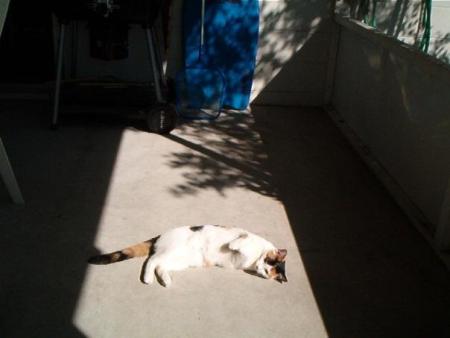
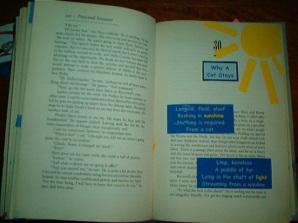
Why A Cat Staysimage05

Languid, fluid, aloof
Basking in sunshine
Nothing is required
From a cat.

Limp, boneless
A puddle of fur
Lying in the shaft of light
Streaming from a window.

Nothing is required
From a cat.
Not even affection.

Which can be doled out
At the cat’s whim.
It may come – or not image06

When called.

Regal, royal, proud
A hunter with quiet steps
To pounce on a prey
Unexpectedly.

Nothing is required
From a cat.
Nor does it ask for
Anything.

So why does the cat stay?
It knows a good thing
When it sees it.image07

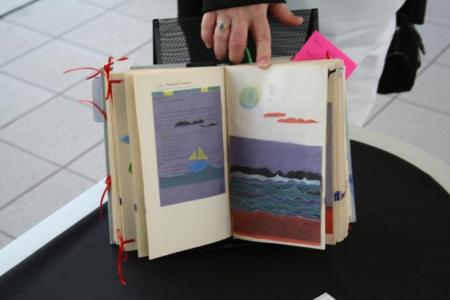
Inspired by a poetry group challenge. Included in an altered book submitted in art contest which won first place. 

Photographs by Carla Girtman


Meet Kitty Barton, Author and Emerging Poet

Today we’re delighted to have Catrina (Kitty) Barton join us. Kitty became a new Moderator during the 2012 Muse Conference, and was an active member of our Poetry Workshop. She considers herself more of an author than poet, but we recognized the lyrical quality of some of her writing, and the depth of emotion in several of her poems, so we believe she can proudly wear the title of Poet, too.

kitty-barton

Catrina Barton is a real go-getter, who turned her avid reading addiction into a vigorous passion for writing. Especially Young Adult Romances. She draws on her knowledge as a Kung-Fu Instructor to make her fight scenes both realistic, and action packed.

When not indulging her fertile imagination to craft stories for your reading pleasures, she enjoys hiking with her family, and amateur belly dancing.

Her love of writing, and her family, rival by her exhilaration from helping fellow writers. She is a proud member of many writing and marketing groups, an active participant at Critique Circle, and several other crit groups.

She’s sharing three poems. The first two were written before the work shop. The final on was written during the workshop, during the Persona Poem exercise. Enjoy her poems and comments, below.

My one, my only

Cold and lonely was my life
Lost in darkness knowing only strife
Forever to drown in sorrow and shame
Until into my life you came
Appearing before me pure as a dove
To show and teach me a miracle called love
Never again will I be lonely
Thanks to you, my one, my only.

Only Bliss

Surrounded by mist
We dance and twist
Our bodies in tune
Beneath the moon
Both in our prime
In a rhythm old as time
Entangled like this
We know only bliss

Persona Poem:

My computer

I sit before you each day, watch you staring at me but we never play.
You use me to play with others but never give me a passing thought,
unless I act up and then you’re annoyed.
Show me some love and help fill my void.

 Kitty says:

I adored the variety of enlightening workshops and have applied all of the lessons I learned to my writing since them. {Especially to my upcoming novel release} I enjoyed meeting so many awesome people, who are as passionate about writing, reading, and helping others as I am.

I am a published author since June of 2012. First full length novel due out the end of March.

Words of wisdom: Do not miss the next Muse Online Conference. 🙂

Favorite personal quote:

“An author cannot grow without both constructive criticism and encouragement.”

My blog for writers: KittyB78.wordpress.com/

Other Social Media Links:
Goodreads: http://www.goodreads.com/author/show/6423796.Catrina_Barton
Facebook: https://www.facebook.com/KittyB78
Twitter: https://twitter.com/Kittyb78


Spotlight on Saleema

Today we are featuring another of our Muse Conference workshop participants. During the week of our workshop, we challenged poets to write three different forms. We chose winners for each, and Saleema’s “My Sun” was clearly one of the best in the Persona form.

We are happy to have Saleema joining us today, to look back on her experience during the Muse Con, and share some of her poetry. And now I’m going to turn the floor over to her.

Mary

On the Muse Conference experience

You asked me what I liked about [the Muse Online Writers Conference].  I have to say everything.  The conference is full of talented, generous writers, who go out of their way to be helpful and share their skills.  I must admit that the poetry workshop took up most of my time this year.  I’m not one of those poets who likes to write quickly.  I often get inspirations, write them out in my notebook, and then type the notes (my rough draft) on the computer. After all this, I begin to sculpt the poem.  I edit, tweak, research, and edit some more. For me writing is a quiet, internal process that even my humorous poems go through.   So, given my immersion in anything I write, it’s always a challenge finding enough time to participate in all the conference workshops that catch my interest.  The Muse Conference is boiling over with gallons and gallons of things to do, to learn, to write, to comment on, to correct, etc.   It’s a wonderful whirlwind of activity and learning.  So, I would have to say that the hardest thing about the Muse Conference for me, is having to accept that there’s only 24 hours in a day, and then pick my workshops very carefully.  I’m so grateful that Lea keeps the forums up, so I can go back and catch up on everything I missed.  That extra time gives us all the opportunity to work at our own pace and keep learning after the conference has officially ended.  I enjoy my catch-up time in the forums almost as much as the conference.

The 2012 Conference was the first one to offer a weeklong poetry workshop… and it was fantastic!  The critiques were great, and the spot on comments really helped me take my writing to another level.   The assignments were enjoyable, though I have to admit, I ended up getting engrossed in the one that asked us to write a poem in another’s voice.  I could have spent the entire workshop delving into that assignment.  It was such fun and really helped me recognize the intricacies of my own voice.  Actually, I’m still experimenting with that form.

I can say, in all honesty, that the Muse Poetry Workshop was one of the best I’ve ever taken.  The level of feedback from the moderators and the workshop attendees was professional and insightful.

A Sample of Poetry by Saleema E. Giltinan

Wearers of Wool

Living in the mountainssunset

far from the tower of Babel,
Peak Dwellers fly to the sun
gathering beams to shine
in the valley of snows.
Their points of view glow
with eternal verities
that enlighten all
who wish to see.

Who’s in Control?

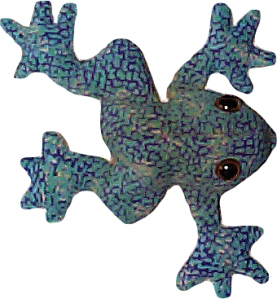
Thoughts jump like frogsfreeimages.co.uk photos of objects

plunging, swimming, floating
in deep and shallow ideas.
They are like TV shows
and radio broadcasts.

When their production
turns into a horror fest,
a fear mongering symphony,
or ridiculous repetitions,
simply change the channel.

Cultivating Change

Delve like a mole,
dig deep, deep, deeper;
tunnel through the soil
of elemental thought.
Craft passageways;
some will curve or spiral,
others will be straight
with narrow paths.
Roots of conditioning
groan, as you
toss them aside
Dig, dig, dig, far below
surface appearances.
Remember, when you’re
tired, respite can be found
in the silent spaces
between your thoughts.

delving-deep

Universe Infinity

About Saleema

Saleema E. Giltinan

Saleema E. Giltinan

Education: I have a Master’s Degree in Psychology and a Bachelor’s Degree in Social Work.

I’ve traveled extensively and spent several years living in India, journaling and studying eastern spiritual traditions.  I have been a spiritual teacher for over twenty-five years.  My favorite writing genre is poetry, although I also write inspirational non- fiction.   My spiritual path inspires my poems.  I enjoy writing poetry because metaphors and poetic stories provide a wonderful format to express spiritual concepts.  The language of symbols is expansive and can speak to many different levels of consciousness.  I love mixing symbols with practical day-to-day experiences as I craft my poems.

Publications:  Other Sheep Magazine published one of my poems.  I actually met the editor at the 2011 Muse Conference, pitched the poem, and got it published.

Thank you, Saleema, for taking our workshop, for the courage to share and grow, and for joining us here on our blog.

If you missed it, read the first post in our workshop participants series.

mary-sig2