sharing a poetic LIFELINE with the world

Archive for the ‘Poetry’ Category

Make Visible: By Art Inspired

 Art sometimes inspires me to write poetry. Below are two paintings and the poems they inspired. Please read Lin’s post A New Way of Looking: Ekphrasis for an introduction to this idea. It is often not enough to just see a painting and write; sometimes research into the subject or the artist is helpful.  I researched James Joyce for the poem, “Joyce.”  The painting was incorrectly titled “Joyce in the City” on another website, where I was inspired to write the poem.  The correct name for the painting is Paris Street, Rainy Day by Gustave Caillebotte, 1877.

Paris Street, Rainy Day

Joyce

Plotting out your novel
in the rain,
or so I imagine.
I struggled with Ulysses,
didn’t get past the first five pages
to be honest.

You wouldn’t kneel
at your mother’s bedside,
standing up against Catholicism
even in death.

Your get rich quick schemes
failed, until you acquired a patron.
Still you squandered the money
every chance
on wine.

We’ll never know much about
your daughter,
the letters burned
by an overzealous relative.

Many eye surgeries later,
Joyce and an umbrella,
woman on his arm,
in the rain.

The second painting, The Little Deer by Frida Kahlo, 1946, also inspired a poem.  I dug a little deeper into the research for this painting.  The surrealism of the painting is reflected in this poem, “A Painting.”

The Little Deer

A Painting

You let your guard down
Didn’t see the hunter’s orange vest
Or didn’t care
Can the mute speak?
Still you run through the woods
You should be dead
A stag with the face of a woman
countenance as mysterious as the Mona Lisa’s
Run, deer, run
As if the plague were after you
As if followed by Roman soldiers
Aching to martyr.

What can you take away from this?  If you need inspiration, look online for paintings to inspire your writing.  They can be modern art, classical, fine art, or even photographs.  You don’t have to research the subject of the painting or photograph or the artist, but  it adds depth to the final work.


Enhanced by Zemanta

To Market, to Market- Sending Out Your Poetic Babies

Marketing Plan

So you’ve written a poem. Congratulations and job well done! But now what?

Time to polish your work till it gleams like a new copper penny, and send it out into the world.

Editing is important, as there is always a better, fresher way to word your thoughts,  fix up a place where the rhythm is off or a rhyme could be improved, add this or remove that, or rearrange some lines. Get feedback from people you trust and work until the poem feels right. Then you’re ready for phase three: marketing.

Some markets or contests require you to pay a reading fee, or buy the book of poetry if they publish your poem. My personal preference is not to send to them. Here’s why: they may not be reputable. If it’s a big, well-known market, perhaps it is worth a shot. But if not, you have just given money to someone who will just pocket it and could care less about publishing your poetry, even if it is excellent. That said, time to look at some markets.

“Where?” you cry, “I don’t know any writing markets!” Believe me, there are plenty. I recommend you sign up at Duotrope to get their weekly fiction and poetry market listings. I also recommend you join CRWROPPS Creative Writers Opportunities List at Yahoo Groups, as well as join a local poetry group. You can find some near your area in Meetup.

Read the listing you pick to submit to thoroughly and make sure they accept your kind of poetry. Look for their submissions page and be sure you follow it to the letter. Nothing will get your poem tossed in File 13 faster than thinking their rules don’t apply to you. They have to read a lot of submissions so don’t give them a reason to eliminate you from the get-go.

So what do you need besides a market listing?

First, you need a Bio. Make it a 50-or-so word biography that tells something about you –  something quirky or intriguing is good, funny is even better, as well as any relevant publishing credits. You can go the online ezine route- easier to break into than a print venue- to help you get  enough poems published to give you a good bio.

Second, you need a cover letter or email that you can modify to fit the particular market you are submitting to. Be polite and professional. Try to find out the editor’s name if you can, if not, “Dear Editor” will do.

Be brief and mention the title of the poem you are submitting for consideration and any relevent information about it. End by thanking them for their time. If they asked for contact information, give it. Then include your poem in the format they requested, which may require you to use a certain font or type of document. Sometimes this is in the body of the email, sometimes as an attached WORD or other format document. If they request a typed snail mail submission, be sure your name and email are on the poem unless they tell you otherwise- envelopes and submission letters can get lost.

Last, keep a record of what poem you sent to what venue and when. Also make a note of how soon to expect a reply from the publisher, if given in their submissions page. If you don’t hear by that time, or 3 months if no deadline is given, a polite inquiry is in order.

When it sells, make a note of the publication date and go celebrate! If it gets rejected, make a note of the date and send it right out again to your second choice. Continue till you make a sale or use up all your markets. But remember, new markets come out every month!

So here’s to your first sale! I’d love to hear about it.


Make Visible: Preditors & Editors™ Readers’ Poll Results

Preditors & Editors™ Readers’ Poll Results

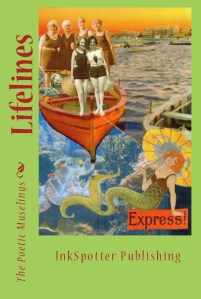
 I’m happy to announce that the cover for “Lifelines” by Lin Neiswender won third place in book/ebook cover art in the Preditors & Editors™ Readers’ Poll.

Also the Poetic Muselings placed third in poets in the same poll.

Our anthology, “Lifelines”, placed tenth in anthologies in the Preditors & Editors™ Readers’ Poll.

 Thank you, everyone who voted!

Critters / Critique.org  hosts the annual Preditors & Editors™ Readers’ Poll which honors print & electronic publications published during 2011.

Enhanced by Zemanta

Persona Poems

English: Gwendolyn Brooks, Miami Book Fair Int...

Gwendolyn Brooks

Persona Poems

Persona poems are poems that are written in a voice other than that of the author, where the author pretends to be someone else. The first one I wrote was in response to a poetry writing exercise. The next one that I recall writing ended up in “Lifelines.” Since then, I’ve created two imaginary poets as part of the science fiction novels I’m writing, and written at least 30 poems by each of them.

Writing a persona poems involves getting inside the head of the narrator (or in my case, the supposed author of the poems). It’s kind of like acting a part in a play, except that the writer is creating their own dialogue.

One thing that surprised me in creating the two poets and writing in their voices was the ease with which I slipped inside their heads. The first poet I created, Raketh Namar, namesake of the main character in my novel Relocated, which will be available from MuseItUp publishing this coming July, was supposed to live and write 5,000 years before the action in the novel, and was the author of one of the most sacred texts of my aliens, the Aleynis. I don’t usually write prayers or write about spiritual subjects, yet I found myself writing them without difficulty.  This past November I created another poet, Constance Trusdatter, a very political poet who lives and writes about 100 years before the action of my current work in progress, another science fiction novel with some of the same characters as the first. I don’t usually write much about politics, yet a good number of Constance’s poems are strongly worded poems about this very subject.

Here is a persona poem by Gwendolyn Brooks, one of my favorite poets.The young girl’s voice, her longing, and her desire to be  bad come through so clearly.

Notice the pattern of two unrhymed lines followed by two lines with end rhymes, and how in the final stanza both pairs of lines rhyme.

http://www.poetryfoundation.org/poem/172082

a song in the front yard

By Gwendolyn Brooks
I’ve stayed in the front yard all my life.
I want a peek at the back
Where it’s rough and untended and hungry weed grows.
A girl gets sick of a rose.

I want to go in the back yard now
And maybe down the alley,
To where the charity children play.
I want a good time today.

They do some wonderful things.
They have some wonderful fun.
My mother sneers, but I say it’s fine
How they don’t have to go in at quarter to nine.
My mother, she tells me that Johnnie Mae
Will grow up to be a bad woman.
That George’ll be taken to Jail soon or late
(On account of last winter he sold our back gate).

But I say it’s fine. Honest, I do.
And I’d like to be a bad woman, too,
And wear the brave stockings of night-black lace
And strut down the streets with paint on my face.

Enhanced by Zemanta

A New Way of Looking: Ekphrasis

I learned a new word  recently, courtesy of a friend and Wiki:

Ekphrasis or ecphrasis is the graphic, often dramatic, description of a visual work of art. In ancient times it referred to a description of any thing, person, or experience. The word comes from the Greek ek and phrasis, ‘out’ and ‘speak’ respectively, verb ekphrazein, to proclaim or call an inanimate object by name.

Nowadays it might be a snapshot of a scene, a work of art, or any creation that puts you in the head of the participants or an object and tell’s you what is actually happening within it.

So I thought, why not pick one of my collages as a prompt and write about it?

The one I chose is called “La Fleur” and here it is:

La Fleur

©2008 Lin Neiswender

Here is my poem about the collage:

The Photograph

Rose Pink my Papa calls me, his little blossom
I smile inside but not for the photograph
The buttons on my shoes are too tight and pinch my toes

My little dogs are lucky, they can run free with bare paws
On the fresh green grass, and rush into the house
When they are tired, heads out the window
Listening to the bird sing

But even they are dressed too fine for comfort
Tight bows of Mama’s fine silk ribbon tied
Around their necks, choking them as does
My lace collar choke me

Still a little girl’s first love
Is her Papa, and so I endure
The scratching of the lace,
The tightness of the shoes

All so Papa can take his photograph
Of his La Fleur Rose

©2012 Lin Neiswender


Poetic Inspiration: Other People’s Poems

75px-Dragon_(PSF)

I love reading poetry. Not only does reading poetry expands my poetic horizons, butI constantly find inspiration in other’s work. Sometimes the subject touches a chord, sometimes I want to try out a particular poetic device, and sometimes — well — it awakens my playful side.

A couple of weeks ago, Robert Lee Brewer posted a “magic” prompt on his blog,
http://www.writersdigest.com/editor-blogs/poetic-asides
and Mark Windham wrote a rip-roaring yarn involving a dragon and a brave hero.

I read Mark’s poem. After bopping myself over the head for having overlooked such a delightful subject, I wrote a poem of my own.

Here they are: first Mark’s poem and then my own.

Mark’s Poem

 (so far untitled)

Damn, but dragon hide is sturdy stuff,
My lance broken, horse dead or run off.
My shield was busted by a swipe of tail,
Helmet went flying and left arm broken.
Our foolishly brave troop is down to me plus three.
All hiding and rethinking our chivalrous vows.
Two have died from swipes of massive claws,
Three roasted in fiery breath, one ingested I fear.
Sitting here with my back against this boulder,
Wondering how in the hell to get out of this mess,
Pledging that the monastery will be my destination;
Damsels can stay in distress, the dragon keep his gold.
What’s this? A newcomer to our futility. Oh Joy!
Much help, I am sure, this old man trudging up the hill;
Stooped against the slope, leaning mightily on his staff,
Clothed in oversized robes and wide brimmed hat.
Halfway up the hill, just below my hiding place,
He is greeted by the dragon’s challenging roar.
Stopping, as if mildly distracted by a butterfly,
He looks from under his hat and strokes his beard.
I hear the now familiar mighty beating of dragon wings,
The old man seems unperturbed, as if studying the event.
Another roar accompanies feeling the heat of belched fire;
Much like seeing the executioners axe, I cannot look away.
Suddenly straightening with unexpected speed and strength,
He thrust his staff forward as the fire engulfs him….
What?! I saw it but do not believe! The dragon’s fire parted,
Passed him by on sides and above; not a singed hair in his beard.
There is a new tone now to the dragon’s cry; rage maybe? Fear?
The sorcerer takes a step forward, staff held high in right hand,
Steely eyed he begins raising the left as he starts chanting,
A white, glowing globe begins to form in his upheld hand.
Continuing his mumbling as he slowly takes two more steps,
Coming even with my spot as the globe grows and swirls.
Beating wings are deafening now as he thrust left hand forward,
Launching his magic at his monstrous, unsuspecting foe.
A brilliant, blinding explosion of light and a piecing scream….
I awake to his gentle hand on my arm; ‘Is it over? Is it dead?’
He smiles and shakes his head. ‘No, one does not kill a dragon.
You just have to convince it that it is time for it to move on.’
He stands and takes up his staff, a helpless old man once more,
And makes his way down the hill, carefully avoiding the rocks.
My remaining companions gather round and watch him go,
All somewhat surprised that he left us the damsel and the gold.


And here’s my response. I decided to make it as unlike Mark’s poem as I could manage.


A Tale of a Poor Knight and an Old Horse

by Margaret Fieland

A man rode out one two-moon night
to win a magic sword.
He rode a horse consumed by blight.
Twas all he could afford.

His clothing, all was soiled and worn
and filled with many holes.
The folks he passed heaped him with scorn
and pelted him with rolls.

His horse was soon quite out of breath
It stopped beneath a tree.
It said, “I feel quite near to death.
Please, master, set me free.”

The man then heaved humongous sighs
and shook a shaggy head.
He felt a measure of surprise
to see his horse had fled.

“Alas,” he said, “it’s much too late
for me to set you free.
I’m much too tired, at any rate,
to dig beneath this tree.”

And so our knight meandered home,
and still without a sword
“because”, he said, “it’s hard to roam
with what I can afford.”

Oh, yes, and a note on the importance of feedback. The initial version of this poem, the one on Robert Brewer’s blog, had the horse “fall dead” at the end of stanza three, but my fellow muselings felt sorry for the horse, and I agreed. Hence now we can all picture him enjoying the grass in some sunny pasture far from poverty stricken knights.

Do check out Mark’s blog:
Mark Windham
http://awakenedwords.wordpress.com/

and let us know what you think of the poems, and if you’re inspired to write one of your own.

Enhanced by Zemanta

An Exercise in Imagery

Dreigiebelhaus (three-gables-house) Am Laien i...

I hope everyone had a wonderful holiday. As my gift to you, I’d like to share a fun exercise to create unique imagery.

Sometimes I find myself getting stuck using the same descriptions and phrases in my writing. Especially in poetry, it loses that pop. One of my favorite exercises to get out of this rut is one I learned in high school.

1. Come up with a list of common adjective/noun combinations. Since it’s the day after Christmas, I’m going to choose some season appropriate terms. The more you come up with, the better a chance you’ll get an awesome description out of this. I like to come up with 10-12, but for teaching purposes I’ll do six. Adjectives in green, nouns in red:

white Christmas
evergreen tree
falling snow
slick roads
gold rings
hot cocoa

2. English: Six dice of various colours. 4-sided ... Now choose a number. Any will do as long as it’s not a multiple of the list you have. Since I have six items, I would not use the number six. You can use virtual dice to give a random number, or roll an actual die. Since I have six phrases, I’ll use a regular die and re-roll if I get a 6. I rolled a 4.

3. This number is the shift number. Leave the adjectives where they are, and shift the nouns down the number rolled. Christmas would shift down 4 to match with gold. My resulting list:

white snow
evergreen roads
falling rings
slick cocoa
gold Christmas
hot tree

4. These are now your prompts! Use any that inspire you in a poem or story. As you can see, some combos are definitely better than others. White snow isn’t very original, but evergreen roads excites me. If you get a dud, and none of the results speak to you, pick a new shift number.

Another variant: write a bunch of adjectives and nouns on pieces of paper, and put them in separate bowls or bags. Mix them up, and grab one from each. A grab bag of inspirational imagery.

Here’s my poem inspired by the above. I have the start of an evergreen poem, but ended up on a tangent and wrote this one instead.

What color is your Christmas?

White with snow
and frosted branches?

Blue with longing
for romances?

Mine is one of gold
as I snuggle down with slick cocoa
and listen to the joy around me.

A child’s laughter making
all those purchases worthwhile

The Carol of the Bells
echoing like falling rings

And at the end of the day
the family gathers round
to watch a movie

As a child I never could have known
Mothers have the best Christmas,
with memories of gold.


For another example, see my very first poem written using this technique.

I’d love to see the poems you come up with, using either my list or one of your own.

Next time on Mary’s Expression: A book review.

Let’s Write a Holiday Poem

English: Modern Bubble light

In honor of  the winter holidays, let’s write a poem celebrating one. Stumped for ideas? You won’t be for long.

Jot down your very brief answers to the following questions:

  1. What is the first time you remember celebrating this holiday?
  2. Who was there with you?
  3. Which was your most memorable celebration of this traditional holiday?
  4. What is the favorite scent you remember from this holiday?
  5. What was the most special gift you received during this holiday?
  6. What is your favorite sound associated with this holiday?
  7. What is the favorite food or beverage you associate with this holiday?
  8. What is the holiday decoration you remember best from this holiday?
  9. What texture or tactile memory do you have of this holiday?

My answers were:

  1. The year my Dad hung balloons and streamers from the ceiling for Christmas morning.
  2. My little sister and two older brothers and our parents.
  3. The first one I remember.
  4. The smell of the blue spruce tree branches.
  5. A huge stuffed panda bear.
  6. The metal bells we got to hang from the lower branches that would tinkle as we swept by.
  7. Pumpkin pie topped with whipped cream.
  8. The angel hair spider webs that diffused the light around the oil-bubbling candle tree lights.
  9. The cozy feel of red and white candy-striped flannel nightgowns

Now, work these memories into a free-verse poem. Nothing has to rhyme. You can rearrange or delete or add more ideas as you go along. Try for a natural flow and pleasing sound of the words you choose.

Here’s my poem:


The Big Christmas

Santa came! Santa came! I shout with my four-year old squeal

Streamers cascade from the ceiling where balloons hover,
Held in place by static electricity and pieces of tape
The room, to me, a fairyland of bubble lights and halos
Pungent scent of  blue spruce tree, needles sticky

Tinkling bells as we pull out presents
My package wrapped in bright paper so big I ask,
Is it a horse?
No horse, better yet, a giant panda, black and white
Contrasting with the chaos of color around me

The memory of my sister and me, in our peppermint-striped
Flannel nightgowns as we hug our new stuffed animal friends
My brothers follow two strings leading outside,
To discover bicycles hung in the trees

Our excitement intoxicating my parents as they share
A Christmas hot toddy and  slice of pumpkin pie
Smiles tired but satisfied,
At this big Christmas
©2011 Lin Neiswender

When you are satisfied with your poem, print it out or email it to the people with whom you share these memories. It will be a holiday gift to them like no other. Perhaps you’ll inspire them to write their special poems too.


Where do poems come from: poetry prompts

Prompts are one of the ways that I generate poems, and one of the subjects I return to again and again is coffee.  Yes, that hot, black (I like mine black), bitter, caffeinated beverage that I gulp down every morning.

I keep my poetry in Google documents, so just for grins, I searched through my documents for poems that mention coffee. I stopped counting after I reached twenty. At least three of those poems were written in response to prompts. Nope, make that at least four.

I am well and truly addicted to coffee. At various times in my life, I have drunk up to twelve cups a day. When I cut way back, now many years ago, I was tired for a month. I drink a cup every morning. If I’m working at the computer, I often pour myself more — and am just as likely to take a couple of sips and forget about the rest. I’ll drink it hot, cold, and anywhere in between. I like mine black and strong, unless it’s iced, and then I like it with half and half. It’s my favorite excuse for memory lapses. I can always think of something to say about coffee.

The poem below was written in response to the April, 2010  day 25 prompt on Robert Lee Brewer’s blog. The prompt: write a poem inspired by a song, and to include song title and artist. Most of the songs in the poem below  are from Chicago’s album, “Chicago 17.”  In order to end the poem in the way I wanted to, I had to use one song from BoyzIIMen.  The poem appeared in Summer, 2010 issue of Cyclamens and Swords .

Road Work

Cars creep along Route 6,
sign reads,
Road construction.
Expect delays,
while Chicago’s “Stay the Night”
blares on my radio.

Headlights illuminate
bits of fog,
rain blows through
open window
while Peter or Bill
sings “Remember the Feeling.”

Swig cold coffee,
get a mouthful of grounds
as “Something About You”
drifts out my window.

Jacket’s wet,
no place to pull over
while someone’s singing
“Something was Wrong.”

Car cuts in front of me,
I stand on my brakes.
Chicago’s crooning
“Please Hold On.”

Sirens sing
up the highway
while Boyz II Men belt out
“End of the Road.”

This is another that was  written in response to a prompt from Robert Lee Brewer’s Poeticasides blog. The prompt was to write a poem in which someone (or something) is stuck somewhere.

Out of Stock

At the coffee house
I order a large inspiration,
cream, no sugar,
but they’re out,

so I pull out my notebook,
sketch connected circles,
large to small
across the page,

add squiggly lines,
then rows of dots,
finally a trace
of a tree,

and wait for something
to fill in the blanks.


The Poetry of Pink

A Young Mary

Mary, two years old

I don’t consider myself very girly. I fancy comfort over style, don’t wear make-up, and for much of my life avoided the color pink. When I was a little girl, I LOVED the color. That soft, carnation pink reminiscent of pebbles and cherry blossoms. Last year I let both the little girl and the color back into my life.

Pink won’t make me a spoiled princess. It can be fun and flirty. It’s not about wearing the color, but embracing the essence.

I love to rock out the vocals in the Rock Band video game series, so honored that expression by naming my in-game band Pink Ink.

Pink ink is also a reference to my writing. I often type up rough drafts in pink text. On a mental level, it keeps me in a more playful, creative mood. On a physical level, it’s harder to read the text so I can focus more on new words than the quality of what’s already written.

Once I decided that being associated with pink wouldn’t label me or put me in a box, it freed me to use it as inspiration, a tool of my own expression. I have an entire page in my bliss book dedicated to pink. A reminder to own pink, what the color means to me, and some fun pink stickers like a pig and a butterfly. Here’s a poem I wrote as I delved into the heart (and letters) of pink.

palace for my soul–
where I am pampered,
feel pretty;
a safe place to play,
my power and passion
come through.

Ink flows from inspiration,
introspection brings illumination,
revealing my true identity,

leaving me nude–
a natural nymph,
wild and new
as I live in the Now.

Knowledge gained
is the key to self,
to the fragile case
protecting my keepsakes.
Unlock the door.
Kiss fate
create Karma.

Do you have a color that inspires you? Or a color that you avoid?

Don’t forget to enter our contest to win a copy of Lifelines.

Next time on Mary’s Expression: A fun exercise to create unique imagery.