sharing a poetic LIFELINE with the world

Archive for the ‘Creative Writing’ Category

Lisa Gentile, Mentor and Moxie Maverick

We’re delighted to spend some time today with
Lisa Gentile,
the “Moxie Maverick”,
career coach, writer, poet, creative artist,
and mentor to
the Poetic Muselings.

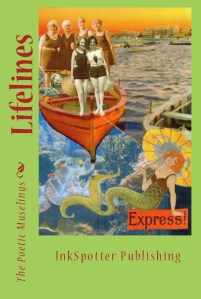
 Michele: Well, Lisa, we’ve had a bit of history since meeting in cyberspace at the October 2007 Muse Online Writers Conference. So much has changed for all of us! Your poetry workshop in 2008 was so powerful, it literally burned out your internet connection on that last day of chats. As I tap-danced my way through a room full of writers from all over the world, we decided to let you know what we were taking back with us from the intense week. Last November, Lifelines was published, the culmination of our efforts following the workshop.

 Did you ever think we’d be having this conversation, in this way, and this time?

Lisa: I had no idea what I was starting when I signed into that first workshop. I never expected that we would later meet up in various states. Now it makes perfect sense that  we are writing to each other, with each other, and in one another’s spaces.

 What do you think helped us succeed when so many drop by the wayside?

It seemed to me that you all immediately appreciated the potential of your sharing. Our workshop exercises asked you to step back and really listen to your work, yourselves, and each other. But you trusted each other, or at least wanted the possible outcomes enough to take risks together.

 We learned so much from you — what might we have taught you in return?

I was humbled to hold an early version of your manuscript, which would eventually become Lifelines, in my hands. It was the culmination of your shared perseverance and vulnerability. I was grateful to have witnessed its creation, even from afar. You taught me to remain open-minded with respect to what others may achieve.

As you know, I see connections in even the not-so-obvious places. When people “take root” in each others’ lives, all kinds of things are possible.

For me, connection has always meant to witness another person, to see, acknowledge and respect what’s important to them. I like how Dr. Brené Brown defines connection as ‘the energy that exists between people when they feel seen, heard, and valued; when  they can give and receive without judgment; and when they derive sustenance and strength from the relationship.’ I find her use of the word ‘sustenance’ compelling. It seems like an important part of the connection between the Poetic Muselings that became Lifelines.

Tell us about Moxie Mavericks — how does one “become” one? And why should one?

Moxie Mavericks is the name of my company, my professional life coaching practice. Moxie means gumption, derring-do, etc. But for me it’s a family value with which I was raised. I come from several generations of people who stand by their principles, whether they make us heroes, antiheroes, or observers. We enjoy each other’s stories. And those stories don’t even have to be spectacular, as long as they are real. We simply witness each other’s moxie when we see it. So people with similar values tend to feel at home here.

Mavericks are the sorts who get very serious about creating personal meaning in their lives. They are, by definition, out on the very edge of the frontier. It’s important to note that the landscape might be internal. People have special needs when they shift to maverick mode. It gets lonely out/in there. Very often others in their lives don’t see the singular vision that a maverick might have or initially understand the actions he or she chooses. So in coaching we build a space where mavericks can get customized support and feel safe to experiment with ideas.

We all have access to moxie and can be a maverick. It’s in there.

I know you are passionate about the concept of transition in an individual’s life. What does this mean to you? What are you seeing that’s so exciting?

People usually expect life coaching to be about defining their dreams, about setting and reaching goals, and about overcoming challenges like procrastination. Indeed, these are some of the tactical aspects of the work we do in coaching. But what I see over and over in my clients is a desire to make meaning out of a transition, to understand what’s being lost and gained by moving. In some cases, if we rush into goal setting we miss the opportunity to slow down and reflect. Forced goals lack authenticity. They are burdensome rather than enriching. Giving clients space and time for this reflection has deepened and enlivened the experiences my clients and I share.

As we talked recently, I envisioned transition as trying to figure out what you need to put in your backpack for a journey — and more importantly, what you must take out and leave out in order to make a transition. That’s the hard part — letting go of what only weighs you down. Any guidance on this? 

We often don’t know that we are entering the journey of a transition when it begins. Sometimes we realize we are far from “home” only when we feel lost. Something has changed but we don’t know what. We also might not know where we are going next. So it can be tricky to pack in advance. Either way, it helps to have a stash of compassion, for oneself and for others. We are all doing the best we can. We need to be patient with ourselves. This is how we can safely look at what’s holding us down. I won’t pretend that it’s easy work. The second handy item is appreciation for ourselves and others. I work with clients on spotting signature strengths–the ones that offer us the most pleasure and personal meaning when expressed. They make for an internal compass of sorts, one that can be recalibrated as interests change.

Where are you going with projects and other aspects of your life these days? 

People have been asking for retreats so I’m working that out. I understand more fully now how they might be of service. This fall two plays that my husband, Nick, and I wrote will be performed at the San Francisco Fringe Festival. Our program is called “Weird Romance”. We have a wonderful director, cast, and crew bringing our characters to life. It’s quite a treat to have others see your imagination walking and talking under the lights. We love hearing the audience laugh.

And what about your future? What’s coming up? 

I am exploring the vulnerability of stillness. It’s a wild ride.

You can’t get away from here without a few words about one of the strangest boat stories I’ve heard in years — and I’m a (somewhat) experienced sailor!

What is the project that made you take to the seas, what’s happening with it now, and where do you see it going?

You are talking about Spirit of the Sea, a new youth sailing program for which I volunteer. This year we acquired a very special boat as our flagship, S/V Ocean Watch. In February we splashed her, cleaned her up, and sailed her from Anacortes, WA, to San Francisco, CA.

We take youth sailing on the San Francisco Bay at not cost to them. Just participating in the sailing of a boat and experiencing the marine environment can be powerful to our youth. But we’re taking it a step further by offering activities that incorporate experiential education, citizen science, and service learning to connect these kids with critical thinking, mentors, and possible career paths. We hope to instill these young sailors with a sense of agency that will transfer to other domains.

“No one makes that trip at that time by choice.” 

That’s exactly what half a dozen insurance agents said.

Why did you do it?

I no longer know why we delivered the boat at that time. To get it done, I suppose. I did it because it was a once-in-a-lifetime opportunity to sail with an incredible group of experienced and moxie-rich sailors, some of whom had become my dear friends. I did it because I had earned it. We had worked hard to get the program to that point and sharing this adventure was a celebration. Also, I was ready for a new way to access information about myself in the world. This is the point of the adventure coaching that I do with some of my clients. This adventure was an opportunity for me to exercise different strengths outside of my daily routine.

Any highlights?

I witnessed first-hand the value of a “game-face” in sailing leadership. It keeps everyone calm and focused. There were many perfect moments. There was a perfect hour of a perfect afternoon. I felt secure with my fellow crew so I was free to marvel at the ever-changing shapes of the waves, patterns of the bubbles, and colors of the waters. And I had some chocolate. I think I felt deeply myself and connected at the same time. But I find that the more I try to look back at these moments squarely, the more they seem to shimmer and dissolve. They are prismatic.

So my work now is to remember how these moments felt and stay open to those sensations in the future.

Was this a transitional journey for you?

It offered key moments in a larger transition. The engine died one morning at dawn, just before a shift change. So everyone was up, exhausted, and busy. While others tracked the problem and rebuilt parts I stayed on watch alone at the helm. We had no wind so we were especially vulnerable. Even once we started moving again, my job was relatively simple: monitor the radar, watch for hazards, make course adjustments, and scan the horizon through the binoculars. But I was absolutely satisfied. I loved that no one checked on me. As the sun came up I studied the beautiful sky and coastline and faced the notion that I had fulfilled, in one way or another, just about every promise that I had made to myself as a kid. I decided to not even review the list, to just let it all be. Now I’m shifting my focus from doing to being.

They say you never return from a journey to the same place. 

When I left I was thrilled that I didn’t know when I would return. I don’t think I’ve quite yet returned. I am practicing patience and expressing my curiosity.

Your websites are as eclectic as you are, Lisa — so much more to talk about at a later date! 

Glad to see that Spirit of the Sea is a recognized 501 tax-exempt Public Charity  — which means that donations not only go to a very good cause, but are tax deductible. I encourage our readers to look at this site and consider a donation to the worthy cause. (Hint: the price of a couple of lattes could help float the boat.):    www.spiritofthesea.org

Your theater production is a hoot! How I’d love to be in San Francisco on Sept. 8, 9, 11 or 14 to see “Weird Romance”:   http://www.sffringe.org

Thank you so much for joining us today! As always, we appreciate your generosity of spirit, wisdom, humor, and that sense of connection we cherish. Good luck with all your adventures.

Thanks, Michele. My pleasure, and I look forward to sharing more soon.

To learn more about what Lisa does, check out:  www.moxiemavericks.com


Lin’s Senryu

#1880 winner of manner poetry contest

I’m a beginner at Senryu and in addition to Margaret’s great links, found this link helpful:

Haiku or Senryu? How to Tell the Difference.
I followed the syllable count but switched the lines. Here’s my first stab at it:

Hot packed waiting room
Doctor gives bad news
How lovely is the sunshine

Margaret’s Senryu

My Senryu, and fun with GIMP.

I’ve been having a blast lately playing with the color manipulation functions with GIMP, though I have yet to read the book I bought that goes through all the features. Consequently, I have a nice directory full of road photos, a great many of which I’ve played with using GIMP.

Last night Michele emailed me and asked me if I could take today’s blog post and create a Senryu. So I grabbed an image from my Pictures directory and wrote about it.


Night Road, photo by me, digital manipulation courtesy of GIMP

Night Road, photo by me, digital manipulation courtesy of GIMP

Night Road
Psychedelic sky
Dream made visible


Mary’s Senryu

Assuming it’s still Senryu if it’s fantasy.

fantasy-image-6

Hero’s Journey

A magical quest
journey for the talisman
a clichéd hero

Make Visible: Focus on Form: Senryu

Welcome to Focus on Form. For the next three weeks, we poets will be writing a poem in the same form and sharing it here on the blog.

My first experience with Senryu poetry was when I posted what I thought was a Haiku and was told it was Senryu instead.  It’s a Senryu because it includes a man-made object (my glasses), even though it’s about the weather; and also because of its sarcastic tone.

Untitled

The June rain
Leaves drops on my glasses
I can’t see summer from here.

June 7, 2008
© 2008 Anne Westlund


Senryū (川柳?, literally ‘river willow’) is a Japanese form of short poetry similar to haiku in construction: three lines with 17 or fewer total morae (or “on“, often translated as syllables, but see the article on onji for distinctions). Senryū tend to be about human foibles while haiku tend to be about nature, and senryū are often cynical or darkly humorous while haiku are more serious. Unlike haiku, senryū do not include a kireji (cutting word), and do not generally include a kigo, or season word.

Senryū is named after Edo period haikai poet Senryū Karai (柄井川柳, 1718-1790), whose collection Haifūyanagidaru (誹風柳多留?) launched the genre into the public consciousness. A typical example from the collection:

泥棒を dorobō wo

捕えてみれば toraete mireba

我が子なり wagako nari

The robber,
when I catch,
my own son

(Excerpted from Wikipedia, http://en.wikipedia.org/wiki/Senryu)

The first step to writing Senryu poems is to think of a theme and what message is to be conveyed. Taking ideas from family life and experiences with friends and coworkers is a good place to start.

Once the theme is established, the next step is to begin jotting down ideas and phrases.  Build on those ideas until they form three lines and add up to 17 syllables or less. Senryu poetry seems easy to write but in actuality it is not easy to convey a complete message in three short lines.

The first line should set up the setting, and the subject should be the focus of the second line; the third line should use action to sum up the poem. This is a simple way to approach writing Senryu. With more practice and reading examples the writing process will become more natural.

One thing to remember when writing this form of poetry is that it is not complex. Senryu uses simple language and incorporates humor.  Here are a few more examples written by modern poets:

As if it were spring
the green mold
on the cheese

© Garry Gay

rush hour-
the blonde in the Porsche peels
an orange

©Robert Bauer

(excerpted from How To Write Senryu Poetry by Sarah Carter, http://www.howtodothings.com/hobbies/how-to-write-senryu-poetry)

Give it a try!  I can’t wait to see what the rest of the Poetic Muselings come up with.

“Make visible what, without you, might perhaps never have been seen.”~Robert Bresson, French Film Director

Enhanced by Zemanta

Farewell, Ray

Photo of Ray Bradbury.

The writing world lost one of its most gifted writers when Ray Bradbury passed away on June 6th. He was one of my literary heroes. Not only could he captivate me with strong story lines and amazing characters from his brilliant imagination, his style reads to me like poetry. It has a magical quality to it that strikes a deep chord in my soul.

I will miss him for that, as will many others. If you ever need a dose of literary Red Bull to energize your writing, get yourself a  copy of his book Zen in the Art of Writing: Releasing the Creative Genius Within You. I promise you won’t regret it.


Sand in the Desert: Putting Together a Poetry Collection

I am a way-back science fiction fan, but until November,  2010, I had never

written a science fiction story. The

The cover for my forthcoming poetry collection

truth is I had a phobia about it, mainly about the world-building, which in the abstract intimidated me.

Around September or October of 2010 I decided I would simply go for it and write a science fiction novel for NaNo.  I started with the world-building: the planet, the aliens, the Terran Federation, the aliens’ society, values, arts, politics (or lack thereof). I’d been mulling over several things for years: a society based on personal responsibility, and one where the “normal” relationships contained multiple partners and included same-sex relationships.  I continued happily outlining the society and the people. I noted down about a page about the plot, including the main character, his father, and a couple of others.  I decided to write a YA/MG sci fi novel.

For various reasons which I will not fully divulge, in case any of y’all decide to read the book, I needed my aliens to be distinctive but not outlandish. I needed them to have skin color that could be found here on earth, yet still be distinctive, so for this and a number of other reasons, one of them being that I was damned sick of the good guys always being white, I made my aliens, my main character, and his father Black.

I also wanted to participate in Robert Lee Brewer’s Poetic Asides November Chapbook challenge, so I conceived of a poet to tie the two together. One of my alien characters is a scholar, and my main character ends up studying the poems of my imaginary poet. Raketh Namar, the author of the poems, exists in the universe of the novel some five thousand years before the action of the book on planet Aleyne. Raketh Namar, the poet, was the author of one of the most sacred texts of my aliens, the Aleynis. I don’t usually write prayers or write about spiritual subjects, yet I found myself writing them without difficulty. Raketh Frey, the main character in the novel, studies these poems during the course of the action. Eight of the poems, noted in the acknowledgments, appear in the book.

In the universe of the novel, this collection of poems was translated into English Common Speech by two of the other characters in the novel, Ardaval Namar and Gavin Frey, the father of my main character, Raketh Frey. Aleynis do not translate their sacred texts, and this translation is therefore unusual.

 Having written the poems, I wanted to put together the collection and publish it, but having dilly-dallied for some time, I decided to self-publish. At the present time, I have a cover, designed by Karen Cioffi, and Michele Graf has edited the collection, including some valuable suggestions about the order of the poems.

All I have left to do is to hop over to CreateSpace and  put the whole thing into their system, and after that I have to decide on a price.

Here is one of the poems, one that does not appear in the book:

Ode to My Father

When I was very small child
he was as tall
as the stars.

When I was boy-high
he had shrunk
to the height of a large tree

When I became a man,
he shrank to the size
of a fist.

When I became a father,
he rose again.
His head touched the sky.

Now he is gone.
I take my small son
and point heavenward.

“There is your grandfather”

Editor’s POV: How to Submit your Work

Lin Neiswender’s Post about Publication Leads was great. She reiterated that there ARE places to send our work, and that we writers and poets are a community; when we share resources, advice, ideas, and our hearts, we all benefit. We are the Poetic Muselings, with a published book of poetry, because others before us opened the doors, reached out to help us, and now we are continuing the process.

I’ve been Poetry Editor for Apollo’s Lyre e-zine for almost two years, having inherited a marvelous forum that I’ve made my own. We publish poets and poems from all over the world, from highly credentialed folks, and those who are courageously sending their work out for the first time — some of it decades old, but unseen by other eyes. I love this unpaid job, the discovery of a fresh voice, vivid imagery, the teasing of form. Our readers must love the publication, too, because they’ve commented about how particular poems inspired them to send their work for consideration.

We get LOTS of poems, and often the decision of what to publish is very difficult. When I first read the incoming items, I do a quick scan of the poem. Some grab me immediately, a huge “YES!!!” bounces in my head. I tag these stars, so they stand out. I don’t pay attention to the bio info yet — I just know I want to find a spot for these words in a future issue.

The next category are those where the poet didn’t follow any of the guidelines:

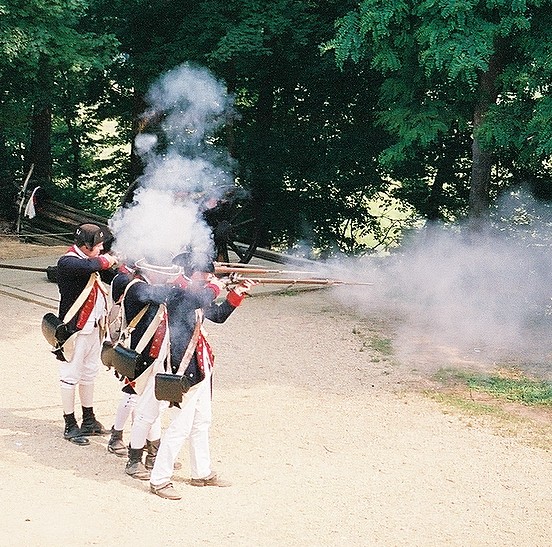
Soldiers at Yorktown

Soldiers at Yorktown (Graf, 2005)

— a maximum of FORTY (40) lines of poetry, excluding stanza breaks

— spread out in up to FOUR poems

— subject line: Poetry, YOUR NAME, # of poems, # of lines total

—  poem and bio  in the body of the email. No attachments

— at a minimum, the use of “//” to designate stanza breaks.

(I also ask for “/” at the end of each line of poetry, but that seems to confuse people.)

— People may send in their work whenever, so long as it doesn’t exceed 40 lines and four poems in any three month period. In the guidelines page of Apollo’s Lyre, I lay out this information, with examples.

Ignore these and your poems are likely to be returned or ignored, depending on the circumstances. Send something with a blank subject line, or an attachment (unless I’ve specifically requested it), and it will travel directly to “Trash”. Do yourself a favor and make it easier for the editor or publisher not to say “NO”.

I’ve received emails from some folks who send (I kid you not!):

— one long email, with over 250 lines of poetry, in multiple poems

— one long email with ONE poem of over 200 lines

— one poem per email, with over a dozen emails received in a short period of time.

— collections of poems (often a dozen or more, with around 100 lines or so)

These leave me with the feeling that I’m looking in someone’s closet, and it’s my job to decide what they should wear. Don’t send me “everything” — send me your very best poem(s).

The next part is trickier, and always amazes me, since it gives the impression that the person submitting didn’t care where or to whom, and assumed we’d figure it out:

— maybe because my name is so often misspelled, I triple-check the editor’s name, spelling, title, etc., before sending anything out. So, when I see my name spelled in any of a multitude of variations, it says someone didn’t proofread before mailing, or didn’t pay attention.

— recently, I got a spate of poems addressed to me as well as about a hundred of the poet’s nearest and dearest editors — with all of our names listed in the cc’s. This really tells me that someone was hunting with a shotgun, not a rifle, hoping to hit and slow down at least one of us without extra effort.

We’re talking about email, people! It’s not like they were worried about postage! What would an employer say to a letter like this? “To Whom It May Concern: I would really like to work for your company, but I don’t think I should have to do any research about what you do, or what you ask for. I don’t have to follow any of your rules, since I’m so incredible you’ll be in a bidding war for my services. Oh, yes, I don’t have much in the way of publishing credits, but that shouldn’t worry you.Please call me back tomorrow. Sincerely, Princess Poet OR Frog Prince.”

Believe me, every time you send your work out in the world, you are applying for a job, that of writer.

If you don’t follow general guidelines, you leave the impression you might be difficult to work with. This leads me to a third category of poems — those with potential, maybe some minor fixing or clarification to bring out their souls.

This pile is reviewed several times, under different circumstances. Some poems take more concentration to grasp, and are worth the effort. Some may need a bit of rearrangement of images, or a shift to present tense, reduction of “ing” words and unneeded articles. Poetry doesn’t have to have complete sentences, cover all gaps. I read these poems aloud for cadence, rhyme, awkwardness or smoothness of sounds.

Before you send anything in — even (in my opinion) novels or non-fiction, but especially poems — read it aloud. Hear what you’ve written, listen to how the sounds complement, contrast, enhance your intent. Where do you breathe? Is it clear from the poem? I know that my Mac desktop computer, and my Windows 7 laptop, have a text-to-voice program that will read your words to you. Usually this is part of “accessibility” options. Turn it on and try it.

There are two other general categories of poems that don’t make it into our publication:

— Those that aren’t quite the quality level yet, perhaps too cliche-driven, forced rhyme, or otherwise not appropriate for Apollo’s Lyre in subject matter. Not all poems are right for all publications. That’s where the search for publishers is important. Read back issues.

— Some incredibly wonderful poems may not be used simply because we don’t have room to publish everything we want, and/or we have other similar poems we’re using. Choosing is hard! Two poems about very similar subjects requires a decision about which one is “best” for us, at the time. I wish the poets success placing the ones I’ve passed on.

I’m as susceptible as anyone else when it comes to being treated fairly, with respect, understanding, and a willingness for a poet to work with me to edit a poem. Usually I’m right with my suggestions, since I’m approaching it with some distance; it isn’t my baby, but I care about it. Sometimes I’m wrong; I just didn’t “get it” about what was intended. When I’ve heard the background, I understand, and might suggest a few words be added to the bio, to help the reader understand, too.

I’m blown away at the talent out there, and here with our blog. I hope some of this helps you get ready for your next batch of outgoing angels. Help them fly to their destination, and not get eaten by the nasty gatekeeping trolls (like me!).

Let us know if you try this, and it works — we’ll spotlight your success. And, if you share other ideas of where to submit poems, we’ll keep an active spot here, giving you credit for it, of course.

Keep writing!

Michele


Thank You for the Publication Leads

Hands put over another, palms down.

I have several poems and art works published lately.

First is Issue 1, Volume 2 of the Restoration Earth Journal, http://www.oceanseminarycollege.org/RE_May_2012.pdf. My collages and poems appear on pages  21 (“Hathor’s Chorus”), page 79-80 (“La  Fleur” and  “The Photograph” ) and page 95 (“Lady in Red”). I appreciate Anne Westlund for suggesting I submit to that journal, which she is published in as well.

Next, three poems are published in Love and Other Passions by the Poets of Central Florida, http://www.amazon.com/Love-Other-Passions-Central-Florida/dp/098515070X.  This came about because of a poetry group I belong to. You can find such groups on MeetUp.

Last, I had my poem A Painful Wait and its art work published in Quarter After, http://quarterafter.org/2012/03/19/issue-no-1/.

I’d like to thank all those who recommended these venues to me. The power of friends helping friends with publication leads can’t be overestimated. So thank you, everyone!


Taming the elusive Iamb

Note: In all of the following, I have indicated stressed syllables in bold.

Woods and Fields near my home

My woods and fields

An iamb is a two-syllable metrical foot where the stress is on the second syllable:

da dum

A trochee is a two-syllable metrical foot where the stress falls on the first syllable:

da dum

Robert Frost’s poem, “Stopping By Woods on a Snowy Evening” is composed of iambs:

Whose woods these are I think I know.
His house is in the village though;
He will not see me stopping here
To watch his woods fill up with snow.

For an example of dactyls check out Henry Wadsworth Longfellow‘s “Song of Hiawatha

Should you ask me, whence these stories?
Whence these legends and traditions,
With the odors of the forest,
With the dew and damp of meadows,

And now Michele’s first stanza:

We claim our fears and ghosts by what we do,
   paths drag us into, not by accident,
   territory steep in our deep taboo.*

*Note: there are several ways to read this line — this is one.

So, lines one and two consist of nothing but iambs, but line 3 starts with two trochees.

One way to figure out the meter is just what I have done above: read the lines aloud, then underline or bold the stressed syllables, then see what you have. Another is to clap as you read: clap on all the stressed syllables while at the same time keeping track of whether this matches your pattern.

Another is to imitate a well-known rhyme or song. One of the only successful rhymed stories I wrote followed the rhythm of a nursery rhyme (unfortunately I’ve forgotten which one). Here are the first couple of stanzas. Can you help identify the song or nursery rhyme I tried to follow?

Old Tom Troll
had a hole by a bridge,
not far from the River Dee,

a lonely hole
not fit for a Troll,
and full of damp debris.

So Old Tom Troll
went out for a stroll
to find new holes to see.

Old Tom Troll
had a hole by a bridge,
not far from the River Dee,

a lonely hole
not fit for a Troll,
and full of damp debris.

So Old Tom Troll
went out for a stroll
to find new holes to see.

Enhanced by Zemanta