sharing a poetic LIFELINE with the world

Author Archive

Six Trillion + 642 Ways to Write a Poem

blog-post-the-storymatic

Yup. Take “The Storymatic”, with six trillion story/poem ideas tidily arranged in a tasteful box smaller than a grocery-store size block of cheddar. Add a book, “642 Things to Write About”. Send them to your favorite aunt whose Muse has been MIA for the past year or so. Stand back and wait for the fallout. Giggle when you get the call and hear that auntie’s Muse came out of hiding long enough to hyperventilate. Wait for the first poem to pop out. Smile, knowing you jump-started the process at just the right time. This is what my darling niece did for me.

The Storymatic is similar to refrigerator magnet words. In this case, you draw two gold color cards that you combine to create a main character. (Like “daydreamer” and “taxidermist” — two cards I chose at random.) THEN draw two copper color cards to lead you into your story. (Mine were “”handcuffs” and “yet another get-rich-quick scheme”.) Now, you can start writing, using these four cards as prompts.
blog-post-642-things-to-write-about
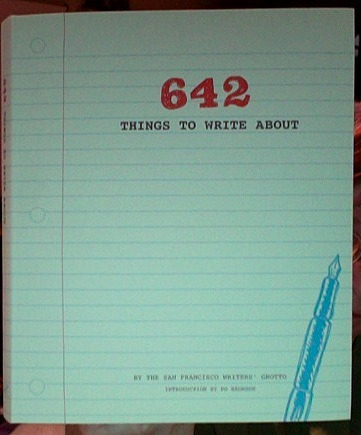
Since I live by the motto, “Why be difficult when you can always be impossible?”, I’m mixing the Storymatic prompts with one of the 642 things to write about. I page-flipped to “She’s lying! This is what she really wants most in the world.”

So, Darling L — here’s what your aunt came up with for her first poem. And, wonder of wonders, a second, deeper one:

The Real Truth?

Part 1: She Lied

When I was a little girl
I was the constant daydreamer
rarely slept, even as a child

always somewhere else
in my head
in my heart

handcuffs of time and place
kept me from drifting
too far from  — what?

For years, my Dad
tried to feed his family
on hopes and smiles

Never at home in his home,
yet another get-rich-quick scheme
slipped away, and away again

My life turned inside out,
a taxidermist nightmare
of guts where freckles should be

when he died
away from home
rotting in the jungle

I said I wanted everything
to be as it was
before. I lied.

What I really wanted
most in the world
was a different life
from start to end.

Part 2:  The Real Truth

She’s lying. Does it all the time.
Daydreamer lost in all the possibilities
Soft, porny handcuffs she can escape
but leaves in place
because it’s easier this way

Maybe one of her wild ideas
will fly today, another
get-rich-quick scheme
that really does work

Reverse taxidermist process
— bringing back to life
all who were close to her —
just for a day or two

To say a proper goodbye
To say what she was too scared
To utter when the time was right
Then, to release them, one by one

This is what she really wants
more than anything else in the world.
To let go with love and compassion.
Closure. Rich beyond money, at peace.


The “642...” book not only has interesting ideas, but was written in one 24 hour period by the San Francisco Writers’ Grotto. As the compiler, Bo Bronson, wrote on the first page, the idea sprang from a discussion among a few folks; an email asking for ideas went out, and great writing prompts came pouring in from thirty-five writers. A day later, the finished manuscript was delivered to the editor.

I loved these words in that intro: “…I tell the story because it’s a lesson in hidden potential. You never know what might happen. … And it doesn’t even have to be your own idea. You just have to get creative and plunge in.” That, my friends, is like showing up — and sharing. You never know what can happen. Our book, LIFELINES, is one such creation.

The Poetic Muselings have traveled far together during these past several years. Besides our book, we’ve all worked on individual projects — written and other media, as well as dealing with a variety of health issues. We are looking at our collective work efforts on this blog, and considering changes in 2014. Not sure what direction we’ll take.

We thank you, our readers, mentors, friends, colleagues, guest posters, and critics, for being part of our world. May the New Year bring us all joy, contentment, success in our adventures, and connection with those who are important to us.

Michele

PS: I challenge you to write a prompt poem to share in the comment below.


Going Deep

thumb_DC79_1024

Today I wrestled and won a round with the mind-messing monkey that clings to me, snickering about all the things I should do, know I should do, intend to do, but never quite get around to doing.

You know the one — we all have them. Usually nags with “someone’s voice of reason”, at a time we’re feeling vulnerable. I hate this voice because it sings off-key, with nasty words that are too true.

In just over a week, I’m going semi-bionic, as I literally leap for that moment when my new left knee replaces the constant pain I’ve been in for a long time. Rehab will hurt like hell, I know, but, at the other side . . .

. . . assuming I make it to the other side. What if I don’t? What if something goes wacky? Expert worriers like me have long lists in our heads, and perhaps on paper. I trust my doctor, rehab team, hubby, hospital, and my own desire to experience some of the good life I’ve eliminated as pain and meds have limited me.

Enough of this! Today, I finally attacked and updated our wills. Nothing fancy, but they now reflect our intentions when it’s “time”. I raged at my mother for several years prior to her last illness and subsequent death, fifteen months later.

“Please!” I begged her. “I don’t care who you leave anything to, but DO SOMETHING. Don’t leave me with a mess to handle when you’re gone.”

“I’m taking care of it,” she kept reassuring me. “I’ll get it done when I’m ready. Dammit, Michele, stop bugging me!”

So she died at 2:00 a.m., on a Sunday morning, in a nursing facility, nothing updated, never told me her wishes, or anything of consequence. The result, as I probated an almost-twenty year old will, fractured the family almost beyond repair.

Fast forward a dozen or so years. Our lives are radically different than even three years ago, when I last updated our wills. Major changes to make so we don’t repeat our dysfunctional history. By the end of Monday, the new wills “should be” witnessed and complete. Then I can breathe, sleep, stop stuffing my face with ice cream (my drug of choice when stressed), and prepare for surgery with a clear and healthy mind.

In honor of my big step, I’m sharing one of my poems from LIFFELINES. May all of this help you make a good choice to finish something very important for your peace of mind.

Restless Peace

I remember…

…How excited you were
to start college at fifty-three,
wanted me to be part of it,
but how nervous I made you.

…Your camel ride,
and how you danced the Hora
without your cane
the last night in Israel.

…Your glitter days of decorating,
the treasures you collected
— herd of elephants,
music boxes, clowns,
gypsy violins,
Lladro figurines.
And flowers—
velvet red roses, especially.

Raw, returning reminder
of sorrow’s bloom.

…You were loyal to your friends,
ecstatic with their triumphs,
anguished in their agony,
fiercely protective of those in need.

…You felt whole when you gave
beyond your limits
of time and energy and hope
then crashed. Again.

And I remember…

…All the times we dealt
in guilt and blame,
held onto hurts and slights,
refused to let them heal.

…Your choices tore us apart,
those left behind.
Impossible to make peace
with your unfinished business.

…You told me, even at the end,
we were supposed to keep arguing.
When you stopped fighting,
I’d know you’d given up.

…We swapped mother-daughter roles
several lifetimes earlier.
I couldn’t parent you any better
than you tried to do with me.

…You had the last word
when you died.
Why do I
keep arguing with you still?

Michele M. Graf

Creativity and the Decluttered Knee

dscn2012-version-2
Soon, I shall experience full knee replacement surgery, leap from hobbled old Crone, muttering to myself and others through a pain-med haze, foggy-focused at best most days.

I’ll push through worse anguish for a bit, then — magically — break through to the exquisite tedium of a lifetime of daily attention to reach a level of mobility and sanity I’ve missed. My world has become smaller in scope, narrower in experience, limited by decisions I’ve made to balance constant pain vs. clear-headedness.

Thinking (and writing) have receded to the background. Every six hours, I joust the bits of my brain that control pain receptors. I succeed at times, but the price is an ongoing trip to la-la land. One small knee twist reminds me to be grateful for the advances in medical technology, and keen to get this over.

A couple of weeks ago, tripping in my la-la land, I discovered a site called 365 Less Things, a journey of decluttering life as well as belongings. Yes, the blog owner is aware of the grammatical situation. People who cannot see beyond the title are missing out on a huge benefit.

As I read the archives, from the first post, comments, links that still work, etc., I’m fascinated. I’m up toApril 2012 posts, getting closer to current in snatches online.  I’ve followed the joy, sharing, and breakthroughs of this international community. Watched them mature, fine-tune their concepts as well as their tactics. I recently sent in a couple of ideas for future posts.

I’m always looking to get my life under control, to make it easier to sit down and work instead of clear my space (and head) in order to attack my writing time productively. The 365 Less Things blog is shifting my life.

I declutter my house by noticing what’s in front of me. I’m looking at my office supplies and books (THE most difficult things for me to let go of) with new eyes. Took extraneous “stuff” off my dining room table. Checked out how to recycle an older iPad and iPhone for a Mini Mac; if we could figure out what to do with the dreadful Windows 8 computer we got hubby late last year, we’d do it in a minute.

But back to my knee –the shredded ligaments, cartilage-less kneecap, shifting lower leg bone, and lots and lots of pain. (I don’t know what they do with old knees; maybe bone donations? They have my okay already.) For my new knee to work, I must exchange my old lifestyle — give up non-productive habits, like I have eliminated gluten from my life — in order to truly live.

This cannot be a sprint — ever. Every day, I must re-earn the right and ability to walk and get around. Every day, I must push beyond my ingrained procrastination genes, well-developed excuses, and creative idiosyncrasies. Embrace boring, mundane, and important actions.

photo-on-2011-10-09-at-10-15
During recovery, as I come off drugs that have kept me from screaming and behaving even crazier than I normally do, I’ll have time to rethink and rework other parts of my life.

I WILL put rehab first in my life. Choose small changes in my mental and physical environment, Clear space, be ready to write during my “writing time”. Play during playtime. Prepare and follow-through with what’s appropriate to heal body and spirit with nutrition, sleep, and attention to the present.

In a strange way, I’ve been heading to this crossroad for the past year. Prior to the 2012 Muse Online Writers Conference (this year Oct. 7 – 13, 2013), I promised my husband I’d turn over my major role in 2013 to others, so we could celebrate his 70th birthday in style. Since his big day comes right after the conference, he’s had a frazzled wife for the past five years.

My present was to be present for him this year. We planned a nice trip, and I worked on a surprise party for him. A couple of weeks ago, we knew this is not the time for this trip. I can barely get around, and can’t imbibe bubbly spirits.

So, no trip, no party, but no other obligations through the end of this year. Nothing else to sneak ahead of what I will do to bring congruence into my life. I’m approaching TaCaMeFi from a very different direction.

I hope you have an opportunity to reassess what’s important soon, but not because you are forced, like I am. May you keep your personal North Star in sight to guide you in all seasons, and enjoy your journey.

Michele


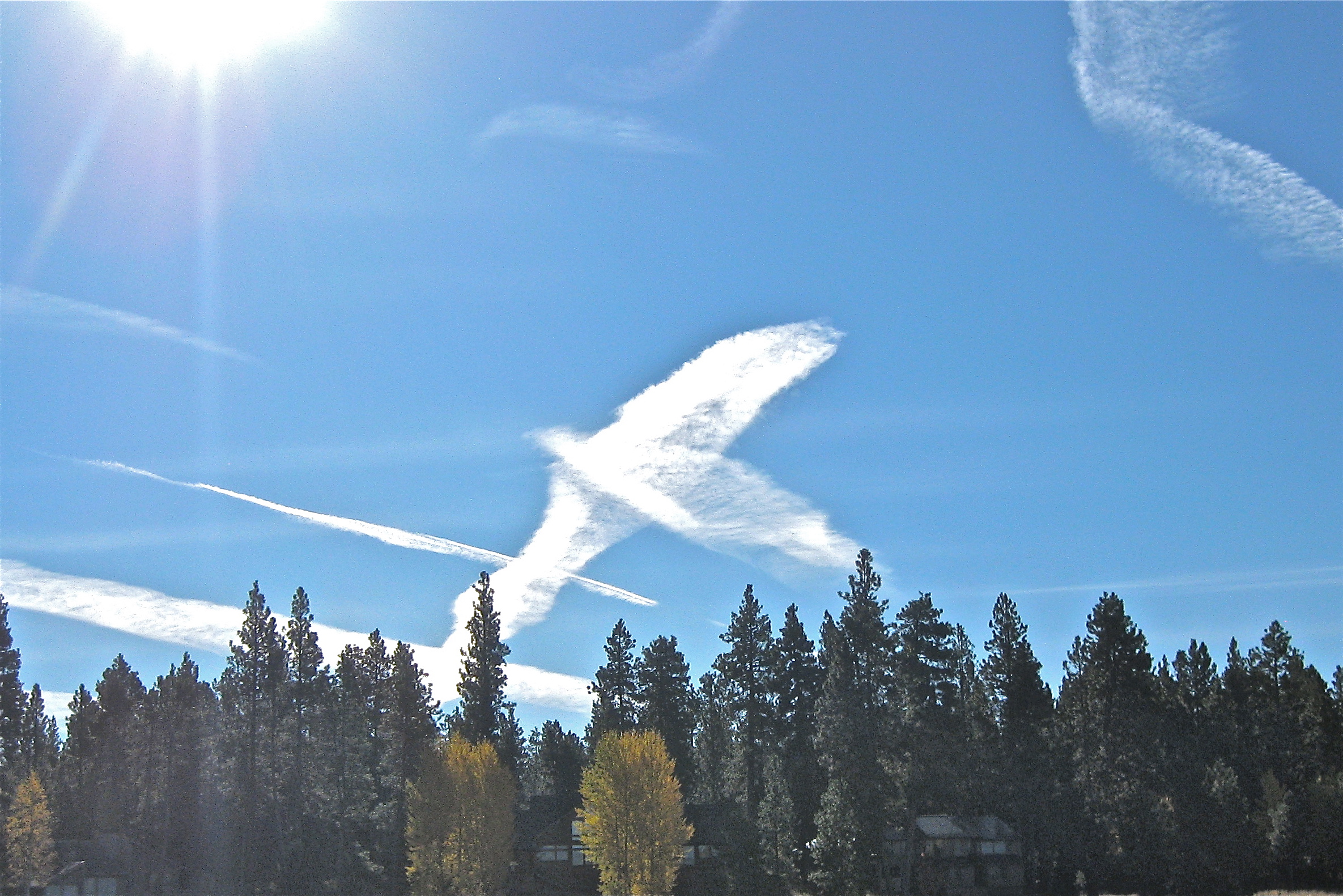
Clouds in Flight

Cloud in Flight

Clouds in Flight, Judy Hayden 2012

“Ah, yes, I remember it well”
Maurice Chevalier, in GiGi

Observations

I see and remember
through filters
of place and need,
hunger and fear,
time as instant as breath

You see a cloud
slide through the sky
I feel dragon’s breath
claim the ground
above the trees

Your wide-angle mind
grasps the world’s entirety
— so easy, you say —
it’s all clearly there
fully defined and framed

My mind cannot hold
virtual, visual
logic-formed snapshots,
all pixels in place

Darkroom details,
emotions, shapes,
visceral images
revealed in layers
are my truth

raw word-pictures,
mental music . . .
or
objects defined
by their given names . . .

we each see and say
our imprinted version
of reality as it never is

Michele M. Graf

This poem grew out of a discussion my husband and I had with friends, when we were each describing what we saw and did on part of our life on the road. How could two people come away with such different memories of the same shared event? One of the best parts of being married to one’s absolute opposite is laughing at all the ways we interpret “Life, the Universe, and Everything”. (Thank you Douglas Adams and the Hitchhiker’s Guide to the Galaxy.)

In June, I was co-presenter of the Eugene Public LIbrary Summer Reading Series Poetry Workshop and Showcase. Judy Hayden’s photography was on display as part of the celebration. I went wild when I saw her bird in flight cloud photo — the clearest image of what I’ve tried to explain about how I process the world. Sentimentally, watching cloudscapes and the moon were my special moments with my father when I was young.  Judy graciously agreed to share this magic image with the Poetic Muselings in this post.

A bit about Judy:  I see light and line, color and texture, gladly through my lens; both still and moving images in nature; blessings from the earth, sea, and sky. 

Inspiration for the cloud photo:  During my annual women’s retreat in Eastern Oregon, a time to laugh, cry, and nurture, this amazing bird-like image appeared briefly on our morning walk, bringing us much appreciated joy and inspiration.

Thank you, Judy, for capturing that bird, and allowing it to soar here! We hope to collaborate on other poetry-photo projects in the future, so watch for more.


Why and How I Write Poetry

On June 1 and 8 this year, I co-presented a two-part poetry workshop at the Eugene Public Library, as part of their Summer Series. I described the method of my madness about a couple of poems I’d written recently, and some of my Poet’s Toolbox techniques that helped me polish the poems. Let me know what you think, and any other tools you could share to help others. I finished this portion of the workshop with a very different poem — much lighter.

Inside My Head:

I see the world in images, flashes that bounce around in my head, the equivalent of “ear worms” – a brilliant term I read recently that describes snatches of songs that pop into consciousness and won’t let go – usually until shoved aside by a new ear worm.

I also feel the world viscerally. Words can choke me, make the hair on my arms stand up, surge through my gut like a gallon of bile, leave me speechless with tears – any number of physical, emotional, and/or mental reactions that sneak up to replay unexpectedly, any time, anywhere.

Words and images power my life, clutter my brain, and beg to be put to paper if I ever hope to understand and process them. I will share three poems, the first two described below. Poem #3 is a change-of-pace / true slice-of-life about the bossiest member of my family.

About these Poems:

In April, Annette Funicello, died. I watched the Mickey Mouse Club as a kid, but I had no fan connection to Annette, and read the first obits without any sense of loss of someone I’d miss.

I knew she had MS, but no clue about how completely her form of the disease devastated. Then I followed a link and watched a short clip showing what her life had been like, having lost most of her ability to even communicate. She resembled a sloppy rag-doll version of her former self.

After the clip was made, she went into a coma and was kept in that state for “several years”. I was haunted by the images, her extended coma, and why, ultimately, the plug was pulled. Two poems, Why No Mercy? and And The Answer Is …, are my attempt to make sense of it.

The Tool Box:

1. My CRITIQUE GROUPS said my images were confusing, when I shared my original poem; they didn’t know if I was talking about a person or an animal. Didn’t get the terrible core – how I was now aware of yet one more way we can die while being forced to keep breathing. After my revision and edits, I read them again to my Crit Groups to see if I’d fixed the problems.

2. I used a partial “LEAPFROG” or “LEAPING POETRY” effort with the poems, looked at each line, image, phrase; the sequence and flow; to dig deep for the truth of what I was trying to say. Sometimes I must write so I can excavate the words for the critical essence, figure out how the parts fit, and fashion bridges to connect what is known with what is missing. Sometimes the results have little in common with the original poem, except the heart.

(There are multiple approaches to Leaping Poetry – most bordering on deep surrealistic juxtapositioning of images, the conscious and unconscious minds, etc. The simpler one, my method, is to look inside each image and phrase, then “leap” to what it conjures up, to see if that’s closer to what I want to say. The new image or phrase replaces the previous one, thus “leaping” closer to my target.)

3. “…Mercy…” became a PERSONA poem, written from the narrator’s point of view, changed from third-person (outside) to first-person (inside the poem).

4. Where possible, I edited to present tense for a sense of immediacy.

5. These are PHOTO/ART poems, inspired by the video described above.

6. Both were written for PROMPTS (to write a Hunter poem and a Hunted poem) during the April 2013 Poem A Day (PAD) Challenge on Robert Brewer’s Poetic Asides. (Link below)

7. I REVISED for content, then EDITED to polish the poems.

8. I READ MY POEMS ALOUD several times before they reached the current version, to see how the words flowed (or didn’t), pacing, and “mouth feel”.

Revise and Conquer: 

 Revision is not a dirty word – it’s the first step to clarity. None of the tools in my arsenal could be used until the words were down on paper. Think of it as a Treasure Hunt; you gotta start your search somewhere. Take what you write today and explore where it wants to go.

I had to admit to myself that the poems clearly were not about Annette. Her life and death were merely the vehicle for an emotional overload of my inner, stinging terror at losing control of my life, unable to make my decisions or wants or needs known. Perhaps it’s a form of claustrophobia, fear of being locked into a tight space, unable to think or help myself, not knowing who holds the key, why I’m being held, or if I’ll ever be released.

So, as you read the poems, know that I’m sharing my own nightmare, and attempting to reason with my own psyche. The poems are still works in progress, delving deep into the whispered realms we seldom share.

Resources:

1. A version of the video about Annette: http://www.youtube.com/watch?v=6VbaLzo–ds

2. Robert Brewer’s Poetic Asides blog:
http://www.writersdigest.com/editor-blogs/poetic-asides


First Draft Opening Lines:

The Hunted:  Why No Mercy?

Last night, in voyeur garb,
I saw the ravaged carcass
of what was once a beautiful creature
the image of wholesome grace . . .

(I include a reference to Oregonian Ken Keysey’s 1962 novel (and 1975 movie) One Flew Over The Cookoo’s Nest. The revised poems follow.)
~~~~~~~~~~~~~~~~~~~~~~~~~~~~~~~~~~~~~~~~~~~~~~~~~~~~~~~~~~~~~~~~~~~

A Dream Is a Wish Your Heart Makes . . .”
Title of former Mouseketeer Annette Funicello’s 1994 autobiography, named after the song from Cinderella.


Why No Mercy?

Last night, my gauzy,
sooty voyeur’s shroud
snagged, ruthlessly tangled,
caught on demon’s flypaper,
sucked into someone else’s life

a once beautiful creature,
the image of wholesome grace,
now a ravaged carcass

tortured, slowly, methodically,
prisoner entombed,
hidden away allegedly with love,

but shown no mercy

Locked in a body no longer mine,
I rage in limbo, not dead, perhaps,
but surely not alive

How long did they keep me
in that madness?
— several years, I heard –
tethered to the eternal drip
of excruciating, painful optimism

For whom, I wonder. Who gained
as I wasted away
to less than nothingness?
Why NOW did they release me?
Why not before?

Ken Kesey had it right.
My Cookoo’s Nest needed a fly-by
many moons earlier, someone
to give me passage by pillow,
admit, like the Indian,
it wasn’t me any more.

May my memory be a blessing
and a warning, give pause.
This is not the dream,
the wish my heart made.


And The Answer Is …

‘Twas done for love
The chance we’d find
That bit of magic,
The only thing left,
To bring you back

 Agony does not do justice to
our hopes dashed, crashed
repeatedly on the rocks
as we prayed to any deities
on call who would, could, respond

We conjured spirits
begged them
for a sign we’d been heard,
acknowledged by the cosmos,
… A single candle’s flicker …

Something, anything, to show
there is — or was — a reason
to believe in belief itself

If only we held on long enough,
prayed hard enough,
sacrificed whatever was required,
perhaps . . .

Finally we knew
No One was home,
wherever home was,
to take the call

Our only mercy
was to let you go.

Perhaps your molecules of pain
were all we had left
to pray with, be heard
not by Gods on high,
but creatures of the earth.
Michele M. Graf


My Birthday and Paul Revere’s Horse

I promised myself I would memorize Henry Wadsworth Longfellow’s poem, “Paul Revere’s Ride” by the time I reached my ninth birthday.

I’d already mastered the spelling of “antidisestablishmentarianism” — I had no clue of its meaning, but someone bet my third grade teacher that she couldn’t teach at least one of her students to spell it. My memory is that she asked me, the star speller in our class, if I’d like to give it a try.

I loved school, loved Miss Elliott, was an obsessive reader well beyond my grade level, and was excited to be picked. To this day, I can rattle off the letters correctly, as long as I do it quickly and don’t over-think.

When we read “Paul Revere’s Ride” in class, it was immediately my favorite because that famous ride happened on my birthday, “the eighteenth of April”. I mean, how cool is it to share my day with Paul Revere and his horse? I still remember several stanzas.

This past birthday occurred in the middle of a critical week in Boston. Broken-hearted, I watched, read and listened to more news reports than I’d done for several years. The courage and resilience Boston and the rest of the country showed touched me deeply.

I had planned to post a wacky “coming of age” poem, about what it means to turn sixty-five. (That’s 455 dog years, if you we’re wondering.) I’ll hold that for another time.

Instead, I decided to share Longfellow’s poem, written in 1860, at another critical point in our history. Yes, Longfellow took some poetic liberties in this work, but his message shines through. As you read it, see if the strong spirit that moved me nudges you a bit, too — especially the first and last few stanzas.

Michele

Paul Revere’s Ride

Listen, my children, and you shall hear
Of the midnight ride of Paul Revere,
On the eighteenth of April, in Seventy-five;
Hardly a man is now alive
Who remembers that famous day and year.

He said to his friend, “If the British march
By land or sea from the town to-night,
Hang a lantern aloft in the belfry arch
Of the North Church tower as a signal light,–
One, if by land, and two, if by sea;
And I on the opposite shore will be,
Ready to ride and spread the alarm
Through every Middlesex village and farm,
For the country folk to be up and to arm.”

Then he said, “Good night!” and with muffled oar
Silently rowed to the Charlestown shore,
Just as the moon rose over the bay,
Where swinging wide at her moorings lay
The Somerset, British man-of-war;
A phantom ship, with each mast and spar
Across the moon like a prison bar,
And a huge black hulk, that was magnified
By its own reflection in the tide.

Meanwhile, his friend, through alley and street,
Wanders and watches with eager ears,
Till in the silence around him he hears
The muster of men at the barrack door,
The sound of arms, and the tramp of feet,
And the measured tread of the grenadiers,
Marching down to their boats on the shore.

Then he climbed the tower of the Old North Church,
By the wooden stairs, with stealthy tread,
To the belfry-chamber overhead,
And startled the pigeons from their perch
On the sombre rafters, that round him made
Masses and moving shapes of shade,–
By the trembling ladder, steep and tall,
To the highest window in the wall,
Where he paused to listen and look down
A moment on the roofs of the town,
And the moonlight flowing over all.

Beneath, in the churchyard, lay the dead,
In their night-encampment on the hill,
Wrapped in silence so deep and still
That he could hear, like a sentinel’s tread,
The watchful night-wind, as it went
Creeping along from tent to tent,
And seeming to whisper, “All is well!”
A moment only he feels the spell
Of the place and the hour, and the secret dread
Of the lonely belfry and the dead;
For suddenly all his thoughts are bent
On a shadowy something far away,
Where the river widens to meet the bay,–
A line of black that bends and floats
On the rising tide, like a bridge of boats.

Meanwhile, impatient to mount and ride,
Booted and spurred, with a heavy stride
On the opposite shore walked Paul Revere.
Now he patted his horse’s side,
Now gazed at the landscape far and near,
Then, impetuous, stamped the earth,
And turned and tightened his saddle girth;
But mostly he watched with eager search
The belfry-tower of the Old North Church,
As it rose above the graves on the hill,
Lonely and spectral and sombre and still.
And lo! as he looks, on the belfry’s height
A glimmer, and then a gleam of light!
He springs to the saddle, the bridle he turns,
But lingers and gazes, till full on his sight
A second lamp in the belfry burns!

A hurry of hoofs in a village street,
A shape in the moonlight, a bulk in the dark,
And beneath, from the pebbles, in passing, a spark
Struck out by a steed flying fearless and fleet:
That was all! And yet, through the gloom and the light,
The fate of a nation was riding that night;
And the spark struck out by that steed, in his flight,
Kindled the land into flame with its heat.

He has left the village and mounted the steep,
And beneath him, tranquil and broad and deep,
Is the Mystic, meeting the ocean tides;
And under the alders, that skirt its edge,
Now soft on the sand, now loud on the ledge,
Is heard the tramp of his steed as he rides.

It was twelve by the village clock,
When he crossed the bridge into Medford town.
He heard the crowing of the cock,
And the barking of the farmer’s dog,
And felt the damp of the river fog,
That rises after the sun goes down.

It was one by the village clock,
When he galloped into Lexington.
He saw the gilded weathercock
Swim in the moonlight as he passed,
And the meeting-house windows, blank and bare,
Gaze at him with a spectral glare,
As if they already stood aghast
At the bloody work they would look upon.

It was two by the village clock,
When he came to the bridge in Concord town.
He heard the bleating of the flock,
And the twitter of birds among the trees,
And felt the breath of the morning breeze
Blowing over the meadows brown.
And one was safe and asleep in his bed
Who at the bridge would be first to fall,
Who that day would be lying dead,
Pierced by a British musket-ball.

You know the rest. In the books you have read,
How the British Regulars fired and fled,–
How the farmers gave them ball for ball,
From behind each fence and farm-yard wall,
Chasing the red-coats down the lane,
Then crossing the fields to emerge again
Under the trees at the turn of the road,
And only pausing to fire and load.

So through the night rode Paul Revere;
And so through the night went his cry of alarm
To every Middlesex village and farm,–
A cry of defiance and not of fear,
A voice in the darkness, a knock at the door,
And a word that shall echo forevermore!
For, borne on the night-wind of the Past,
Through all our history, to the last,
In the hour of darkness and peril and need,
The people will waken and listen to hear
The hurrying hoof-beats of that steed,
And the midnight message of Paul Revere.

The Mark of Abel, by Viola Ryan

mark-of-abelSo exciting to introduce you to Viola Ryan, an amazing woman in her own right, plus two of her Main Characters who insisted on getting in on the act today to discuss their new book, The Mark of Abel, (details below) the first book in her series. I’ve heard about these MC’s, read some of their words, but this is the first time they’ve been let loose in our blog.

Some teasers before the interview:

Is a frustrated artist Lucifer’s ticket back to heaven or will falling in love with her reawaken the compassion that got him expelled?

Lucifer is fed up with humanity. He created hell to deter evil, but man’s inhumanity is only escalating. He just wants to return home to heaven, but ever since that little problem in the Garden of Eden, the Pearly Gates remain firmly shut to him. It doesn’t help that he’s the first vampire, an abomination in God’s sight.

Fortunately, two thousand years ago Lucifer’s estranged brother, Jesus, gave him a prophecy. To fulfill it, all Lucifer has to do is find the right artist, study her artwork and the path back to heaven will be revealed. The artist even bears a symbol so he knows who she is. Too bad she is murdered every time he finds her.

Janie’s a frustrated artist and college art teacher who wants two things—a guy she can show her paintings to and a night without nightmares. Each nightmare plagues her until she paints it. She doesn’t realize these paintings are key to unlocking her destiny, one that could redeem the original fallen angel.

Wow! Ready to meet the gang?

Michele: Welcome, Viola! You and I have talked about your artistic and poetic characters, and I know you’ve all had quite a busy month. I’m going to let you play lion-tamer here, and be your spotter during this interview. So, the stage is yours, to mix my metaphors . . .

Viola Ryan:  Thank you for inviting us! Both Lucifer and Janie are anxious to explain why they are each right and the other is . . . not-so-on-track. They promised to behave, mostly, so we’ll see. So, I’d like to welcome Lucifer and Janie, the stars of my debut release The Mark of Abel, to The Poetic Muselings.

Lucifer: Roses are red, Violets are blue, Hell is hot, and so are you.

Janie: Luke! Shame on you. Michele was nice enough to let us be here and Viola took time aside from writing the sequel. (aren’t you dying to find out what she’s going to do to us next?) Poetry is important.

Lucifer: What do you know about poetry? You’re an artist. A picture speaks a thousand words.

Janie: But that’s what a poem does. It isn’t the sum of its words. It paints a picture every bit as much as my paintings do.

Lucifer: So no dirty limericks?

Janie: NO! Viola please continue. 

Viola: Thank you, both. You can see why he’s so much fun to write.

Janie: When he’s not brooding over how God has wronged him.

Lucifer: God wronged you, too. And I don’t brood.

Janie. Sulk? Pout? Whine?

Lucifer: Not funny. 

Janie: Not even a little bit?

Viola: (laughing), more than a little bit. Back to the interview you guys. Geeze, it’s like I’m  writing The Mark of Abel again. You two like to go on your own little paths regardless of what I want you to do. 

Lucifer: And you love every minute of that.

Viola: Maybe.  Back to the interview. Since we are at the Poetic Muselings, I thought we’d talk a bit about Janie’s art and art in general. Janie’s been reincarnated many times, but she’s always an artist of some sort. Why do you think that is?

Janie: Art always speaks to something deep in me. I have to paint or express myself someway or I’ll explode.

Lucifer: You are creative and a priestess. Put those together and you get some type of artist. Poets, too.

Viola: What do you mean a priestess?  You aren’t exactly chummy with God anymore. 

Lucifer: There is a greater truth to this universe that supersedes even God. Janie’s art helps people reach that. That’s what good art does.

Janie: I didn’t know you felt that way. I’ve always believed that. Art is a way to reach a deeper understanding. That’s why I teach art appreciation at Archer College. Art speaks a language that lives deep inside us. A picture does more than speak a thousand words. It speaks things words themselves cannot. It reaches our souls. It feeds our souls, something modern society starves for. That’s why society needs artist of all sorts, including poets.

Viola: You mentioned you’d explode. Can you go into this?

Janie: I have horrible nightmares. If I don’t paint them, they build up inside me. The pressure is intense. For awhile I tried to resist painting them. I want to paint happy paintings, like Renoir. First, my muse fled. She wasn’t going to let me paint anything pretty. Then I felt tingles in my extremities. I was constantly flexing my hands to try and shake this off. It didn’t work. Eventually, I felt like I was having a heart attack, like my heart was actually being crushed. I had to give in. As soon as I started painting my nightmares, the pain went away.

Lucifer: It’s a good thing you kept painting them or we never would have figured things out. They were–

Janie: No spoilers.

Viola: Thank you. Your paintings are one of the most important twists in the book.

Lucifer: Hey, what about me? I’m not the red horned, pitchfork wielding Devil everyone knows and hates.

Viola: I know. I said, ONE of. Of course the reimagining of Judeo-Christian stories is the most important twist and a lot of fun to write.

Lucifer: I like being the first vampire.

Viola: I’m glad. It’s getting to be dinner time here for me, so do either of you have anything else you’d like to say?

Lucifer: Ladies first.

Janie: Isn’t he cute? He really is a gentleman in many respects. What I’d like your reader to do is give him a chance. A lot of what you’ve heard is wrong. He’s no teddy bear, but he’s not a bad guy.

Lucifer: Thanks. I should say something nice here about Janie, but she’s laid her heart out and there is nothing more beautiful than that. Words would just mess things up. I  wish I could write a poem demonstrating how wonderful she is, but I can’t. Maybe your readers can do that.

Viola: Thank you both for coming. Thank you Michele for having us. Feel free to ask us anything in the comments. We’ll be around if you want to chat.

Michele: Thank you, Viola, Lucifer, and Janie. I love the intricacy of your story, the intensity, and creative re-presenting of issues. Things are never what they seem. I know you are all working madly on the next book, and hopefully, working together! We’re so glad you joined us.

Our readers can add their comments to this post, and we’ll make sure you have a chance to respond.

holy-hell-blog-tour-mark-of-abel

We’re including links to your awesome Book Trailer, (LOVE the soundtrack!) and publishing details. The Mark of Abel is in ebook now, and will be in print in September 2013.

MuseItUp Publishing:  http://museituppublishing.com/bookstore2/index.php?page=shop.product_details&flypage=flypage.tpl&product_id=516&category_id=69&manufacturer_id=250&option=com_virtuemart&Itemid=1&vmcchk=1&Itemid=1

Amazon: http://www.amazon.com/The-Mark-of-Abel-ebook/dp/B00B0FSH9A/ref=sr_1_4?ie=UTF8&qid=1358130524&sr=8-4&keywords=The+Mark+of+abel

 Trailer Link: http://www.youtube.com/watch?v=UayqdSPMFMQ&feature=youtu.be

viola-ryan
And a bit about Viola Ryan:

A very good friend of Viola Ryan in high school said, “You don’t think outside the box. You blow the thing up.” Sometimes boxes need exploding. That’s why she’s here. She has a whole bag of C4 and isn’t afraid to use it. She’s blessed with people who treasure her eccentricities or at least put up with them.

Sometimes the box can be a cozy place. Without some sort of stability, her two daughters’ and her life would be unmanageable. That stability comes from her husband. He’s the rock holding her family together.

On the flip side, his career is anything but stable. He’s a Chief Marine Safety Technician in the US Coast Guard. They’ve lived from Kittery, Maine to Yorktown, Virginia. Fortunately, the moves have all been on the east coast. Then again, the Coast Guard tends to guard the coast.

Her oldest daughter (16) was born on Cape Cod, not far from Plymouth. Massachusetts. Her youngest (12) was born in Yorktown, Virginia, down the road from Williamsburg. Viola jokes they’re doing the colonial America tour.

Social Media Links:
Website: http://www.violaryan.com/ 
Blog: http://violaryanauthor.blogspot.com/
Facebook: http://www.facebook.com/jeanie.ryan.9
pinterest: http://pinterest.com/violaryan/
Goodreads: http://www.goodreads.com/author/show/6922260.Viola_Ryan
Amazon Author Page: http://www.amazon.com/author/violaryan


Boundaries and Compassion: Relationships

Our thanks once again to mega-mentor Lisa Gentile, for this follow-up to Boundaries and Compassion (Part 1).

harlee-sketchLisa’s thoughtful response to the questions at the end of the post were what I needed recently to reframe a situation with someone I trust and worked closely with in the past. We hit a couple of communication and expectations bumps that left us both at odds. (Continued at the end of Lisa’s post). 

How do you choose your confidant?

In general, confidant candidates appear randomly in my life. A client of mine recently said that when she shares a little, enters a vulnerable space, and her conversation partner then shares a little bit in that vulnerable space they can begin to build trust. It starts with a risk. It takes trust to build trust.

I am grateful to have a handful of confidential relationships. We can go to each other to share aspirations, successes, confessions, and challenges without fear of eliciting resentment or judgment from each other. But these feelings do come up, we’re only human. We try to be compassionate toward ourselves and each other and say, “Hey, this topic is awkward for me right now. I’m not up to this.”

When I need to share something specific I consider who is physically, emotionally, and mentally available and maybe who is already close to the topic at hand. I suspect that I also consider which of my friends seems to reflect the image of myself that I want to live up to through the matter of the moment. That gives me a sense of safety when I’m vulnerable. This bias is natural. However, I do trust my confidants to hold me accountable and to call me out on flawed logic or restrictive thinking.

How do you recognize and communicate the type of feedback you need? 

First I spend some time in my “cave”, in the swim lane, or on the trail trying to figure out whether and where I am stuck. I try to notice which thoughts are circling in my mind, where I draw blanks, or what I feel I need to express. The researcher in me likes to determine what information I need in order to reach an actionable decision. Then I can go to a friend and say, “I need your help in looking at blank.”

But it’s not always so simple to reach a clear hypothesis. So more and more I do myself the favor of realizing earlier in the process that I can explore these very questions with a confidant or, depending on the topic, my coach. I can bring in support sooner rather than later.

How do you recognize unjust and/or inappropriate comments or actions from others?

It starts in the gut, the heart, or the brain. Pick an organ. We all want to feel appreciated for who we are. If I feel unheard, used, or otherwise discounted I hold back. If I think that the other person is determined to project his or her own agenda rather than respect my effort to share myself and reach out, I am discouraged from sharing more at that time. It might be that the timing is bad for one or both of us. It might be habitual.

But we can be more methodical about identifying unsafe harbors. One approach is to be aware of I-statements that are really you-statements in disguise. I-statements are meant to be assertive or declarative without being offensive. An example of an I statement is, “I feel that my share of the work is too large.” This opens the conversation up for empathy, problem solving, and collaboration. An example of a cloaked you-statement is, “I feel that you are not a team player.” This statement bypasses the opportunity to solve the practical problem, puts the receiver on the defensive, and further isolates the sender. Few people will warm up to hearing “I feel that you . . . “

Especially in the creative world, I-statements can be pivotal in providing constructive criticism and even in giving compliments. The Wikipedia article on I-messages gives a nice example of feedback: “ . . . one might say, ‘I had to read that section of your paper three times before I understood it,’ rather than, ‘This section is worded in a really confusing way,’ or ‘You need to learn how to word a paper more clearly.’ (http://en.wikipedia.org/wiki/I-message)

When it comes to compliments, I would much rather hear, “I like it when you synthesize and reflect what I’ve said. I know you are listening,” than, “You are good.” The former is specific and describes a connection. The latter is a judgment.

Of course confidants can get away with more because they have trust equity. They are not evaluating the entire relationship after every sentence and they have time to elucidate messages. Furthermore, our interpretation of language is filtered by our beliefs and cultural norms so it makes sense to not be too quick to rule someone out. Deborah Tannen developed an interesting theory that we care about how the information we pass effects the receiver as much as we care about the information that we pass.

It would be nice if we all had the time, energy, and presence of mind to polish our communication skills from time to time. Short of that, if we continually encounter someone who doesn’t match our expectations of personal responsibility, it might be a good idea to keep a polite distance.

Does it happen repeatedly with the same person or people?

Difficult people have good days and easy people have bad days. I have grown close to people who initially offended me. I hope that others have given me a second, third, and fourth chance. But when it’s a recurring issue, I detach.

Specifically, what tactics have you developed to protect yourself in these situations, separating you (the recipient) from the message and sender of that message?

No kidding, when a comment catches me off guard I sometimes visualize an aikido turn that is designed to let the offending gesture roll past me and return me to my center stance.

If I must socialize or work with someone who probably means well but with whom I don’t feel mutual trust, I try to limit our interaction to group activities where there is not much pressure on one-to-one experience.

How and what do you communicate in this scenario?

It depends on the context and our relationship. Sometimes it’s helpful to “check-in.” I might ask whether there is something specific on the speaker’s mind. I might say I need a time out to sort out the issues. I might ask whether we can separate the issues together.

One conflict resolution technique that I use in the Moxie Mavericks Team Strengths Builder workshop can be useful here. Conflict often leads to mutual feelings of disrespect. Sometimes it helps to stop and share what we each value most in the situation—which signature strengths we are trying to express. Then we can appreciate each other and find a way for both objectives to be met.

How do you remain compassionate, but protect your personal boundaries?

Oh, the forgiveness I have received!

Life can be hard for all of us. At times people have assumed things about my life and therefore how I should behave. I’ve learned to try to not assume things about the lives of others. I don’t know what I don’t know. Hopefully, we don’t have to condemn others to protect ourselves. We need to nurture our own emotional resiliency.

Contracts are helpful. My sister and I are both business owners and sometimes we collaborate. When we do, we write and sign a contract. Some people think we’re silly. But we clarify and document our expectations so we can focus on collaboration. We define our boundaries for that particular aspect of our relationship.

How do you heal yourself after such an encounter?

To sustain performance, we have to manage our energies through a regular cycle of expenditure and recovery. Emotional energy is one of the four types that requires special attention. To recover my emotional energy after a difficult encounter, I acknowledge my negative feelings and show myself a little compassion. I use Dr. Kristen Neff’s guided meditations for self-compassion. They are available for free at www.self-compassion.org.

Sometimes it helps to make an effort to empathize and forgive, to consider the situation from the other person’s perspective. Then I do something that I enjoy in order to move toward positive feelings again.

What form of creativity helps you re-center and move forward again?

I like working in the yard or at the workbench because the projects require decisive action and the results are somewhat immediate. There are usually half a dozen projects that I can sand, paint, saw, drill, or dig at a moment’s notice. I like a walk in the woods, a swim, or a sail to really refresh. Knitting works in a pinch. These activities help me discharge energy from adrenaline and cortisol. Journaling and sketching help me sort out residual thoughts.

Lisa Gentile, M.S.
Moxie Mavericks Life Coaching
www.moxiemavericks.com
www.facebook.com/moxiemavericks
www.twitter.com/moxiemavericks
lisa@moxiemavericks.com

—–

Thank you, Lisa!

Identifying your own responsibility in these interactions, and engaging with coping skills to deal with the flow –  rather than reactive response – is something I need to remember. . . at the time of encounter. I need to also remember to breathe OUT without words or monkey mind thoughts to get my bearings.

Trying to get it all figured out before asking for help is another biggie — I’m really glad you stated that here. Too often, we — the helper types — think we should be able to handle “it” ourselves, and can waste precious time, psychic energy, and generate huge amounts of destructive worry and adrenal overload when we don’t consider our resources (like trusted confidants).

I’m glad I had your wisdom before I talked to my colleague. I addressed, and cleared the air, about one of our issues in a way that was constructive for both of us. My gut kept me silent about the other at that time; something wasn’t “right” about how I wanted to talk about it. Rereading this post made me realize I was approaching the problem with pseudo-“I” statements that were really “you” criticism.

Boundaries, Compassion, and Relationships — the very heart of so much of our poetry, no?

Michele


Meet Carla Girtman


Carla lives in Central Florida with her family and three cats (who claim they write better than she does). She has been writing since sixth grade (and
image00
still has most of her handwritten work in a box somewhere), but didn’t really have anything formally published until 1996 when her story “Me? I’m No Writer” was published in the Phoenix (Valencia Community College) magazine. She received her BA in English in 2000 and her MA in Technical Writing in 2005.

When she isn’t working undercover at an international airport or teaching online, she manages to write speculative flash fiction and especially enjoys writing microflash. Her flash stories have been published in Clockwise Cat, Flashshot, Demonic Tome, Flashes in the Dark, Short Humor Site, Blink Ink, 101 Fiction, and her work has appeared in two print anthologies, The Zombie Cookbook and Vicious Verses and Reanimated Rhymes. Carla is spearheading the anthology: Midnight Tarot: A Fool’s Journey; Mermaids, Zombies, and Vampires – O My! A collection of published and new fiction; and Fits and Starts: 102 Prompts For Story Inspiration. Carla has participated in the  National Novel Writing Month four successful times. Her first Nano novel When Elves Return has actually sold copies she didn’t buy herself.

She doesn’t really consider herself a poet and generally writes when the Muse stabs her with a pen.  Her poem, “When God Awakens,” appeared in The Corner Club Press and the poem “The Ring” found a home in Dark and Dreary Magazine. Her friend Linda, got her involved with the Muse Poetry Workshop which she helped develop the participant’s workbook. Carla mostly lurked in the Muse Conference due to restraints of grading 15 thousand-word rough drafts for her online composition class. Her favorite part of the Muse Conference was working with the Poetic Muselings and creating the workbook! She also enjoyed creating an aragman poem which did get into the workshop, and of course, it was about cats.

What kind of advice would she give to writers and poets? Set aside a regular time to devote to writing. (She’s also not very good at taking her own advice!) Don’t be afraid of rejection or be discouraged by it. A word written today is one less written tomorrow.

She enjoys reading, watching movies, and collecting antique books and the McDonald’s Madame Alexander miniature dolls.

Below are some poems that I have written.

Alarm! Tracing
the cat who hides
Alarm! Crating
The cat who snarls and yowls.
Alarm! Carting
The cat to the vet.

Alarm! Cat grin!

Aragman for the Muse Conference Poetry Workshop

Break Up

Upon the tin roof
Rain drums its tantrum.
Silver pillows of clouds
mound the sky.

Flashes of lightning
Flit like knives of fireimage01

Following the trail
To where my love lies.

Charting the storm
Which roils my heart,
I weep from loss
And wait for dawn.

(Photo is from Microsoft word’s clip art file.)
Poem was inspired by specific words for an anthology and was eventually withdrawn.

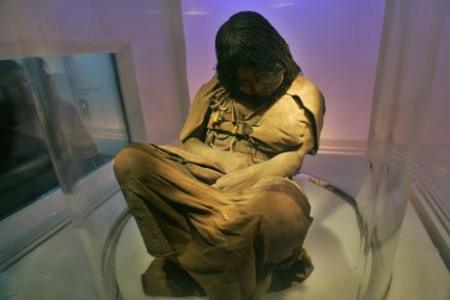
To the Young Mummy Recently Found

Atop an ancient volcano
Buried hundreds of years agoimage02

In a sanctuary shrouded in ice
a girl child was found below.
What thoughts went through your head
When to the altar led
To become the sacrifice?

Photograph by Maria Stenzel/NGS

Were you proud or full of dread?
You were ten, maybe twelve years old
Too young to shed your innocent blood.
The priests had hoped it would suffice
And appease their angry god.

You were frozen and preservedimage03

Your body to the god reserved.
Only once again to become a sacrifice
On the altar of science to be observed
And solve the riddle that would show
Why was a young novice
Buried hundreds of years ago
Atop an ancient volcano.

Photograph by Natacha Pisarenko/AP

Written for UCF poetry class inspired by a news story. Glose form.

Pictures found on http://news.nationalgeographic.com/news/2007/09/photogalleries/mummy-pictures/photo6.html
Shadow of Demons

With shadows of dread
In stillness dark, I alone
wrestle the demons.

Haiku – poetry group challenge

Ocean Song image04

Under the window, near the sea
Trembling lip sings sad stories
By mermaids who pluck strings
Of harps against a bare shoulder.
I sit by the window, bow against fiddle
Harmonize with the mermaid’s harp
Joining songs. Seductive dreams
Invade my sleep until morning’s rays
Chase the splash of a fish tail
Beneath the ocean’s wave.

Photograph by Carla Girtman


Published in issue one “use these words” 2008. Specific words were required.

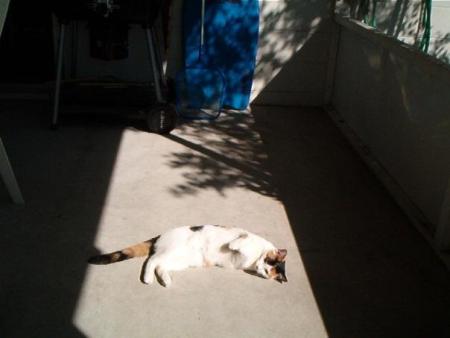
Why A Cat Staysimage05

Languid, fluid, aloof
Basking in sunshine
Nothing is required
From a cat.

Limp, boneless
A puddle of fur
Lying in the shaft of light
Streaming from a window.

Nothing is required
From a cat.
Not even affection.

Which can be doled out
At the cat’s whim.
It may come – or not image06

When called.

Regal, royal, proud
A hunter with quiet steps
To pounce on a prey
Unexpectedly.

Nothing is required
From a cat.
Nor does it ask for
Anything.

So why does the cat stay?
It knows a good thing
When it sees it.image07

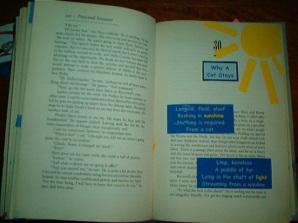
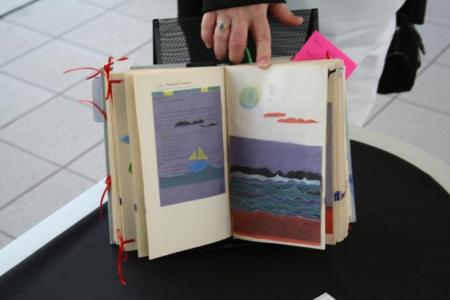
Inspired by a poetry group challenge. Included in an altered book submitted in art contest which won first place. 

Photographs by Carla Girtman


Meet Kitty Barton, Author and Emerging Poet

Today we’re delighted to have Catrina (Kitty) Barton join us. Kitty became a new Moderator during the 2012 Muse Conference, and was an active member of our Poetry Workshop. She considers herself more of an author than poet, but we recognized the lyrical quality of some of her writing, and the depth of emotion in several of her poems, so we believe she can proudly wear the title of Poet, too.

kitty-barton

Catrina Barton is a real go-getter, who turned her avid reading addiction into a vigorous passion for writing. Especially Young Adult Romances. She draws on her knowledge as a Kung-Fu Instructor to make her fight scenes both realistic, and action packed.

When not indulging her fertile imagination to craft stories for your reading pleasures, she enjoys hiking with her family, and amateur belly dancing.

Her love of writing, and her family, rival by her exhilaration from helping fellow writers. She is a proud member of many writing and marketing groups, an active participant at Critique Circle, and several other crit groups.

She’s sharing three poems. The first two were written before the work shop. The final on was written during the workshop, during the Persona Poem exercise. Enjoy her poems and comments, below.

My one, my only

Cold and lonely was my life
Lost in darkness knowing only strife
Forever to drown in sorrow and shame
Until into my life you came
Appearing before me pure as a dove
To show and teach me a miracle called love
Never again will I be lonely
Thanks to you, my one, my only.

Only Bliss

Surrounded by mist
We dance and twist
Our bodies in tune
Beneath the moon
Both in our prime
In a rhythm old as time
Entangled like this
We know only bliss

Persona Poem:

My computer

I sit before you each day, watch you staring at me but we never play.
You use me to play with others but never give me a passing thought,
unless I act up and then you’re annoyed.
Show me some love and help fill my void.

 Kitty says:

I adored the variety of enlightening workshops and have applied all of the lessons I learned to my writing since them. {Especially to my upcoming novel release} I enjoyed meeting so many awesome people, who are as passionate about writing, reading, and helping others as I am.

I am a published author since June of 2012. First full length novel due out the end of March.

Words of wisdom: Do not miss the next Muse Online Conference. 🙂

Favorite personal quote:

“An author cannot grow without both constructive criticism and encouragement.”

My blog for writers: KittyB78.wordpress.com/

Other Social Media Links:
Goodreads: http://www.goodreads.com/author/show/6423796.Catrina_Barton
Facebook: https://www.facebook.com/KittyB78
Twitter: https://twitter.com/Kittyb78