sharing a poetic LIFELINE with the world

Author Archive

Make Visible: Focus on Form: Really Bad Limericks

I wrote these today.  I’m not one to write limericks.  I’m not real comfortable with the form.  The last one is for a special friend of mine.

Here goes nothing!

Presenting Really Bad Limericks:


Savannah

There was a girl from Savannah
Who had the most terrible manners
She never said please
And often would tease
Even those who tripped on peeled bananas.

Seattle

There was a man from Seattle
Who got in the rottenest battles
If he sat next to you at a bar
Best to take yourself very far
From his brass knuckles, used often on cattle.


Ocean Shores

There was a woman from Ocean Shores
Who only saw open doors
She was so positive
That God was the causative
With only good things in store.


Orlando

There was a lady from Orlando
Who was all about the Can-Do
Collages, poems and short stories
Productive, even with her health worries
Wish I had her ducks in a row.
“Savannah,” “Seattle,” “Ocean Shores,” and “Orlando” © Anne Westlund


“Make visible what, without you, might perhaps never have been seen.”~Robert Bresson, French Film Director


Make Visible: Inspired by Nature

My poem, “The Banquet,” was inspired by deer in our side yard.  As a writer, don’t be afraid of using nature as inspiration, especially as a jumping off point to a longer piece.  Your poem doesn’t have to be explicitly about flora or fauna, but could evolve into a metaphor about something else entirely.

Poetry prompt:  Go for a walk outside.  If something from the natural world catches your eye, start a poem with that image as the kernel.

The Banquet

The deer eat the weeds,
the apples, the lower branches of trees.
Such enthusiasm!

What feast have you set out
before them?
Like watching a puppy or a child eat.

Of the seven deadlies, gluttony…
Now it’s the ice cream aisle,
the frozen dinners and pizza,
the deli, the chip and pop aisle,
the white bread, the lowly potato.

You are laughing at us,
I know.

How disappointed you must be in us?
With our rice cakes, salads without dressing,
low-carb diets.
Come eat!
Life is a banquet, the table is set.
Are there no takers?
“Manna makes me fat.”
“Fishes go right to my thighs.”
So we starve in the desert,
refusing what you have offered,
this miracle.

© Anne Westlund

“Make visible what, without you, might perhaps never have been seen.”~Robert Bresson, French Film Director

Photo by Chris Westlund

Enhanced by Zemanta

Make Visible: Focus on Form: Senryu

Welcome to Focus on Form. For the next three weeks, we poets will be writing a poem in the same form and sharing it here on the blog.

My first experience with Senryu poetry was when I posted what I thought was a Haiku and was told it was Senryu instead.  It’s a Senryu because it includes a man-made object (my glasses), even though it’s about the weather; and also because of its sarcastic tone.

Untitled

The June rain
Leaves drops on my glasses
I can’t see summer from here.

June 7, 2008
© 2008 Anne Westlund


Senryū (川柳?, literally ‘river willow’) is a Japanese form of short poetry similar to haiku in construction: three lines with 17 or fewer total morae (or “on“, often translated as syllables, but see the article on onji for distinctions). Senryū tend to be about human foibles while haiku tend to be about nature, and senryū are often cynical or darkly humorous while haiku are more serious. Unlike haiku, senryū do not include a kireji (cutting word), and do not generally include a kigo, or season word.

Senryū is named after Edo period haikai poet Senryū Karai (柄井川柳, 1718-1790), whose collection Haifūyanagidaru (誹風柳多留?) launched the genre into the public consciousness. A typical example from the collection:

泥棒を dorobō wo

捕えてみれば toraete mireba

我が子なり wagako nari

The robber,
when I catch,
my own son

(Excerpted from Wikipedia, http://en.wikipedia.org/wiki/Senryu)

The first step to writing Senryu poems is to think of a theme and what message is to be conveyed. Taking ideas from family life and experiences with friends and coworkers is a good place to start.

Once the theme is established, the next step is to begin jotting down ideas and phrases.  Build on those ideas until they form three lines and add up to 17 syllables or less. Senryu poetry seems easy to write but in actuality it is not easy to convey a complete message in three short lines.

The first line should set up the setting, and the subject should be the focus of the second line; the third line should use action to sum up the poem. This is a simple way to approach writing Senryu. With more practice and reading examples the writing process will become more natural.

One thing to remember when writing this form of poetry is that it is not complex. Senryu uses simple language and incorporates humor.  Here are a few more examples written by modern poets:

As if it were spring
the green mold
on the cheese

© Garry Gay

rush hour-
the blonde in the Porsche peels
an orange

©Robert Bauer

(excerpted from How To Write Senryu Poetry by Sarah Carter, http://www.howtodothings.com/hobbies/how-to-write-senryu-poetry)

Give it a try!  I can’t wait to see what the rest of the Poetic Muselings come up with.

“Make visible what, without you, might perhaps never have been seen.”~Robert Bresson, French Film Director

Enhanced by Zemanta

Make Visible: Thank You!

In Lin Neiswender’s post, https://poetic-muselings.net/2012/05/29/thank-you-for-the-publication-leads/, she thanked those people who pointed her towards publication opportunities.  In this post I thank the publishers who provided me with publication opportunities in the last couple of months.

First of all, my thanks goes to Katherine E. Batten (MacDowell), D.Th and Mark A. Schroll, PhD for publishing my poems and photo in Restoration Earth Journal Volume 2, Issue 1:  http://www.oceanseminarycollege.org/RE_May_2012.pdf.  My work can be found on these document pages:

p. 74 “Crime Scene Investigation” (poem)

p. 87 “Princess” (photo)

p. 89 “Live Just for Today” (poem)

Secondly, I’d like to thank Matt Fry, publisher of Strange Pulp, a sci-fi/fantasy magazine given away free at the OASIS 25 Convention in Orlando, Florida, May 25-27, 2012.  My fantasy short story, File Under “S”, is published in Strange Pulp.  (Thanks also to Lin for pointing me towards this publication lead.)

These publishers have allowed me to share my work with a larger audience.  Once again, thank you!

“Make visible what, without you, might perhaps never have been seen.”~Robert Bresson, French Film Director


Enhanced by Zemanta

Make Visible: The Villanelle

I wrote this Villanelle several years ago for a Valentine challenge on Poetbay.com.

The rhymes aren’t exactly right, but it does make a unique Valentine poem.


Valentine

Cupid’s arrows pierce my heart,
Despite love’s shifting sands
Never will we two part

Card stolen from Wal-Mart
More than eruptions from my glands
Cupid’s arrows pierce my heart

To get to you I took the BART *
IPOD plays my favorite bands,
Never will we two part

I feel the sting of his golden darts
Make of me any demands
Cupid’s arrows pierce my heart

Dressed up like a dime-store tart
You held me in your gentle hands
Never will we two part

Your eyes travel my Holy Lands
Ready for your commands
Cupid’s arrows pierce my heart
Never will we two part.

* BART-Bay Area Rapid Transit

February 10, 2009

© Anne Westlund

Children's Valentine, 1940–1950

Children’s Valentine, 1940–1950 (Photo credit: Wikipedia)


Enhanced by Zemanta

Make Visible: Story a Day

It’s almost May…

On the Story a Day website it boldly says: StoryADay.org is home to an annual Extreme Writing Challenge:

Write a story every day in May.

Still confused.  Want more info.  Here are “The Rules” from StoryADay.org.

The Rules

You must stay drunk on writing so reality cannot destroy you. ~Ray Bradbury

The Story A Day Challenge is a creativity challenge.

It came about when I (Julie) needed to prove to myself that I could still actually write stories — not just talk about writing, read about writing or even write about writing!

I needed bootcamp.

I declared May 2010 to be StoryADay May and set about telling the world (to keep myself honest).

As other writers started to hear about it, they clamored to sign up. They got excited. They challenged themselves. They challenged their friends. They wrote a lot. And some of them went on to do great things.

So here we are, declaring May 2012 to be:

The 3rd Annual Story A Day May

The rules:

  • Write (finish) a story every day in May.

The details:

  • Stories may be any length (50 words? 5,000?) but they must be stories (they must take us or the characters somewhere).
  • Stories may be fiction or non-fiction (but if you’re already blogging in non-fiction or keeping a journal, consider trying fiction)
  • You get to decide what “every day” means. If you need to take Sundays off, go for it. You make your own rules, but you are encouraged to set them up early, and stick to them!
  • Sign up as part of the community here. Get a username and join in the groups and comments. (sign-ups open soon. join the StoryADay Advance Notice List to be first in line)
  • You can post your story at your site, or in the forums here or you can simply post an update in the Victory Dance Group saying that you completed that day’s story.

The point:

  • To foster creativity
  • To come out with 31 first drafts, nuggets, chapterettes, ideas, and
  • To prove that you can craft a story. Lots of stories. To practice that craft

What Should You Do Next?

  • Get on the Advance Notice List to find out when sign-ups open (I only open it up sporadically, to combat spam sign-ups) PLEASE email me at editor at story a day dot org or contact me on twitter @StoryADayMay if you have questions. Really sorry for any inconvenience.
  • Take a look at the Inspiration and Productivity links on the Resources page.
  • When you have a username, Make some friends,, Join or create a group.
  • Most of all, gather your ideas between now and May 1. You’re going to need at least 31 of them.

This story a day business sounds intriguing and challenging!  If you are interested please go to the Story A Day website to find out more.

The Stories of Ray Bradbury

The Stories of Ray Bradbury (Photo credit: Wikipedia)


Enhanced by Zemanta

Make Visible: Aragman

I made my anagram poem, an Aragman, from a line from “A Blessing”, a beautiful poem by James Arlington Wright.  I found 6001 anagrams for “contain their happiness.”  I chose the ones I used for the poem below from the first 1000.

Here are the basic rules for constructing an Aragman (courtesy of Mary Jensen, her post is here: Focus on Form:  Aragman).

*****************************************************************************

Rules

The poem consists of six-line stanzas, ending with a stand alone line.

The concept centers around anagrams (“aragman” is, in fact, an anagram of “anagram”). Here are the rules, as set by Buttaci:

  1. First of all, begin with a word or two, perhaps your first name or first and last name. Settle on a word or two with not too many letters.
  2.  After you settle on a word, go to the internet site http://Wordsmith.org/anagram
  3. Type in your word and click on “Get Anagrams.” Instantly, you will be provided with all the words that use the letters of your chosen word.
  4. Copy/paste all the words that are derived from your chosen word and carry it over to your Microsoft Word screen, give the file a name, and save it.
  5. Now take a look at each of the anagrams and decide on a few for your aragman. You will need three for each six-line stanza. From the list select those anagrams that can be woven into your poem.
  6. In each stanza, odd-numbered lines 1, 3, and 5 are different anagrams from your list. If it’s possible, restrict each anagram on these lines to the same number of syllables. Make these anagram lines darker than the others. Even-numbered lines 2, 4, and 6 are completions of corresponding anagram lines 1, 3, and 5. If possible, let these completion lines also conform to the same number of syllables.
  7. The poem’s last line stands alone, after the stanzas, and it is one more anagram line.

The trick for this is finding a good phrase or word that will produce enough workable anagrams. Have fun trying different word combinations until you find something you like.

******************************************************************************

Those are the rules, here’s how to break them.

Contain Their Happiness

(you are a blessing to me)

You speak to me in code, tapping on my wrist,

heartaches pinion pints

the pinions of my heart, the engines of my mouth,

apothecaries ninth spin

the bottle spins, “Drink Me” the tag reads,

piranhas cops ninetieth

he’s not like the others, for the 90th time,

partisanship once thine

I cleave you, we break apart,

pharaohs incites tenpin

like bowling in bikinis, it’s a delicate dance,

antenna choppiest irish

radio only gets U2 songs from the 80s, vinyl varieties,

passionate chip thinner

to fit into your white-picket-fence vision, let me

phantasies enrich point

enter your dreams, as you have mine,

catnap pithiness heroin

such a diabolical drug in my veins.

© Anne Westlund

Point Judith, Rhode Island

Enhanced by Zemanta

Make Visible: Start Your Own Tribe

Please refer to my previous post Make Visible:  Find Your Tribe.

So you’ve checked out a few social networking sites and been to a few local meetings but don’t really feel comfortable with any of them.  Give it time!  Maybe you just need to hang around for awhile and get to know people better.  Or maybe, and this is very likely, the groups don’t address you specific interests.  What to do?  Why not start your own social networking site or offline group and find your tribe?

Wait.  Don’t abandon the sites and groups you’ve tried out.  They are good places to find people with similar or the same interests that you have.  Here are seven easy steps to starting your own tribe:

  1. Decide on the focus for your group. It should be something you are passionate about. You don’t need to know everything about your subject to start a group about it.
  1. Name your group. Find a name you can live with that sums up what your group is all about.
  1. Find a free (or paid) platform for your new tribe. Or find a meeting place for your offline group.  Here are some suggestions, by no means exhaustive.

Online:

Google Groups

Yahoo Groups

Webs.com

Tribe.net

Ning.com

Offline:

Libraries

Churches or Synagogues

Community Centers or Convention Centers

Cafés

Restaurants

  1. Then set up your site the way you want or consider topics for your first offline meeting.  Real world groups have slightly different considerations than online groups.  You will need to find out about refreshments, if you need a key, if they need to buy drinks or food (if in a café or restaurant), and if there’s a fee to use the room.  For online groups you may be able to design the site the way you want it to look, and set notification and membership settings. You can usually decide whether to let anyone join, join by invitation only, or to extend your membership to a select few.  For offline groups you also have a choice whether to have a public group or a private group where you handpick the members.
  1. Advertise!  This is where those previous networking sites and offline groups come in.  They are great places to post about your new group and find new members for your new tribe.  You can email and call your friends and post on Facebook, Twitter and Google+.  Keep in mind whether or not you are inviting “everybody”, interested parties only, or a few select friends.  That will determine how and where you publicize your new group.
  1. Provide content.  Some people will come to your group and just chat, but it’s better to give them something to chat about.  For online groups you can provide your own content, photos, writing, and artwork.  Depending on whether your group is public or private, you can also share book excerpts.  Always when sharing, share who the author or artist is. For real world groups, you may just have the group members bring something to talk about, or you could bring in speakers or teach classes in your subject.  It may cost to hire speakers or teachers, so this is another opportunity to provide your own content or have group members take on these roles.
  1. Don’t let all this go to your head!  Sure you started the group and can decide who goes and who stays, but don’t be a dictator.  Let your new friends voice their opinions and post their own content.  Encourage dialogue and respect among equals.  As owner, you are in charge of getting rid of any spam accounts, sharing basic guidelines, and discouraging explicit photos and profanity (if that bothers you or becomes a problem).

One caveat:  Your group may start slowly, may be active at times and inactive at other times, or may grow exponentially.  You never know.

If you are interested in Divination subjects, like Tarot and the Runes, please join me at The Divine Life Google Group:

Enhanced by Zemanta

Make Visible: Find Your Tribe

It is so important as creatives that we find a group of people that we feel comfortable with.  They share our values, our interest in creating and inspire and challenge us. Or maybe we just like to hang around with them, have fun and do fun things with them.  Groups offer us a chance to make friends, learn and share.  All this applies to both online and offline groups.

Online Groups:

Where do you start?

Tribe                                      many interests

Yahoo Groups                          many interests

Google Groups             many interests

Image representing Tribe as depicted in CrunchBase

Image via CrunchBase

CoachCreativeSpace                all creative interests

Writer’s Digest Community       writers

Wet Canvas                             visual artists

For Tribe, Yahoo and Google groups there’s a box to put in your interest (keyword), a list of groups will come up that you may want to join.

Offline Groups:

Where do you start?

This depends on the size of your community.  You may be able to find groups through Meetup.com, your local newspaper, Weekly, or posted at your library or grocery store.  These groups may be related to interests, like writing, activities, like yoga, or church or self-help groups.

What next?

Join the group, post an introduction or go to the first meeting and introduce yourself, be friendly, become involved, participate.

It’s that simple.


Enhanced by Zemanta

Make Visible: Capture Your Ideas

This post was inspired by Michele’s wonderful post:  Never Forget Your Dreams.

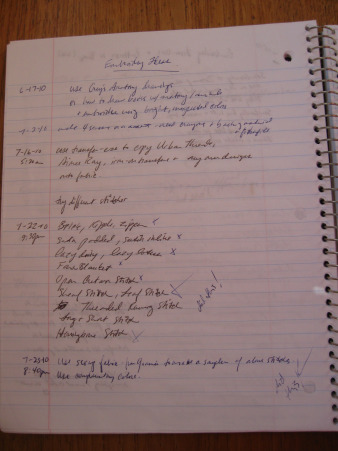
If you capture your ideas you’ll actually have more of them.  For one thing, you will have a record of the ideas you do have! This applies to writing, art and even things like organizing your garage.  I use a Scanner Daybook (from Barbara Sher’s Refuse to Choose) for my craft, organization, school, and other ideas.  Some pages below:

100 Dreams

Click on photo to enlarge.

For writing ideas I have a small notebook in my purse, but any piece of scratch paper will do.  Then I transfer the writing ideas to 4 x 6 notecards that I keep in a “recipe” box.  I also keep notes on my computer desktop using Stickies (a computerized version of yellow sticky notes).  Other methods of capturing your ideas include leaving pens and notepads around the house, using voice-activated software for computer, voice recorders or saving notes on your phone or blackberry.


img_16631

Embroidery Ideas


Why capture your ideas?  Not only will you have a record of ideas that you can refer to later for inspiration or planning;  you will free your brain up from trying to remember them.  This leaves you space to use your imagination and bring your ideas to fruition in the form of a story, artwork or clean garage.  🙂


Enhanced by Zemanta